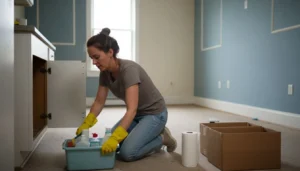

I taped a deep cleaning schedule inside a kitchen cabinet door in February of 2024. It had 47 boxes on it. By the second week of March I had started opening that cabinet only halfway, because I did not want to look at the boxes I had not checked, and by April the whole thing was in the recycling and I was back to cleaning whatever bothered me most on a Sunday afternoon.
What I use now has four dates in it. Four, in my phone calendar, each with a short list in the notes field. It has lasted two years, which is about twenty-two months longer than anything else I tried. This post covers how often the deep jobs need doing. What to do in each room is a separate question and I answered it already in my deep cleaning checklist, which goes room by room and says nothing at all about frequency.
Why my deep cleaning schedule kept collapsing
Every printable I downloaded made the same mistake, and it took me a year to see it. They mix maintenance with deep work on the same list.
Once “wipe the baseboards” sits next to “shampoo the living room rug,” every week looks equally heavy on paper. It is not. One is eight minutes with a damp sock over your hand. The other is renting a machine, moving furniture, and losing a room for a day. When both are just a checkbox, you skip the week that has the rug in it, and skipping one week is how a schedule dies.
The second problem was the calendar itself. A 52-week schedule assigns week 34 to the fireplace whether or not you have a fireplace, and mine told me to clean gutters in a third-floor apartment. I did not have gutters. I had a balcony and a neighbor’s cat.
The daily and weekly stuff got its own home. It lives in my daily cleaning routine, fifteen minutes, and it has not changed in a year. Everything below starts where that routine ends.
What belongs on a deep cleaning schedule, and what does not
My test takes about three seconds per job. If leaving it for six months would either show to a guest or damage something, it belongs on the deep schedule. If leaving it for six months would just mean it is a bit worse when you get to it, it is maintenance and it belongs in the weekly rotation instead.
In practice, deep work has a physical tell: you have to move something heavy, take something apart, or wait for something to dry. Pulling the fridge out. Unclipping the range hood filter. Washing curtains you then cannot hang for four hours. Wiping the counter fails all three, which is why it is not on this list even though it is the thing I do most.
I got this wrong for a long time by putting the oven on a monthly line. Nobody needs a monthly oven. What I needed was to stop spilling in it.
Every three months: the four Saturdays that carry the whole year
First Saturday of January, April, July, and October. I start at nine and I am usually done a little after eleven. Last time I timed it out of curiosity: two hours and ten minutes, with one coffee break in the middle.
The quarterly list is short on purpose. Vacuum the mattress and rotate it. Pull the range hood filter and let it sit in the sink in hot water and dish soap while I do everything else. Ceiling fan blades and the insides of the light fixtures, which collect more than anyone wants to think about. Move the couch and the bed and vacuum where they were sitting. Wash the pillows. Shower curtain liner straight into the washing machine with two towels.
Seven jobs, and six of them are easy. The fan blades surprised me. I had lived with mine for two years and assumed the gray fuzz was permanent, the way you stop seeing a scuff on a wall. It came off with one pass of a damp cloth and I felt stupid for about a week.
Twice a year, and honestly that is plenty
April and October, and these are the ones that need a real afternoon. Four hours, and I do not pretend otherwise anymore.
The fridge comes out from the wall and the condenser coils get vacuumed, which is the single job on this whole page with a payoff you can measure on your power bill. The oven gets done properly. Windows inside and out, plus the screens, which I hose down on the balcony and lean against the railing to dry. Curtains come down and go in the wash. Under the washer and dryer. Grout, but only where it is dirty, which brings me to the thing I wasted a whole Saturday on once.
I scrubbed the bathroom grout with a toothbrush for three hours and it looked identical at the end. The grout was worn, not dirty, and worn grout is a sealing job. Three hours. I could have watched a whole season of something.
Once a year, and the jobs I took off the schedule for good
The annual list is three things: carpets and rugs, upholstery, and the walls in the hallway around the light switch, because that one spot is gray by December. I rent a machine for a Saturday in spring and that covers the first two in the same session.
The mechanical once-a-year jobs, the furnace filter and the dryer vent and the machines that hide their own dirt, all cluster in autumn for me, and I wrote those up separately in the fall cleaning checklist because they run on the weather rather than on a calendar quarter.
Then there is the list of jobs I stopped doing, which took longer to build than any of the others.
I stopped flipping my mattress, because it is a one-sided pillow top and flipping it does nothing except put the comfortable part against the frame. It gets rotated end to end and that is all it needs. I stopped deep cleaning the guest room on the kitchen’s schedule, which is absurd when you say it out loud: nobody sleeps in there for eleven months of the year. It gets done the week before someone comes. And I gave up on spring cleaning as an event, a three-day blitz where you do everything at once and then do nothing until next March. That is an annual crisis with a nicer name.
How the deep cleaning schedule hooks onto a real calendar
Four recurring calendar events. First Saturday of the quarter, nine in the morning, list pasted in the notes field so I never have to go find it. That is the entire system and it cost me nothing.
The rule that made it stick is the one I would give anybody: whatever is not done by one o’clock rolls to the next quarter, not to next weekend. Rolling to next weekend is how a two-hour job turns into a thing you owe yourself, and things you owe yourself compound into avoidance. Rolling to next quarter means the fan blades stay fuzzy until April. Nobody died.
If a whole-house session in one go suits your brain better than spreading it out, that is a real approach and I wrote about how I run it in my post on cleaning days. And if what you actually need is the weekly layer underneath all of this, the room-by-room rotation lives in my cleaning schedule by room.
What changes with pets, kids, or allergies
Two of these three move the schedule less than people expect.
Kids do not change the deep cadence much. They change the floors and the couch cushions, and both of those are weekly jobs. My quarterly list did not grow when my daughter started walking. My vacuum just started working harder.
Pets do change it. Fur gets into the fridge coils and the vents, so a dog moves the coils from twice a year to three times, and the under-furniture vacuum from quarterly to monthly. That is the whole adjustment.
Allergies are the one case where the frequency shifts for real, and the numbers matter more than instinct here. The National Institute of Environmental Health Sciences says to wash all bedding and blankets once a week in hot water, 130 to 140 degrees Fahrenheit, to kill dust mites, and to keep indoor humidity at or below 50 percent with a dehumidifier or air conditioner. The temperature is the part that gets skipped. Warm is not hot enough.
The Asthma and Allergy Foundation of America adds the piece that belongs on a deep schedule rather than a weekly one: vacuum your mattress every one to three months, more often if it is not inside a fully enclosed allergen-barrier cover, and replace pillows every two years and mattresses every ten. That last one is not cleaning at all, but it is the reason my quarterly mattress job exists in the first place, and it is the only line on this page with a ten-year timer on it.
The deep cleaning schedule at a glance
If you are starting from nothing, start here. The last column is the one I use most, because it means you do not have to trust the calendar blindly.
| Job | How often | How long it takes me | What tells you it is overdue |
|---|---|---|---|
| Vacuum and rotate the mattress | Every 3 months | 15 min | You wake up stuffy and it clears within an hour of getting up |
| Range hood filter, soaked and scrubbed | Every 3 months | 10 min of hands-on, 40 min soaking | The filter feels tacky when you press it |
| Ceiling fans and light fixtures | Every 3 months | 20 min | Gray fuzz on the leading edge of the blades |
| Vacuum under the couch and the bed | Every 3 months, monthly with a pet | 25 min | Dust bunnies visible at the edge without moving anything |
| Fridge pulled out, coils vacuumed | Twice a year, 3x with a pet | 30 min | The motor runs longer, or the side of the fridge is warm |
| Windows, screens, and curtains | Twice a year | 3 hours for a small place | The light looks flat on a bright day |
| Oven, properly | Twice a year | 45 min plus soak time | Smoke on preheat before anything is in there |
| Carpets, rugs, and upholstery | Once a year | A Saturday, machine rented | Traffic lanes are a different color than the edges |
Three deep cleaning schedule mistakes I made first
- I ran it monthly for a year and burned out by month five. Monthly sounds responsible and it is the cadence almost every printable pushes, but a real deep job every four weeks means you are always three weeks from the next one. I did nine months of it, quit in September, and did nothing until the following spring. Quarterly is less impressive and I have never missed one.
- I scheduled by task instead of by date. My first version was a list of 30 jobs with a frequency written beside each one, which meant every single week I had to sit down and work out what was due. That calculation is the work. Now the list lives inside the calendar entry itself, and I have nothing to work out at nine in the morning.
- I treated every room as equal. The kitchen and the main bathroom generate almost all of the actual grime in my home. The guest room and the hall closet generate close to none, and putting them on the same rotation meant I spent April Saturdays cleaning rooms nobody had entered since January while the range hood filter went another quarter.
Grab the free printable: my one-page Deep Clean Frequency Card, with the quarterly seven, the twice-a-year six, the annual three, the overdue signals for each, and the short list of jobs you can stop doing entirely. Get the free card →
What didn’t work for me
The 52-week cleaning schedule was the most seductive failure. One task per week for a year, which sounds gentle and sustainable and fits on a single sheet. The problem is that it assigns jobs to weeks that have nothing to do with your house, so week 19 says patio furniture in May whether or not you own any, and one skipped week throws off the 33 that follow. Mine came apart in week six.
Chore apps were the other one. I used two, both with notifications. A reminder for a two-hour job at eight on a Saturday morning gets swiped away like any other reminder, and after nine or ten swipes you stop reading them at all. A calendar event never pings me. It sits on the day, in the same place I look for everything else, and I have never dismissed a Saturday.
Frequently asked questions
How often should you deep clean your house?
Most of it is quarterly and the rest splits between twice a year and once a year. Mattress, range hood filter, fans, and under the furniture run every three months. Fridge coils, oven, windows, and curtains run twice a year. Carpets and upholstery are annual. Almost nothing genuinely needs a monthly deep clean, and monthly is the cadence most people quit on, so if you are choosing between a monthly plan you will abandon and a quarterly one you will keep, keep the quarterly one.
What is the difference between deep cleaning and regular cleaning?
Regular cleaning is the surface you can reach without moving anything: counters, floors, sinks, laundry. Deep cleaning means you have to move something heavy, take something apart, or wait for something to dry. That test sorts every job in a house in about three seconds and it is the only definition I have found that holds up in practice. If you can do it while a kettle boils, it is not deep cleaning.
How long does a deep clean actually take?
My quarterly session runs about two hours and ten minutes in a two-bedroom home. The twice-a-year one runs closer to four, mostly because windows and curtains involve waiting. A first-time deep clean of a house that has never had one takes considerably longer, usually a full weekend, and that is the session worth splitting across two days rather than trying to power through in one.
Two years in, the payoff I did not expect was mental rather than visible. The fans are cleaner, sure. Mostly I stopped carrying around the low background sense that the house was falling behind, because four dates a year is a small enough number to hold in your head. If you do one thing after reading this, open your calendar and put a two-hour block on the first Saturday of October. Leave the list empty for now. The date is the part that works.
Get my free Home Reset Planner
The calm, room-by-room planner I use to reset my whole home without the overwhelm. Join the newsletter and I’ll send it straight to your inbox.
No spam, ever. Unsubscribe anytime. — Lena
Keep reading — more on Cleaning Routines

How to Make Your House Smell Good All the Time (Without a Single Plug-In)

Cleaning Days: How to Clean the Whole House in One Afternoon
The Fall Cleaning Jobs You Only Need to Do Once a Year