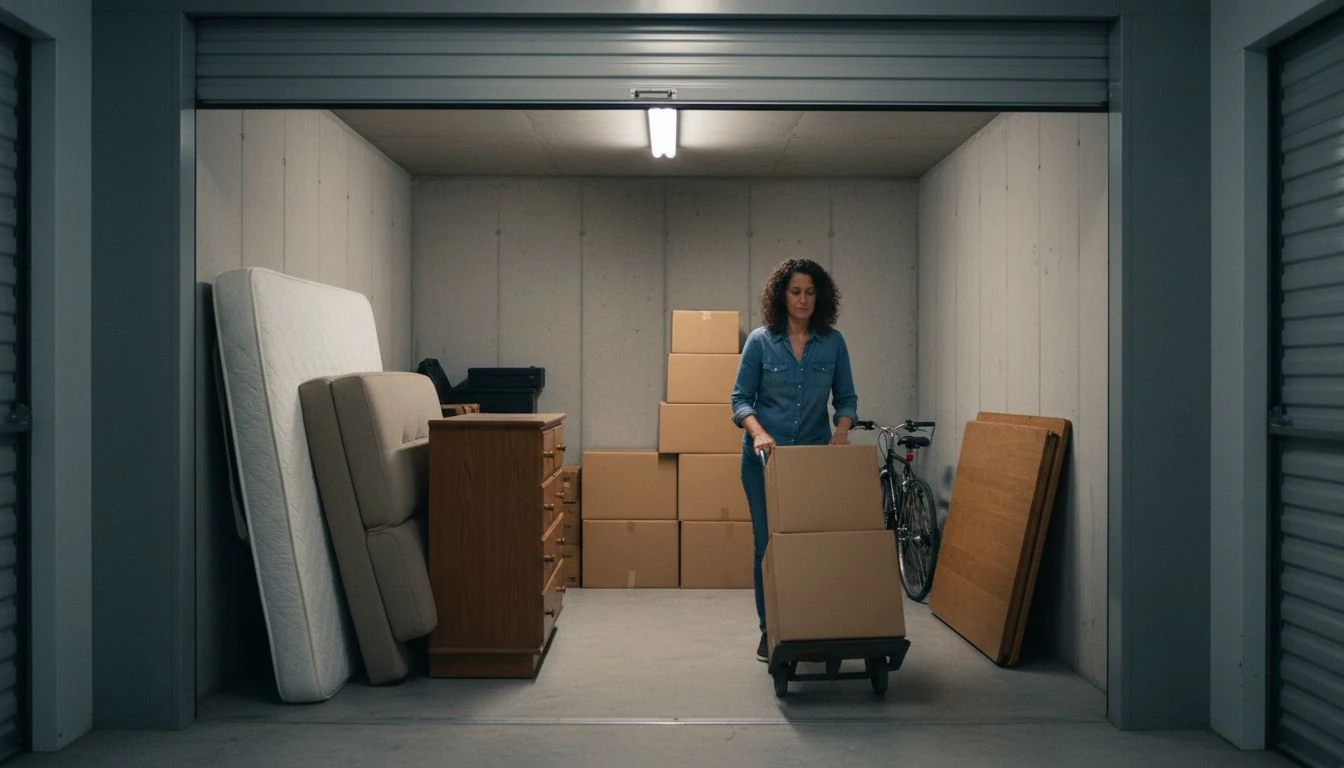
The day I cleared out my old 10×10, I noticed something I had missed for fourteen months. Everything I owned in there sat in the front half. The back five feet held one rolled rug and a lot of concrete. I had paid for a room and used a hallway, and nobody at the front desk had tried to talk me out of it.
So when my friend Dana called in August to say she was moving in with her partner and needed to store a one-bedroom apartment for six months, I didn’t let her guess at storage unit sizes. We measured everything, taped the outline of a unit on my garage floor, and packed her furniture into the tape before she rented anything. She signed for a 5×10. It fit, with room for a bike.
Below: the tape method, what fits in each size, the pieces that force you up a size, and the height most people pay for and never use.
Storage unit sizes at a glance
Unit names are floor dimensions in feet, width by depth. The height is the part that doesn’t show up in the name. According to SpareFoot’s storage unit size guide, most units run about eight feet tall, which is how they get their cubic footage:
- 5×5: 25 square feet, about 200 cubic feet. A hall closet.
- 5×10: 50 square feet, about 400 cubic feet. A large walk-in closet.
- 10×10: 100 square feet, about 800 cubic feet. An average bedroom.
- 10×15: 150 square feet, about 1,200 cubic feet. A small one-car garage.
- 10×20: 200 square feet, about 1,600 cubic feet. A standard one-car garage.
SpareFoot also lists a 5×15, a 10×25 and a 10×30, and not every facility carries all of them. The ones above are the sizes you’ll see on almost every rate sheet.
The room comparisons help, but how much of that space you use comes down to how you load it. Nobody at the counter walks you through that part.
The tape test: how I size a unit before renting
This took us one Saturday afternoon and a roll of blue painter’s tape. It works in a garage, a driveway, or an empty living room.
- List the big pieces first. Anything you can’t carry alone. Dana had nine: a queen mattress and box spring, a bed frame, a loveseat, a dresser, a bookcase, a small dining table, two chairs and a TV.
- Measure each one. Length, depth, height, written on a sticky note stuck to the piece. It took twenty minutes.
- Tape the unit on the floor. We taped a 5-by-10-foot rectangle on my garage floor and marked one short side as the door.
- Load it for real. Mattress and box spring on their sides against the back wall. Tall things along the sides. Chairs upside down on the table. Boxes last.
- Leave an aisle only if you’ll need to get in. Dana was storing for six months with nothing she needed to reach, so she skipped it. If you’ll visit, give up 18 inches down the middle and take the next size.
Her whole apartment covered about three quarters of the taped floor at waist height. Stacked to about six feet, she had space left for her bike and eight more boxes. The leasing office had told her on the phone that a one-bedroom “usually needs a 10×10.”
I don’t think the office was trying to upsell her. Suggesting the bigger size is the safe answer when you haven’t seen someone’s furniture. The tape is the only way I know to find out what your own stuff needs.
What fits in each storage unit size
Each size below, next to real moves I’ve watched or helped with and what SpareFoot says it holds.
5×5. SpareFoot says a dresser, a small mattress set and 15 to 20 regular boxes. In practice, this is the seasonal unit: holiday bins, camping gear, off-season clothes. If you’re storing furniture, a 5×5 is almost always one size too small.
5×10. SpareFoot says a studio or one-bedroom, including a queen mattress set, a loveseat, a dresser, a TV, a bike and around 30 boxes. That was Dana’s apartment, almost item for item. The catch is the sofa. A full-length three-seat sofa doesn’t fit sideways across a five-foot width, so it goes in on its end, which not every sofa survives.
10×10. SpareFoot’s number here is useful: up to 100 medium boxes if you stored nothing else, more like 50 to 60 once furniture goes in. Two bedrooms and a family room, it says. Mine held one bedroom, a sewing machine and a lot of boxes that should have gone to donation, and it was half empty.
10×15. The first size where a refrigerator and a full living room fit without puzzle-solving. SpareFoot puts it at a two- or three-bedroom home and at least 60 boxes.
10×20. A one-car garage. SpareFoot says a three- or four-bedroom household, including a washer, dryer and fridge, and 80 to 100 boxes. It’s also the size people rent to park a standard car.
The pieces that push you into bigger storage unit sizes
Boxes squeeze into whatever gap is left. Furniture doesn’t bend. Everyone I know who picked the wrong size did it because of one or two pieces, not the boxes.
- A sectional. It comes apart, but each section still wants floor space.
- A refrigerator, which has to stand upright and should never have anything stacked on top.
- A long sofa in a five-foot-wide unit.
- A king mattress set, which is 76 inches wide lying flat and awkward on its side.
- A dining table that doesn’t come apart. Take the legs off if you can; it goes from a floor hog to a flat board against the wall.
If one of these is the only thing forcing you up a size, it’s worth asking whether that one piece is worth a whole extra size every month. Our storage unit cost breakdown shows what a single size jump adds over twelve months, and that number is how Dana decided to sell her old sectional instead of storing it.
Height is the free space you’re already paying for
An eight-foot ceiling means the top third of the unit is paid for no matter what. Most people load to shoulder height, then stop, because lifting a box above your head in a narrow unit is miserable.
What helped us:
- Use the same box size for everything. Mixed boxes don’t stack; matching ones stack like bricks. Dana used medium boxes only, plus a few small ones for books.
- Heavy on the bottom, light on top. Books and dishes low, bedding and lampshades high.
- Bring a two-step stool. It costs less than a size upgrade.
- Stand mattresses and tabletops on their edges along the walls, not flat on the floor.
One more measurement: the door. The roll-up door on the unit we looked at was a few inches narrower than the unit itself, and the mattress only went in at an angle. Ask the office for the door width, and measure your widest piece against it.
Which things need climate control
Most of what people store handles an ordinary drive-up unit fine. Paper and photographs don’t. The National Archives’ guide to storing family papers and photographs says to keep them below 75 degrees Fahrenheit and below 65% relative humidity to prevent mold, while avoiding humidity below 15%, which makes paper brittle. It also says to keep them off the floor and away from leaks.
A drive-up unit in a hot summer can blow past both numbers. My box of photographs came out of the old 10×10 fine, but it had been on a shelf and I got lucky. If most of what you’re storing is furniture and kitchen things, a standard unit is fine. If there’s a box you’d cry about losing, either bring it home or pay the difference for climate control on a smaller unit and keep the rest in a cheaper one.
Storage unit sizes by the piece: a footprint cheat sheet
These are the rough footprints of common pieces, measured from our own furniture and Dana’s. Yours will vary, so measure before you rent.
| Piece | Rough footprint | Can it stand on end? | Smallest size it fits in, loaded well |
|---|---|---|---|
| Queen mattress + box spring | 60 x 80 in flat; about 20 in deep on edge | Yes, on the long edge | 5×5, if little else goes in |
| Loveseat (about 60 in long) | 60 x 35 in | Sometimes, check the frame | 5×10 |
| Three-seat sofa (about 84 in long) | 84 x 36 in | Only if it’s sturdy | 5×10 on end; 10×10 lying down |
| Dresser | 60 x 20 in | No, keep it upright | 5×5 |
| Refrigerator | about 36 x 34 in | Must stay upright | 10×10 alongside a room of furniture |
| Dining table, legs off | under 6 in deep against a wall | Yes, on edge | Any size |
| Medium moving box | about 18 x 18 in | Stack 5 to 6 high | Fills whatever’s left |
Three storage unit sizing mistakes to skip
- Taking the size the phone suggests. A one-bedroom “needs a 10×10” is a safe answer for the office, not a measurement of your things. Tape it out first.
- Loading furniture flat. A mattress lying flat eats a third of a 5×10. On its edge it takes a strip against the wall.
- Storing things you haven’t decided about. Every maybe-box you store makes the unit bigger. Sort before you pack, not after.
What didn’t work: the walk-in test
Before the tape, Dana’s plan was to stand in a few empty units and imagine her furniture inside. We did that at one facility. Every unit looked enormous empty, and she walked out convinced a 5×5 would do.
It wouldn’t have. Her mattress set alone would have taken a quarter of the floor. Empty concrete is hard to judge: small units look roomy, and big ones look like you’ll never fill them. The tape on my garage floor, with her real loveseat sitting inside it, ended the argument in about ten minutes.
The other thing that didn’t work was guessing box counts. She thought she had “maybe twenty.” She had thirty-four. Count them, or at least count the rooms and assume more than you think.
Grab the free printable: my one-page Storage Unit Sizing Sheet, with a spot to measure your big pieces, a tape-test layout for a 5×10 and a 10×10, and the four questions to ask before you sign. Get the free sizing sheet →
Before you rent: shrink what’s going in
The cheapest size change is the one you make before moving day. When Dana sorted her apartment, a third of her boxes turned out to be things she was keeping out of guilt, and the sectional went to a coworker for $150. That’s what got her from the 10×10 the office suggested into a 5×10.
If you’re sorting ahead of a move, our declutter-before-you-pack plan walks through it room by room. And if you’d rather have the storage come to your driveway than drive to it, compare the math in our guide to portable storage containers vs. a storage unit.
FAQ
What size storage unit do I need for a one-bedroom apartment?
Usually a 5×10, if you load it well and stand the mattress on its edge. SpareFoot lists a 5×10 as fitting a studio or one-bedroom, including a queen mattress set, loveseat, dresser, TV and about 30 boxes. Move up to a 10×10 if you have a full-length sofa, a refrigerator, or you need an aisle to reach things.
How tall are storage units?
Most are about eight feet tall, which is how a 5×10 gets roughly 400 cubic feet. Ceilings vary by facility, and roll-up doors can be narrower than the unit, so ask for both measurements before moving day.
How many boxes fit in a 10×10 storage unit?
SpareFoot estimates up to 100 medium boxes with nothing else inside, or about 50 to 60 once you add furniture and bedroom sets. Matching box sizes stack higher and waste less space than a mix.
If you’re about to rent, do the tape test this weekend. Measure your five biggest pieces, tape a 5×10 on the floor, and see what fits before anyone at a counter tells you what you need.
Get my free Home Reset Planner
The calm, room-by-room planner I use to reset my whole home without the overwhelm. Join the newsletter and I’ll send it straight to your inbox.
No spam, ever. Unsubscribe anytime. — Lena
Keep reading — more on Home Organization
What Professional Closet Organizers Actually Cost (and the Session I’d Book First)
Organize Closet by Color: The System That Holds Up (and Where It Backfires)

Craft Closet Organization for People Who Actually Craft