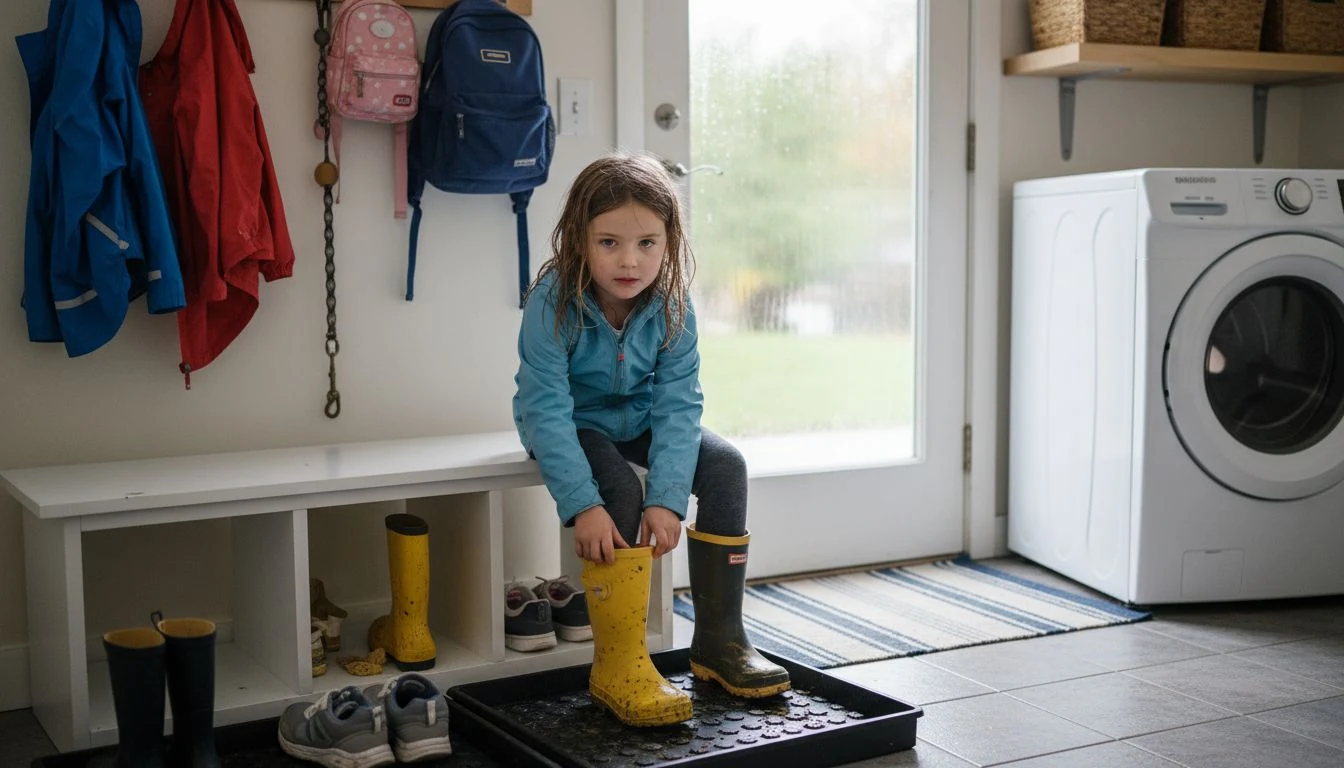
The first cold rain of October came on a Tuesday, and by dinner there were eleven shoes on the floor by our back door. Three people live here. Two of the shoes were soaked through, one still had a sock in it, and the dog had already carried a muddy sneaker to the couch.
Our back door opens from the garage into a 6 by 8 foot space that also holds the washer and dryer. It’s the door we all use, so it’s our mudroom whether it wanted the job or not. These are the mudroom organization ideas I set up that week, what each one cost, and the two I’d skip if I did it again.
Why the back door needs its own system
We have a front entryway too, and I wrote about it in my front hall organization post. But from October to March nobody here comes in the front. Coats, backpacks, wet boots and the dog’s leash all come through the garage, and that’s where the pile grows.
The front hall gets a mirror and a bowl for the mail. The back door gets water, mud and three of us arriving at 3:45 with our hands full. It needed different stuff.
Start with a boot tray that’s bigger than you think
Wet boots were the real mess. I started with one rubber tray, 15 by 30 inches, and it held two pairs. It was full by Wednesday.
Now there are two trays side by side next to the bench, plus a cheap washable rug in front of the door. Wet shoes go on the tray, no exceptions. Dry shoes go in the cubbies (more on those below).
The puddles were a bigger problem than the floor. The EPA’s guide to mold and moisture says to dry wet areas and items within 24 to 48 hours, and to keep indoor humidity below 60 percent, ideally between 30 and 50. Our laundry corner sits right there, and with the dryer running and boots dripping, the air got damp fast. A $15 humidity meter on the shelf told me I wasn’t imagining it. I checked the dryer vent, I leave the garage door cracked for an hour after we get home, and the boot trays get emptied and wiped every Sunday.
Mudroom organization ideas that worked in 48 square feet
I don’t have room for built-in lockers. I have one wall about 6 feet wide, plus the space over the washer. This is what went on it, in order.
- A storage bench with three cubbies. It’s 42 inches wide. Each kid gets a cubby for dry shoes, and the third holds the dog’s towel and the spare gloves. Sitting down to pull off boots means nobody hops around on one foot dripping on the floor.
- One hook per person, at their height. Four hooks on a rail above the bench, one each plus the leash. My 7-year-old’s hook is 40 inches off the floor so she can reach it. Before, all the coats went on one hook and slid off at night.
- A second, higher row for bags. Backpacks and my work tote get their own hooks, so the coats don’t get buried.
- A small basket per person on the shelf over the washer. Hats, gloves, scarves. In summer those baskets hold sunscreen and bug spray instead.
- A wall pocket for anything with paper. Permission slips used to land on the dryer. Now they go in one pocket, and I check it every night. It’s a tiny version of the family command center we have in the kitchen.
- A towel hook for the dog. One old bath towel by the door. Wipe paws, then she’s allowed in.
None of this needed a contractor. The bench was flat-pack, and the hook rails went into studs with the drill we already had.
Give every person one zone, and only one
The rule that fixed the most was the simplest. Each person gets a hook, a cubby and a basket, and nothing else. If your stuff doesn’t fit in your zone, the extra goes back to your room.
My 11-year-old fought this for about four days. He had two jackets and three hoodies piled on the hooks by the back door. Two went to the coat closet, the hoodies went to his dresser, and a week later he couldn’t tell me which ones he’d moved.
The kids picked the color of their own baskets. I’m pretty sure that’s the only reason they use them.
Keep the dirt at the door
I used to think the doormat was about saving the floors. Then I read the EPA’s page on reducing lead exposure at home. It says lead in soil can get tracked inside on shoes and clothes, and it recommends doormats outside and inside every entryway, and taking your shoes off before you come in. Our house was built in 1962, so that one stuck with me.
Now there’s a coarse mat on the garage side of the door and a washable one inside. Shoes come off on the tray. Muddy soccer clothes go into the washer, which is lucky enough to be three feet away.
What these mudroom organization ideas cost me
I gave myself a $250 budget and spent a little under. The table matches each purchase to the problem it was supposed to fix, so you can skip the ones you don’t have.
| What kept happening | What fixed it | What I paid |
|---|---|---|
| Wet boots on the floor, puddles by the door | 2 rubber boot trays | $34 |
| Kids hopping on one foot, shoes everywhere | 42-inch storage bench with 3 cubbies | $89 |
| Coats sliding off one shared hook | 4-hook rail at kid height and a 4-hook rail up high | $38 |
| Gloves and hats lost by November | 3 small baskets for the shelf over the washer | $21 |
| School papers on top of the dryer | Wall file pocket | $14 |
| Damp air and a musty smell | Humidity meter and a washable inside rug | $33 |
The shoe count by the door is down to whatever fits on the trays. Most nights that’s six.
Three mudroom mistakes I made first
- Buying cute open baskets for wet stuff. I put the boots in a woven basket the first week. It was soggy and smelled by Friday. Wet things need rubber or plastic.
- Putting hooks at my height. The kids couldn’t reach them, so their coats ended up on the bench. Measure from the floor for the smallest person.
- Using the mudroom as overflow storage. A case of paper towels and a box of donations sat there for a month and ate half the floor. The mudroom only holds things you grab on the way out.
What didn’t work for me
I tried a tall shoe rack first, the kind with eight slanted shelves. It looked great for about a day. My kids won’t put a wet shoe on a shelf, and the bottom row turned into a dumping spot for everything else. It moved to my closet, where it works fine. If you want other options for dry shoes, my shoe storage ideas post has a few that fit tight spaces.
I also tried a drop-zone tray on the dryer for keys and phones. Within two weeks it held receipts, hair ties and a single Lego. The keys hang on a hook by the door now, and the tray is gone. If your mudroom shares space with the washer like mine, my laundry room organization post covers how I keep the two jobs apart.
Grab the free printable: my one-page Mudroom Reset Checklist, with the one-zone-per-person rule, a hook-height chart for kids, and the Sunday wipe-down list for the boot trays. Get the free checklist →
FAQ
What are good mudroom organization ideas for a small space?
Use one wall. A bench with cubbies at the bottom, a row of hooks at kid height, a second row up high for bags, and a shelf with baskets above that. Wet boots go on rubber trays on the floor, not in the cubbies.
How do I keep a mudroom from getting wet and smelly?
Use rubber boot trays, empty and wipe them once a week, and let the space air out after everyone gets home. The EPA recommends drying wet items within 24 to 48 hours and keeping indoor humidity below 60 percent.
Can I make a mudroom without a separate room?
Yes. Ours is a 6×8 laundry area by the garage door. Any spot next to the door your family uses most can work, even a hallway wall, as long as each person gets a hook and a place for shoes.
If your back door looks like mine did, start this weekend with the boot trays and one hook per person. That alone took us from eleven shoes on the floor to six on a tray. Add the bench once you see what still lands on the floor.
Get my free Home Reset Planner
The calm, room-by-room planner I use to reset my whole home without the overwhelm. Join the newsletter and I’ll send it straight to your inbox.
No spam, ever. Unsubscribe anytime. — Lena
Keep reading — more on Home Organization
Small Apartment Organization Ideas (Renter-Friendly, No Drilling)

Home Office Organization Ideas for a Small Space
Storage Unit Sizes: What Actually Fits in a 5×10, 10×10 and 10×20