The July we moved in, I went down with a headlamp and counted twenty-six boxes I hadn’t opened since 2019. Three of them were soft at the bottom. That’s the part most basement organization ideas skip right past: the room is doing something to your things the whole time they sit there, and no amount of matching bins fixes a damp floor.
This isn’t a purge-weekend plan. I tried that once, quit at hour five, and shoved everything back down the stairs in worse shape than I found it. What cleared my basement instead was a humidity check that cost eleven dollars, a short list of things I stopped storing down there, and twenty minutes at a time over three weeks. Fourteen boxes. No lost Saturday.
Jump to:
- Why most basement organization ideas fail by Sunday night
- Check the damp before you buy a single bin
- What should never live in a basement
- The 20-minute box rule that replaced my purge weekend
- Basement organization ideas for a low ceiling and one bulb
- Get everything four inches off the floor
- Label it for the person who comes looking in three years
- What the basement does to your stuff
- The basement organization ideas that didn’t work for me
- Frequently asked questions
Why most basement organization ideas fail by Sunday night
Most basement organization ideas open the same way: block off a weekend and empty the whole room onto the driveway. I tried it in April. By two in the afternoon I was sitting on an overturned crate holding a shoebox of loose cables, unable to decide anything at all, and the light was going.
The basement is different from every other room in one specific way. You have to sleep in the bedroom and eat in the kitchen, so those rooms force you to finish. The basement has no deadline at all. Leave it half-sorted for eleven months and the house keeps working fine, which is how a half-finished purge quietly becomes the new normal down there.
It’s also the one room where the container decision comes before the sorting decision. Put a perfectly good box in a damp basement and it rots anyway. That’s why the moisture check now comes first, always, before I touch a single item.
Check the damp before you buy a single bin
I bought a little digital hygrometer for about eleven dollars and set it on the bottom stair. In late July it read 68 percent. I had no idea that was bad until I looked it up, because the room didn’t smell like anything and the walls looked dry.
The EPA’s guidance is to keep indoor humidity under 60 percent, and ideally somewhere between 30 and 50 percent, because mold needs the moisture more than it needs dirt (EPA, A Brief Guide to Mold, Moisture and Your Home). My 68 was well into the range where cardboard goes soft and wool goes spotty. That explained the three squishy boxes.
A dehumidifier on a timer brought mine to about 52 percent in four days. That one change did more for what I could safely keep down there than any shelf I’ve ever bought. Leave the hygrometer sitting for three days before you decide anything. If yours reads above 60, your basement is a plastic, metal and glass room for now, and the paper and fabric go upstairs.
One more cheap test while you wait. Tape a square of clear plastic to the concrete, seal all four edges, and come back tomorrow. Water beading underneath means moisture is rising through the slab, which you fix with a dehumidifier and a plumber before you fix it with bins.
What should never live in a basement
This is the section I wish I’d read in 2019. Some things simply lose the coin flip down there, and moving them upstairs costs nothing.
Photographs and irreplaceable documents come first. The National Archives is blunt about it: family papers and photos belong in the living areas of the house, not attics or basements, because the temperature and humidity swings are what damage them (National Archives, Storing Family Papers and Photographs). I lost the edges of a wedding album learning this. The pages had curled and stuck to each other, and there’s no undoing that.
Then textiles you care about. Wool, down, anything vintage. Bugs and damp both find them, and you won’t notice until the season you need them. Those went into the linen closet upstairs, where I can see them.
Then cardboard, as a material. A cardboard box on a concrete floor wicks moisture up into itself like a paper towel, and it’s also the preferred housing of every insect in the neighborhood. I don’t store anything in cardboard down there anymore, including the boxes that came with appliances.
Last, anything with a battery in it, plus paint and adhesives, which are unhappy with cold. And important paperwork, which has a much better home upstairs in a system you’ll actually use, like the five-folder setup I keep in the kitchen.
The 20-minute box rule that replaced my purge weekend
Once the humidity was handled, I stopped trying to do the room. I did one box. This is the part of my basement organization ideas that friends roll their eyes at until they try it.
The rule is simple. Set a timer for twenty minutes, bring one box up to the kitchen table where the light is good, and don’t go back down until it’s empty. Three destinations only: goes back to a labeled bin, leaves the house, or moves upstairs to where it belongs. Anything I couldn’t decide in about thirty seconds went into a single “ask me in January” bin, and I allowed myself exactly one of those.
Fourteen boxes took three weeks of a few evenings each. Roughly four and a half hours, less than the purge weekend I abandoned, except this one finished. The kitchen table matters more than it sounds, too. Downstairs I kept everything, because everything looks fine in dim light. Upstairs I could see the water stain on the tablecloth and it went straight into the trash. If the deciding is your bottleneck, start with the categories that barely hurt and let the momentum carry you to the sentimental boxes later.
Basement organization ideas for a low ceiling and one bulb
My basement has a single bare bulb and about six foot four of headroom, so half the pretty layouts on Pinterest were never happening. Two things fixed the space more than shelving did.
Light came first. A clamp light on the beam and a battery motion light at the bottom of the stairs, maybe fifteen dollars together. You cannot sort what you cannot see, and a dark room quietly teaches you to dump things at the bottom of the stairs and leave.
Then I zoned by how often I go looking, not by category. Seasonal things nearest the stairs, because I fetch them four times a year. Archive boxes, the ones I open almost never, at the far wall. An overflow zone for household stock, paper towels and the like. And one deliberately empty corner, because the day you need to move the couch there’s nowhere to put it otherwise.
Keep the walkway clear at eighteen inches minimum and don’t stack in front of the electrical panel, the furnace, or the water shutoff. If your basement is really a storage room rather than a room room, some of the vertical tricks I use in small spaces transfer down here, and my garage setup covers the wall-track approach if you have the height for it.
Get everything four inches off the floor
In 2019 our water heater let go and put about two inches of water across the slab. Everything sitting directly on concrete was lost. Everything on the one wire shelf survived, dry and boring.
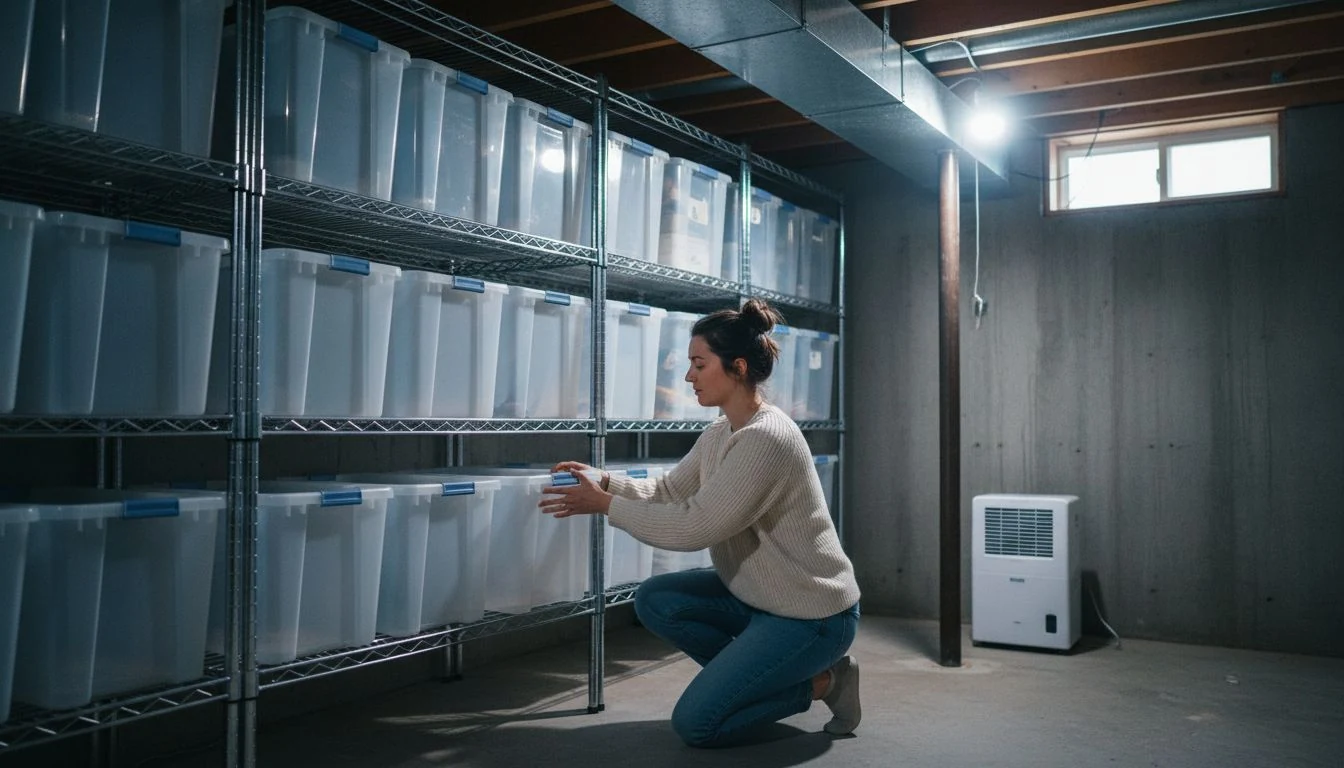
So now nothing touches the floor. Four wire shelving units cost me around sixty dollars secondhand and hold the whole room. Bottom shelf sits four to six inches up, which handles a heater failure or a heavy rain backup, and the open wire lets air move so nothing sits in its own dampness.
I normally argue against buying plastic tubs, and I still do almost everywhere else in the house. The basement is my one exception, and I’ll defend it. Sealed plastic with a gasket lid is the only thing down there that survives both humidity and a wet floor. Buy fewer, better tubs rather than a wall of thin ones, and buy them clear so you don’t open six to find the Christmas lights.
Label it for the person who comes looking in three years
Labeling is where most basement organization ideas stop too early. My old labels said things like “kitchen extras,” which meant nothing to me eighteen months later. Now every bin gets a strip of masking tape on the short end and the long end, so it’s readable however the bin ends up turned, and the label lists the three biggest things inside plus the year I packed it.
The year is the useful part. A bin marked 2019 that I have never once opened is telling me something honest about its contents, and it’s a much easier conversation than trying to decide item by item.
Then I take one photo of each full shelf on my phone and keep them in an album called Basement. When someone asks where the extension cords are, I look at my phone instead of going down the stairs. That single habit has saved me more trips than any label.
What the basement does to your stuff (and where it should go instead)
I made this sheet after the wedding album. Every row comes down to one question: does the basement leave this thing alone, or does it slowly eat it?
| What you’re storing | What the basement does to it | Better home |
|---|---|---|
| Photos, albums, negatives | Humidity swings curl and stick the pages; emulsion goes cloudy | Interior closet upstairs, off the floor |
| Wool, down, vintage fabric | Damp invites mildew spots and feeds moths | Linen closet or under-bed, cedar with it |
| Cardboard boxes | Wicks moisture up from the slab and houses insects | Recycle it; move contents to gasket bins |
| Paperwork and tax files | Warps and mildews, and you stop filing what you can’t reach | A file box in your actual living space |
| Electronics and batteries | Cold plus condensation corrodes contacts, batteries leak | A closet shelf at room temperature |
| Holiday decor, tools, camping gear | Nothing, honestly. This is what basements are for | Sealed bins on wire shelving, stays put |
Common basement organization mistakes to avoid
- Buying the bins before reading the humidity. Containers can’t outrun a 68 percent room, and you’ll have spent the budget on the wrong problem. The hygrometer is eleven dollars and tells you which basement you actually have.
- Stacking bins instead of shelving them. A stack means the thing you need is always on the bottom, so you stop putting things back and start piling beside it. Shelves cost more up front and are the reason the system survives past month two.
- Treating the basement as the decision-free zone. Carrying something downstairs to avoid deciding about it is just paying storage rent in your own house. If it goes down, it goes down for a stated reason, in a labeled bin, with a year on it.
Grab the free printable: my one-page Basement Zone Map, the fill-in sheet I use to log each shelf, its zone, and the year each bin was packed. Get the free basement zone map →
The basement organization ideas that didn’t work for me
The twelve matching lidded bins were my expensive lesson. About ninety dollars of thin plastic, bought in a burst of enthusiasm before I’d measured anything, and the lids weren’t gasketed. Two winters later the ones on the floor had a fine dusting of mildew on the outside and one had cracked in the cold. I’d solved the aesthetic problem and none of the actual ones.
The label maker was the smaller flop. Crisp printed labels that peeled off the plastic within a season, because the humidity got under the adhesive. Masking tape and a marker have outlasted all of them, and I can rewrite tape when the contents change.
I also kept a spreadsheet of what was in every bin. It lasted nine days. The shelf photos on my phone do the same job for about two percent of the effort, and I’ll take the version I keep doing.
Frequently asked questions
How do I organize a basement without taking a whole weekend?
Ignore the basement organization ideas that start with emptying the room. One box at a time, twenty minutes, carried up to a well-lit table so you can see what you’re deciding on. Fourteen boxes took me three weeks of a few evenings, which came out to less total time than the purge weekend I gave up on. The room never has to be fully emptied at once.
What humidity level is safe for storing things in a basement?
Aim under 60 percent, and 30 to 50 is better. Mine read 68 in July and dropped to about 52 with a dehumidifier on a timer. Below that line you can store most things safely; above it, stick to plastic, metal and glass until you’ve fixed the moisture.
Are plastic bins or cardboard boxes better for basement storage?
Plastic, and it isn’t close. Cardboard pulls moisture up from the concrete and attracts insects, while a sealed gasket-lid tub survives both damp air and a few inches of water on the floor. Buy fewer sturdy clear ones rather than a wall of thin opaque ones.
Get my free Home Reset Planner
The calm, room-by-room planner I use to reset my whole home without the overwhelm. Join the newsletter and I’ll send it straight to your inbox.
No spam, ever. Unsubscribe anytime. — Lena
Keep reading — more on Home Organization
Storage Unit Sizes: What Actually Fits in a 5×10, 10×10 and 10×20
What Professional Closet Organizers Actually Cost (and the Session I’d Book First)
Organize Closet by Color: The System That Holds Up (and Where It Backfires)