
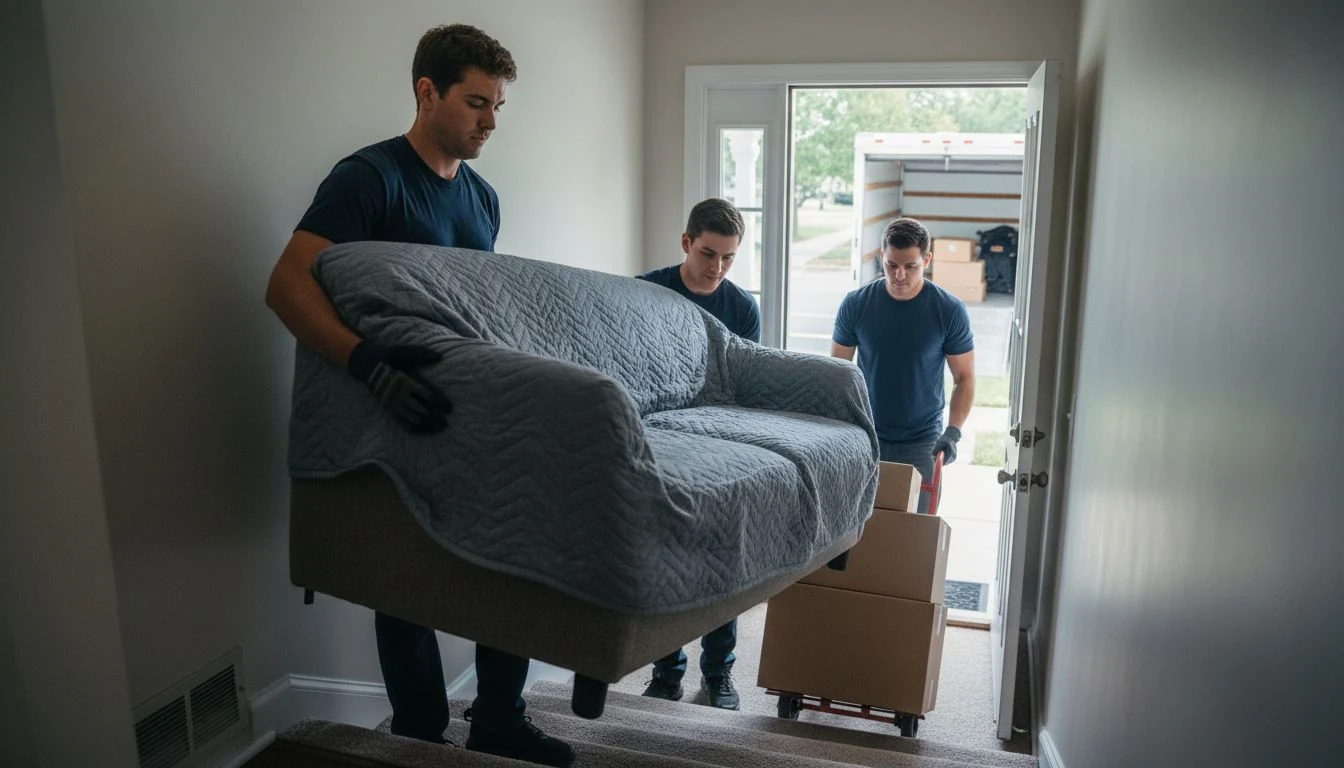
My brother Sam moved nine miles last month. One bedroom, second-floor walk-up, to a ground-floor duplex across town. He asked three local moving companies for prices and got back $139 an hour, $185 an hour and a flat $1,050. He called me because he couldn’t tell which one was cheapest.
Neither could I, at first. The hourly number is only one line of a local movers cost. The rest is minimums, travel time, crew size and a handful of fees that show up on the bill. I sat at his kitchen table with the three quotes and a calculator, and this is what we worked out, plus what he paid in the end.
How local movers price a move
Long-distance moves are usually priced by weight or volume. Local moves, the ones inside the same metro area, are almost always priced by the hour. You pay for a crew and a truck from the time they start until the time they finish, plus whatever the company adds on top.
That means the hourly rate matters, but so does how fast the crew works. A cheap rate with a slow crew can cost more than a pricier rate with an extra person. If you’re moving farther, my long distance moving cost breakdown covers how that pricing works instead.
The three quotes Sam got, side by side
All three were for the same move, the same week, with the same list of furniture: a queen bed, a couch, a dresser, a desk, a small dining set and about 30 boxes.
- Company A: 2 movers and a truck, $139 an hour, 3-hour minimum, plus one hour of travel time charged no matter what.
- Company B: 3 movers and a truck, $185 an hour, 2-hour minimum, plus a flat $95 truck and fuel fee.
- Company C: a flat price of $1,050, written as the most he’d pay.
Company A looked cheapest. It wasn’t, once we added the travel hour and guessed how long two people would take to carry a couch down a narrow staircase.
What goes into local movers cost besides the hourly rate
These are the lines that moved the total on Sam’s quotes. Ask about each one before you book.
- The minimum. Most companies charge for 2 or 3 hours even if the job takes less. For a studio, the minimum can be most of the bill.
- Travel time. Company A charged a flat hour for the drive to Sam’s place and back. Company B built it into the $95 fee. Ask how they bill it, because it’s easy to miss.
- Billing increments. Company B billed in 15-minute blocks after the minimum. Company A rounded up to the half hour.
- Stairs and long carries. Sam’s stairs didn’t add a fee, but they added time. One company asked how far the truck could park from the door, so I’m guessing they’ve been burned before.
- Supplies. Mattress bags, tape and shrink wrap were extra on two of the three quotes. Sam’s mattress bag was $15.
- Heavy or awkward items. A piano, gun safe or pool table is often a separate charge, sometimes a separate crew. My friend’s upright piano got its own post on what piano moving cost her.
Where the hourly rate goes
I wanted to know why a crew costs $185 an hour when movers don’t take home anything close to that. The Bureau of Labor Statistics Occupational Outlook Handbook lists a median hourly wage of $18.38 for hand laborers and material movers as of May 2025.
At that median, three movers cost the company about $55 an hour in wages. The other $130 covers the truck, fuel, insurance, payroll taxes, the office, the person answering the phone and profit. I don’t know how each company splits that. But it made me feel better about the $20 cash tip Sam gave each mover at the end.
What Sam paid, and what the local movers cost came to
He picked Company B. Three people finished in 3 hours and 40 minutes, which billed as 3.75 hours. Here’s how the three quotes would have landed for that same job, using Company B’s real time and my best guess for a two-person crew.
| Line on the bill | Company A (2 movers) | Company B (3 movers, what Sam paid) | Company C (flat) |
|---|---|---|---|
| Hourly rate | $139 | $185 | n/a |
| Hours billed | 5.5 (my estimate) | 3.75 | n/a |
| Labor and truck | $764.50 | $693.75 | $1,050 |
| Travel or truck fee | $139 (1 hour) | $95 | Included |
| Mattress bag | $15 | $15 | Included |
| Total before tip | $918.50 | $803.75 | $1,050 |
Add the $60 in tips and Sam’s move came to $863.75. The extra person cost $46 more per hour and saved him more than $100.
Three local movers mistakes we almost made
- Comparing only the hourly rate. Company A’s $139 was the lowest number on paper and the most expensive move once the travel hour and a slower crew went in.
- Booking from a phone quote. Sam’s first call ended with “about $500.” Nothing about that was in writing, and it didn’t include the minimum or the fee.
- Not asking about damage coverage. We almost skipped this. One quote’s paperwork offered very little coverage unless he paid extra, and the salesperson didn’t bring it up on the phone.
Get it in writing before anyone lifts a box
Rules for local movers depend on your state, so look up yours. Texas is a good example of what to ask for. Its TxDMV moving checklist tells you to get a written proposal showing the maximum price you could be required to pay, not to rely on verbal agreements, and to read every document before you sign. It also says the contract has to spell out the mover’s liability for loss or damage, and that it can be $0.00.
That last one surprised Sam. He bought extra coverage for $40 because his desk was his grandfather’s.
What didn’t work for us
Sam tried to save money by packing the night before. He ran out of boxes at 11 p.m. and threw the rest of the kitchen into trash bags. The movers carried 14 loose bags, which took longer than boxes would have, and that time was on the clock. Next time he says he’ll rent plastic bins, like the ones in my post on moving totes rental.
He also moved a box of old textbooks he hadn’t opened since college. At $185 an hour, carrying stuff he didn’t want was the most expensive thing in the truck. My decluttering before a move plan would have caught it. And if you’re getting quotes right now, read how low cost moving companies build their quotes before you pick one.
Grab the free printable: my one-page Local Mover Quote Sheet, with a column for each company, every fee to ask about, and a box to estimate hours so you can compare real totals instead of hourly rates. Get the free quote sheet →
FAQ
How is local movers cost calculated?
Most local moves are billed by the hour for a crew and truck, with a 2 or 3 hour minimum. On top of that you may see a travel time charge or truck fee, supplies like mattress bags, and extra charges for heavy items. Ask for the full total in writing, not only the hourly rate.
Is a bigger moving crew more expensive?
Not always. A three-person crew has a higher hourly rate, but it can finish faster. For Sam’s one-bedroom move, three movers at $185 an hour came out about $115 cheaper than our estimate for two movers at $139 an hour.
Should I tip local movers?
It’s common but up to you. Sam gave each of his three movers $20 in cash for a move just under four hours. Hand it to each person directly instead of leaving one tip for the whole crew.
Before you call anyone, count your boxes and list the big furniture. Then ask every company the same five questions: hourly rate, minimum, travel charge, billing increment and damage coverage. Sam did that on his second round of calls, and it took him 20 minutes to see which quote was cheapest.
Get my free Home Reset Planner
The calm, room-by-room planner I use to reset my whole home without the overwhelm. Join the newsletter and I’ll send it straight to your inbox.
No spam, ever. Unsubscribe anytime. — Lena
Keep reading — more on Home Services & Costs

Home Staging Cost: What Stagers Charge (and What You Can Do Yourself)

Rug Cleaning Cost: Area Rugs, Wool, and When It’s Worth Sending Out

Oven Cleaning Service Cost (Book It Before Thanksgiving)