Two Septembers ago I lost a field trip permission slip, a dentist appointment, and most of my patience in the same week. The slip turned up under a cereal box the day after it was due. That was the week I finally built a real family command center. Not the color-coded wall you scroll past on Pinterest, just a small corner by the back door that catches the calendar, the papers, and four backpacks before they explode across the kitchen.
I’ve run some version of this setup for three school years now, through one apartment move and two kids who lose everything that isn’t bolted down. Here’s exactly what a family command center needs, where to put it, and how to get yours working before the first week of school buries you.
Jump to:
What a family command center actually is
A family command center is one small spot in your home where the whole household’s schedule and paper live, so nobody has to ask “where’s my form” five minutes before the bus. That’s the entire job. It holds the calendar, the papers that need action, and the things that walk out the door every morning.
Notice what it is not. It’s not a craft project, and it’s not a second full-time chore. Mine is a 24-inch stretch of wall and a shelf. The families who keep these things running long-term almost always have the plain, slightly ugly version. Michigan State University Extension makes the same point in their own guide to building a command center: start with the functions, not the decor. Function first. Cute later, if ever.
Where to put your family command center
Put it where your family already dumps things, not where a photo would look nicest. This is the mistake I made first. I built my pretty version in the dining room because the light was good, and everyone kept dropping their stuff by the back door anyway. The command center sat empty for a month.
So watch your traffic for a couple of days. Where do the shoes land? Where does the mail get set down? That corner is your answer, even if it’s awkward. For most homes it’s the entryway, the mudroom, or the wall right beside the kitchen. If your entry is already a pile-up, my post on entryway organization ideas pairs well with this and fixes the drop-zone half.
The four zones that make it work
Every family command center that actually holds up has four jobs, and it’s worth naming them so nothing quietly goes missing. You don’t need four separate gadgets. You need four functions covered, even if two of them share one shelf.
- The calendar zone. One shared calendar the whole family can see. A big wall month, a whiteboard, or a synced phone calendar printed weekly. Pick one and kill the others.
- The paper zone. An inbox tray for papers that need action (sign, pay, RSVP) and a small folder for keep-this stuff. Everything else gets recycled the same day.
- The drop zone. Hooks for backpacks and keys, a spot for shoes, a charging cubby for the devices. This is what stops the morning scramble.
- The launch zone. A small shelf or basket where tomorrow’s things sit tonight: the signed form, the library book that’s due, the water bottle.
The launch zone is the one people skip, and it’s the one that saves you. Set it up the night before and your morning gets ten minutes shorter. Routines like this aren’t just about tidiness either; the CDC’s parenting resources on structure note that predictable systems lower stress for kids too, not only for the exhausted adult refilling the water bottles.
How I set ours up for the school year
I built the current version on a Sunday afternoon for about $35 in supplies, most of it from Target and the dollar section. Here’s the order I’d do it in, because doing it out of order is how I wasted the first $15 on stuff I gave away a month later.
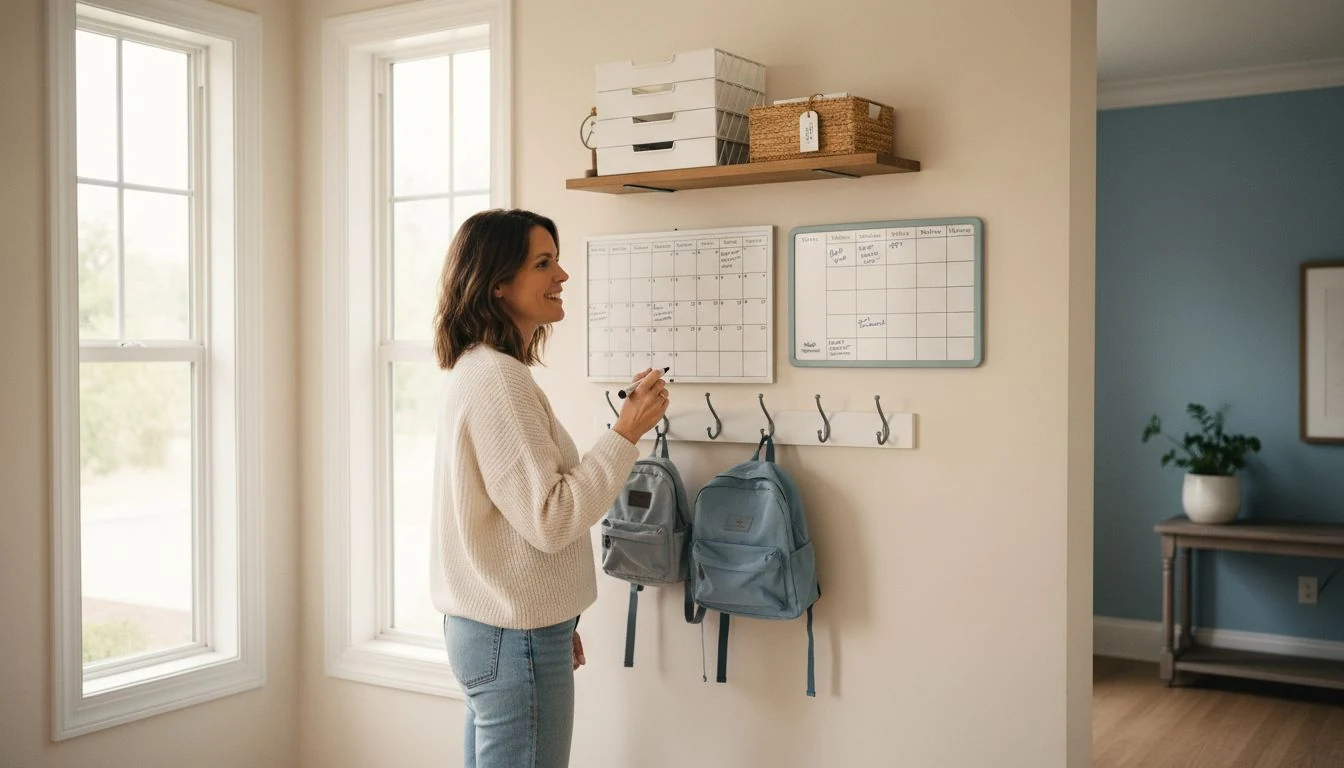
First, I hung four hooks at kid height, not adult height. My six-year-old can only hang her backpack if the hook is somewhere she can actually reach, which turns out to be lower than every tutorial suggests. Then I mounted a cheap month calendar and a small dry-erase board beside it for the week’s moving parts: early dismissal, the dentist, who has soccer.
Under that went two stacked letter trays. Top tray is the inbox, anything that needs a signature or a check. Bottom tray is the outbox, the stuff that goes back to school. When the outbox has something in it, it goes straight into the launch basket that night. The paperwork half of this leans on the same habits in my guide to organizing paperwork at home, so I won’t repeat the whole filing bit here.
Last, I added a small bin for chargers and one basket labeled “tomorrow.” That basket does more work than anything else on the wall. If homework lives somewhere else in your house, my kids homework station ideas cover that corner so the command center doesn’t have to.
Family command center ideas for small spaces
You do not need a mudroom. My whole setup lived on the back of a closet door for a full year in our apartment, and it worked fine. When you’re short on wall, go vertical and go behind doors.
An over-the-door organizer holds papers and small supplies. A single tension rod with S-hooks becomes your drop zone. A magnetic dry-erase sheet sticks to the side of the fridge for your calendar zone. Renters, none of this needs a drill: command hooks and adhesive pockets carry the whole thing, and they come off clean when you move. I’ve tested the peel-off ones through an actual move and lost exactly one hook to a textured wall.
The trick in a small home is ruthlessness about the paper zone. One inbox tray, and it gets emptied twice a week or it becomes a paper avalanche. There’s no room to let it drift.
What didn’t work for me
The fabric wall pockets everyone loves? Mine sagged, swallowed papers whole, and I forgot anything that slid to the bottom. I gave them away within a month.
The elaborate color-coded chore-and-reward chart lasted about nine days. I’d built a system so detailed that maintaining it became its own chore, which is the exact trap to avoid. The version that survives is boring on purpose. And the giant family planner binder I bought? Beautiful, and I never once opened it after week two. A wall you can see beats a binder you have to remember to check, every single time.
The one-glance zone cheat sheet
If you only build one thing this weekend, build the four zones. Here’s the fast version: what belongs in each zone, and the one thing I’d skip so you don’t overbuild it like I did.
| Zone | The one thing that makes it work | Skip this |
|---|---|---|
| Calendar | One shared month view everyone can see at a glance | A second “backup” calendar nobody updates |
| Paper | An action inbox tray, emptied twice a week | Deep filing bins at the command center |
| Drop | Hooks at kid height for bags and keys | Adult-height hooks your kids can’t reach |
| Launch | One “tomorrow” basket packed the night before | A morning-of scramble to find everything |
Common family command center mistakes to avoid
- Building the pretty version first. Decor before function is why so many of these end up empty. Cover the four jobs with plain supplies, live with it two weeks, and only then make it nicer if you still want to.
- Putting it where it looks good, not where you live. If the family already dumps everything by the back door, that’s the spot, even if the light is bad and the wall is small.
- Making the system too detailed to maintain. A command center that needs daily upkeep becomes another chore you’ll quietly abandon. Boring and low-effort is what survives a real school year.
Free printable: Want the whole setup on one page? Grab the Family Command Center Checklist from The Calm Roost printables library: the four-zone layout, the supply list, and the two-minute nightly launch routine, all on a single sheet you can tape inside a cabinet door.
Frequently asked questions
What should be in a family command center?
Four things, no more: a shared calendar everyone can see, an inbox tray for papers that need action, hooks and a spot for backpacks, keys, and shoes, and a “tomorrow” basket you pack the night before. Add a charging bin if your kids have devices. Anything beyond those functions is decoration, and decoration is the part that makes people give up.
Where is the best place for a family command center?
Wherever your family already drops their stuff, usually the entryway, mudroom, or the wall next to the kitchen. Watch your traffic for a couple of days before you mount anything. The prettiest spot in the house is useless if nobody naturally walks past it, and the awkward corner by the back door is gold if that’s where the backpacks already land.
How do I set up a family command center in a small apartment?
Go vertical and use the backs of doors. An over-the-door organizer handles papers, a tension rod with hooks becomes your drop zone, and a magnetic sheet on the fridge covers the calendar. For renters, adhesive command hooks and stick-on pockets do the whole job and peel off clean when you move, so you don’t need to drill a single hole.
Get my free Home Reset Planner
The calm, room-by-room planner I use to reset my whole home without the overwhelm. Join the newsletter and I’ll send it straight to your inbox.
No spam, ever. Unsubscribe anytime. — Lena
Keep reading — more on Home Organization
Small Apartment Organization Ideas (Renter-Friendly, No Drilling)
Mudroom Organization Ideas That Survive Wet-Boot Season
Home Office Organization Ideas for a Small Space