The first year my oldest started real homework, I bought a beautiful little desk, a cup of rainbow pens, and a corkboard I never once pinned anything to. Within three weeks it was a landing strip for library books and a single sad sock. If you’re hunting for kids homework station ideas before school starts, let me save you the money and the guilt: the setup that actually sticks is smaller, cheaper, and closer to where you already are than Pinterest wants you to believe.
I’ve now set up a homework spot for two kids across three school years and one apartment move. Here’s what earns its space, what I quietly gave away, and how to build the whole thing this week so it’s ready before the first worksheet comes home.
Jump to:
What a kids homework station actually needs
Strip away the aesthetic and a homework station is three things: a clear surface, the supplies a kid reaches for daily, and light. That’s the whole list. Everything past that is decoration, and decoration is what turns a work spot into a clutter magnet.
I learned this the expensive way. The pretty desk failed because it lived in my son’s bedroom, far from me, and homework at seven is not a solo sport. He needed me two feet away answering “how do you spell because” for the fortieth time. So the fancy station sat empty while we did math at the kitchen counter anyway. The counter won. I stopped fighting it.
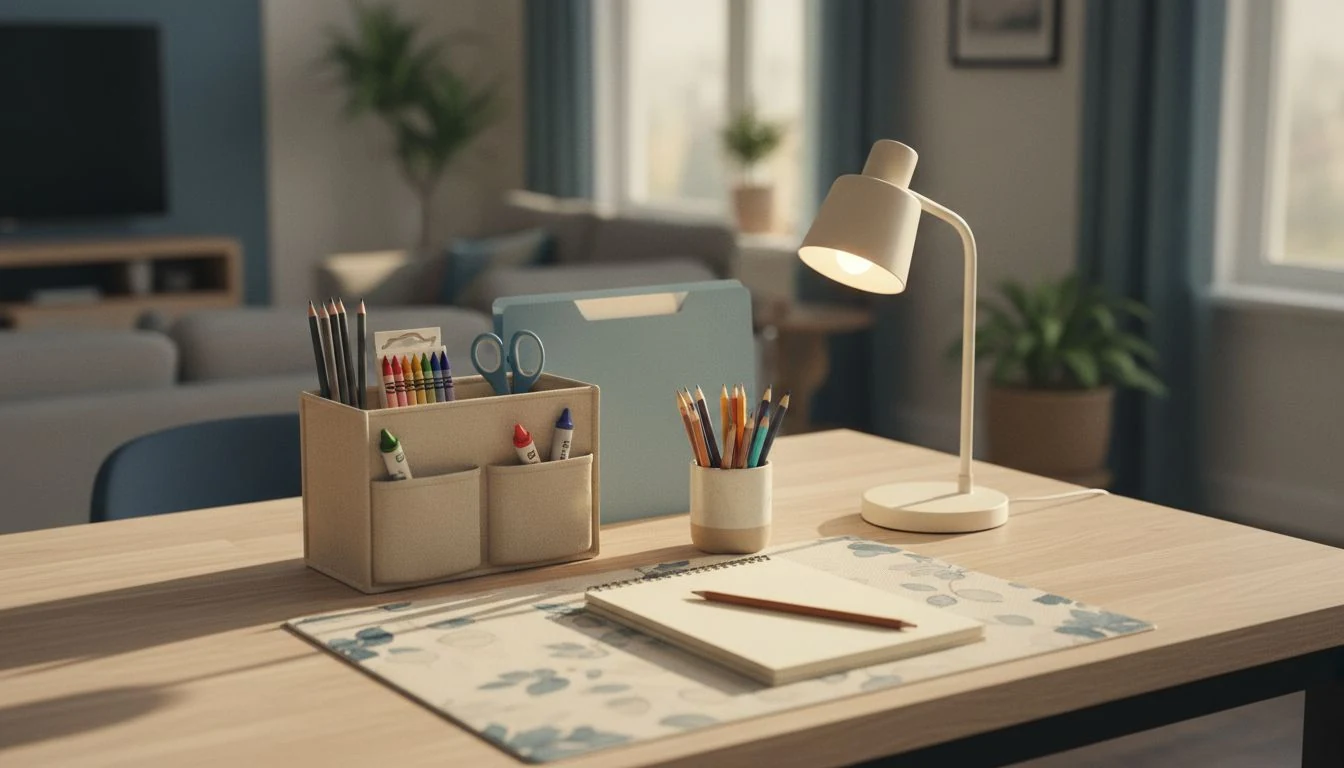
Keep the supply list honest: pencils, an eraser, a sharpener, crayons or colored pencils, safety scissors, a glue stick, and a folder for papers that go back to school. For an older kid, add a calculator and sticky notes. That’s it. If a supply hasn’t been touched in two weeks, it doesn’t live at the station.
Where to put it (the kitchen-table truth)
Here’s my honest opinion after trying the bedroom desk, the dining room, and a corner nook: most young kids do homework best near a parent, which usually means the kitchen or dining table. Proximity beats a dedicated room every time for elementary ages. The American Academy of Pediatrics’ guidance on building good homework habits backs up the basics: kids need a consistent, quiet spot without distractions, and parental supervision can help when homework gets hard.
So instead of building a permanent desk, I built a portable station: a caddy that lives on a shelf and comes to the table at homework time, then goes back. The table stays a table for dinner. The supplies stay corralled. Nobody loses the good scissors. This one shift fixed 90% of our homework friction, and it cost me about twelve dollars for the caddy.
If your kid is older and genuinely focuses better alone, a real desk in a quiet corner earns its keep. Read the room, literally. A middle schooler with a laptop and a door is a different animal than a first grader with a glue stick.
My homework station setup, piece by piece
Here’s exactly what’s in our grab-and-go setup, in order of how much I use it.
- The caddy. A cheap plastic or canvas caddy with a handle. Pencils and erasers in one section, crayons in another, scissors and glue upright. It travels from shelf to table in one trip.
- A single folder per kid. One two-pocket folder: left side “needs a parent,” right side “goes back to school.” This alone ended our permission-slip panics.
- A clip-on lamp. Kitchen overheads cast shadows right where a right-handed kid writes. A small clip lamp fixed the squinting for under fifteen dollars.
- A wipeable placemat. Defines “this is your work zone,” catches glue and eraser dust, wipes clean in one swipe. Weirdly, having a defined edge helps my youngest settle in faster.
- A timer. An old kitchen timer, not a phone. We do focused stretches with a real ticking timer because a phone at homework is a portal to nowhere.
Total for the whole kit, buying new, ran me around forty dollars. I already owned most of it. The point of any good kids homework station is that it’s cheap enough to redo when a kid changes grades and needs change.
Kids homework station ideas for small spaces
We did two of these years in an apartment with zero spare corners, so I have real opinions about tight quarters. You do not need floor space. You need one shelf and one flat surface you already own.
Go vertical. A single wall shelf or an over-the-door organizer holds the caddy, the folders, and a small bin without eating any floor. Use the back of a pantry or closet door for supplies so the counter stays clear. If you’re already rethinking the entry pile, the same corral-it logic I used for entryway organization works for homework gear: give it a home by the door it enters and leaves through, in this case the backpack drop.
Speaking of backpacks, pair the homework station with a simple backpack drop right where they walk in. Bag down, folder out, done. It’s the same drop-zone thinking from my back-to-school home reset, and it’s what keeps homework from turning into a nightly search party for a worksheet.
Setting it up before school so it sticks
Do this the week before school, not the frantic night before. Setting it up early does two things: it works out the kinks while the stakes are low, and it lets your kid help build it, which makes them weirdly protective of the spot afterward.
Let them pick the caddy color and pack it themselves. Ownership is half the battle. Then do a five-minute dry run: sit down, unpack the caddy, “do” a pretend worksheet, pack up, put it away. Silly, yes. But muscle memory before the pressure hits is what makes a system survive week three, when the novelty is gone and everyone’s tired. Consistency, not perfection, is what the research on homework routines keeps coming back to; the Child Mind Institute’s strategies for smoother homework lean hard on the same “same time, same place” idea.
Then protect the routine like you’d protect a nap schedule. Same shelf, same table, roughly the same time. If your afternoons are chaos, anchor homework to something that already happens, like right after a snack. Attaching a new habit to an old one is the cheapest trick in the book, and it’s the backbone of my whole daily reset routine too.
What to buy by age (and what to skip)
The biggest money leak with kids homework station ideas is buying for a grade your kid isn’t in yet. A kindergartner does not need a label maker. Here’s what actually earns a spot at each stage, and what you can skip until later.
| Stage | Station essentials | Skip for now |
|---|---|---|
| Grades K–2 | Fat pencils, big eraser, crayons, safety scissors, glue stick, one folder | Desk, calculator, pen cup, corkboard, label maker |
| Grades 3–5 | Regular pencils, colored pencils, ruler, glue, folder, small caddy, clip lamp | Dedicated room, printer, fancy planner, drawer organizers |
| Middle school | Pens, highlighters, sticky notes, calculator, folder or binder, timer | Elaborate label system, second monitor, standing desk |
| High school | Real desk or quiet corner, good lamp, charger, headphones, calculator | Cutesy caddy, kid supplies, anything that lives in the kitchen |
Common homework station mistakes to avoid
- Buying the big desk first. The desk is the last thing to buy, not the first. Start with a caddy and the kitchen table, and only build a permanent spot once you know where your kid actually focuses.
- Hiding it in the bedroom. For elementary kids, out of sight means out of mind and far from help. Keep young kids near you until they can genuinely work alone.
- Over-supplying it. A drawer of gel pens and gadgets is a distraction buffet, not a work zone. Fewer, well-chosen supplies get used; a cluttered station gets avoided.
Free printable: Want the whole setup on one page? Grab the Homework Station Checklist from The Calm Roost printables library: the by-age supply list, the caddy packing list, and the before-school dry-run steps, all on a single sheet you can tape inside a cabinet door.
Frequently asked questions
What do you put in a kids homework station?
Keep it to daily-use basics: pencils, an eraser, a sharpener, crayons or colored pencils, safety scissors, a glue stick, and one folder for papers. Add a calculator, highlighters, and sticky notes for older kids. A clip lamp and a timer help too. Anything that hasn’t been touched in two weeks doesn’t need to live there.
Where is the best place for a kids homework station in a small home?
The kitchen or dining table, paired with a portable caddy that lives on one shelf. You don’t need floor space or a spare room. Go vertical with a wall shelf or an over-the-door organizer, and keep the supplies in a grab-and-go caddy so the table stays usable for meals.
How do I set up a homework station that my kid will actually use?
Build it the week before school, let your kid pick and pack the caddy so they feel ownership, and do a two-minute pretend run-through. Then anchor homework to a set time and place, like right after an afternoon snack at the same spot. Consistency and their buy-in matter far more than how the station looks.
Get my free Home Reset Planner
The calm, room-by-room planner I use to reset my whole home without the overwhelm. Join the newsletter and I’ll send it straight to your inbox.
No spam, ever. Unsubscribe anytime. — Lena
Keep reading — more on Home Organization
Small Apartment Organization Ideas (Renter-Friendly, No Drilling)
Mudroom Organization Ideas That Survive Wet-Boot Season
Home Office Organization Ideas for a Small Space