The first week of school nearly broke me a few years ago. New shoes, fresh backpacks, a planner I bought with real optimism, and by Wednesday there were three permission slips lost under a pile of mail and one kid crying about a missing library book. That was the year I stopped chasing the shopping list and started doing a back to school home reset instead. It wasn’t a deep clean or a Pinterest entryway, just a calm, functional setup that catches the chaos before it spreads through the whole house.
The goal here is modest. A landing spot for backpacks, one place where the week lives, and a paper system that doesn’t end in tears by Friday. I built mine over a single weekend with stuff I mostly already owned. Below is exactly what I did, in the order that worked, plus the parts I tried and quietly abandoned.
Why a back to school home reset beats a back-to-school shopping spree
Most of us prep for the new year by buying things. Bins, folders, a fancy label maker, another planner. I did all of that and my house still felt like a tornado hit it by mid-September. The problem was never a shortage of supplies. It was that nothing had a home, so everything ended up on the kitchen counter.
A back to school home reset flips the order. First you decide where things land, then you buy only what supports that decision. When I finally set up real systems, my actual shopping list shrank to a pack of hooks and a wall calendar. The stuff I’d already hoarded did the rest. If you have a counter that collects clutter no matter how many times you clear it, that counter is begging for a system, not a scolding. My guide on what to declutter first when you’re overwhelmed is a gentle place to clear the runway before you build anything new.
Start your back to school home reset with the drop zone
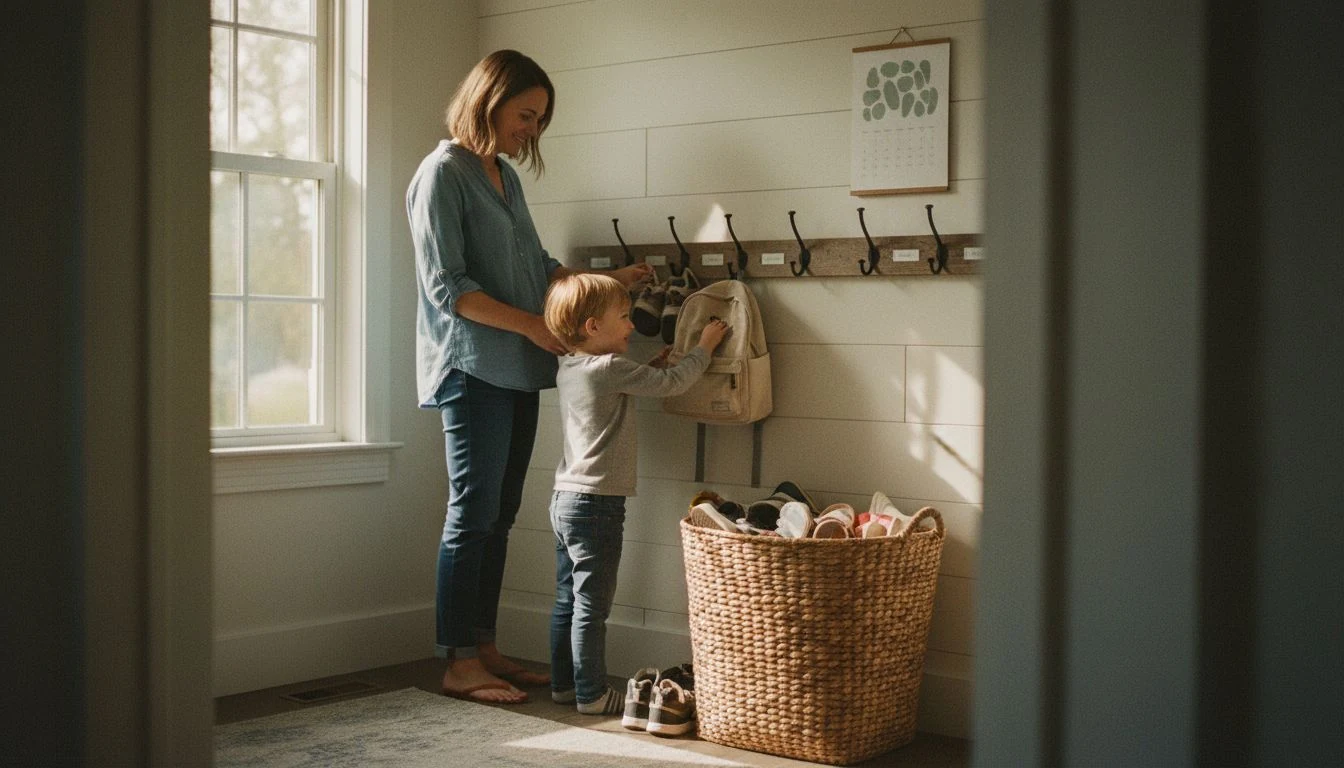
The drop zone is the single highest-leverage piece, so it gets done first. This is the spot, usually near whatever door your family actually uses, where backpacks, shoes, and that one rogue water bottle live. Give every kid one hook at their height and one bin or cubby for shoes, and the floor stops being a backpack graveyard overnight.
Here is what a drop zone needs, and nothing more:
- A hook per person, low enough that kids can reach it without you. If they can’t hang it themselves, it won’t happen.
- One bin or basket each for shoes, hats, and the gloves that arrive in October. Open bins beat lids every time, because a lid is one step too many for a tired seven-year-old.
- A landing tray for keys, sunglasses, and your own work badge, so the adults get a spot too.
- A small trash or recycling bin nearby for the avalanche of paper that walks in every afternoon. We’ll deal with the keeper papers in a minute.
I labeled each hook with my kids’ names the first year because they kept fighting over the good one by the window. Tiny detail, enormous peace. The whole drop zone took me about ninety minutes, and it is the reason mornings stopped feeling like a search party.
Build a command center that runs the week
The command center is the brain of the operation, and it can be tiny. Mine is a thirty-inch stretch of wall by the kitchen. It holds a big monthly calendar, a clip for the current week’s must-do papers, and a basket for the school stuff I need but don’t want on the counter.
Three things earn their place on that wall:
- A family calendar everyone can see. Color-code by kid if that helps you; I use a different marker color per person and it has saved me from double-booking more times than I can count.
- A this-week clip or folder for the forms, flyers, and field-trip slips that need action in the next seven days. Everything else gets filed or tossed the day it arrives.
- A launch basket for the items that travel back to school: signed forms, the returned library book, the lunchbox that needs to go out the door. If it leaves the house tomorrow, it lives in the basket tonight.
The command center only works if it’s where you already stand, not in a perfect office nobody visits. Put it where you make coffee or pack lunches. A beautiful station in the back hallway is a museum, not a tool. The same realistic mindset runs through my post on keeping a tidy home when you have kids, because systems only stick when they fit the life you actually live.
The paper pile: where a back to school home reset usually dies
If your reset is going to collapse anywhere, it’s here. School generates a staggering amount of paper, and most of it is noise. The trick is a fast sort the moment it enters the house, not a someday-I’ll-deal-with-it pile that grows teeth.
I use a four-way sort that takes under a minute per day:
- Act: needs a signature or a reply this week. Straight to the command center clip.
- File: report cards, medical forms, anything you’ll need later. One folder per kid, done.
- Recycle: the flyer for the thing you already saw online. Most of the stack lives here.
- Display, briefly: the proud artwork. We rotate it on the fridge for two weeks, then photograph the favorites and let the paper go.
That display-and-photograph habit is what keeps me from drowning in macaroni art I genuinely love but cannot store forever. Keep one or two physical pieces a season; let the camera hold the rest. Building a daily-sort habit is so much easier when the rest of your home runs on a light rhythm too, which is exactly what my cleaning schedule by room for busy weeks is built to do.
Grab the free Back-to-School Command Center Printable
I put the drop-zone checklist, the four-way paper sort, and a one-page weekly launch list onto a single calm sheet you can stick right on your command center wall. No complicated setup, just the prompts that keep the first month from running you over.
The 15-minute reset that keeps the whole thing alive
A back to school home reset is not a one-time event you finish in August. It’s a small daily loop that protects the work you already did. Mine runs twice a day and takes about fifteen minutes total, split in two.
In the evening, we do the launch: backpacks packed and hung, the next day’s paper in the basket, lunch decisions made before everyone is exhausted. In the morning, we do the catch: a thirty-second sweep of the drop zone so nothing wandered overnight. Consistency matters more than perfection here, and so does sleep. A predictable bedtime makes every morning calmer, which is why the CDC guidance on healthy sleep habits sits in the back of my mind every single school night. Tired kids and a tidy entryway rarely coexist.
If the routines themselves are the hard part in your house, you are not failing. Transitions are genuinely tough for kids, and the nonprofit Child Mind Institute has steady, practical advice on easing the back-to-school adjustment that helped me lower my own expectations to something humane. Calm first, tidy second.
What didn’t work for me, so you can skip it
I want to be honest about the misses, because the polished posts never are. The elaborate color-coded binder system I built one ambitious August lasted about eleven days. It was too many steps, and steps are where systems go to die. The clear acrylic file holders I bought looked gorgeous and held nothing useful, because vertical paper storage means I never see the bottom two-thirds. And the dedicated homework cart on wheels just became a mobile junk drawer that roamed the house.
What survived was always the boring, low-effort version: open bins, hooks a kid can reach, one weekly clip, a daily sort that takes a minute. Every time I made the system fancier, I made it more fragile. The reset that lasts is the one your most tired, most distracted family member can keep on autopilot. Aim for that, not for the photo.
Back-to-School Home Reset: Where to Set Up Each Station
A back-to-school home reset goes smoother when every part of the morning has a “home.” Instead of one big homework corner that turns into a junk pile, give each daily task its own small station so kids can run the routine without you hovering.
| Station | Best spot in the house | What lives there | Why it works |
|---|---|---|---|
| Launch pad | By the door you actually use | Backpacks, shoes, signed forms, water bottles | Nothing gets forgotten in the morning scramble |
| Homework spot | Quiet, well-lit, near an outlet | Supplies caddy, charger, a timer | Kids start faster when supplies aren’t a scavenger hunt |
| Snack station | A low fridge shelf + low pantry bin | Pre-portioned snacks they can reach | Builds independence and cuts the after-school “I’m hungry” chaos |
| Paper drop | Kitchen counter or fridge side | One tray: to-sign, to-keep, to-toss | Permission slips stop disappearing |
| Outfit prep | Closet or a hook rack | Five labeled spots or a hanging organizer | Sunday-night prep ends the “I have nothing to wear” stall |
Where back-to-school resets usually fall apart
- Putting the launch pad somewhere “nice” instead of somewhere used. If the family pours in through the garage, a pretty front-entry drop zone stays empty while the garage floor fills up.
- Setting it all up for your convenience, not the kid’s height. If your child can’t reach the snack bin or hang their own backpack, you stay the bottleneck every single morning.
- Skipping the paper tray. Loose forms, flyers, and artwork are what bury a counter fastest, so give them one shallow tray before week one even starts.
FAQ
When should I do a back to school home reset?
The sweet spot is the two to three weeks before school starts, when you have a little breathing room but a real deadline. That said, a reset works any time the system has slipped, including a mid-year do-over in January. Don’t wait for a perfect free weekend that never comes. Even a single ninety-minute session on the drop zone moves the needle more than weeks of good intentions.
What is the difference between a drop zone and a command center?
The drop zone handles physical stuff: backpacks, shoes, water bottles, the gear that walks in the door. The command center handles information: the calendar, the action papers, and the items launching back out tomorrow. One catches things, the other runs the schedule. You want both, and they can live a few feet apart near whatever door and counter your family actually uses.
How do I keep the back-to-school chaos from coming back?
Protect it with a short daily loop instead of relying on a one-time setup. A few minutes each evening to pack and hang backpacks and sort the day’s paper, plus a quick morning sweep of the drop zone, keeps everything from sliding. The systems that last are the simplest ones, so resist the urge to add steps. If a piece keeps getting skipped, it’s too complicated, not too neglected.
Get my free Home Reset Planner
The calm, room-by-room planner I use to reset my whole home without the overwhelm. Join the newsletter and I’ll send it straight to your inbox.
No spam, ever. Unsubscribe anytime. — Lena
Keep reading — more on Home Organization
Bedding Storage Ideas When You Don’t Have a Linen Closet
Winter Capsule Wardrobe: A Calm Closet for the Cold Months
Guest Bedroom Ideas: Set Up a Calm Guest Room Before the Holidays