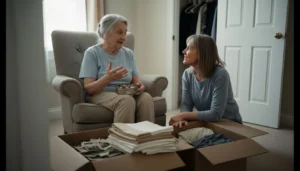

I kept a chipped ceramic owl on a shelf for six years because my grandmother gave it to me, and I hated it. Every time I dusted around it I felt a little knot in my chest. That knot has a name, and it’s decluttering guilt: the heavy, sticky feeling that letting go of an object means letting go of the person, the memory, or the version of yourself attached to it. If you’ve ever held a gift you don’t use, can’t display, and won’t throw out, you already know exactly what I mean.
Here’s the short version before we go deep: you are allowed to keep the memory and release the object. The two are not the same thing, no matter how loudly the guilt insists they are. Below is the gentle, no-shame approach I actually use, the scripts I lean on when family gets involved, and the safe ways to pass things on so you never feel like you just trashed someone’s love.
Why decluttering guilt hits so hard
Guilt over letting go isn’t a character flaw or proof that you’re “bad at minimalism.” It’s your brain doing exactly what it evolved to do. We attach meaning to objects, and once a thing carries a memory, parting with it can feel like erasing the memory itself. Researchers who study hoarding and attachment point out that the distress is real and measurable, not imaginary. The U.S. National Institute of Mental Health notes that strong difficulty discarding possessions is a recognized pattern precisely because the emotional pull is so powerful; you can read their plain-language overview of obsessive and compulsive-related behaviors at NIMH if you want to understand the spectrum it sits on.
Most of us aren’t anywhere near a clinical issue. We’re just normal people who were raised to believe that throwing out a gift is rude, that keeping things honors the giver, and that sentimental equals permanent. None of that is true, but it runs deep. Naming the feeling is the first crack of light. When I finally said out loud, “I feel guilty, not attached,” the owl got a lot easier to look at.
The reframe that dissolves most decluttering guilt
The single shift that changed everything for me: the gift already did its job the moment it was given. Your grandmother didn’t hand you a ceramic owl so you’d store it forever. She handed it to you to say “I was thinking of you.” That message was delivered years ago. The object is just the wrapping paper of a feeling you already received in full.
So when the decluttering guilt flares, I run three quick questions:
- Do I love it, or do I just feel obligated to it? Love stays. Obligation can go. If picking it up makes your shoulders drop instead of lift, that’s your answer.
- Am I keeping the thing, or keeping the person? You keep the person in your memory, your stories, your photos. The shelf space is negotiable.
- Would the giver actually want me to suffer over this? Almost nobody who loves you wants their gift to become a source of low-grade dread in your home.
One more trick that carries a lot of weight: keep one, photograph the rest. If you have a box of your kid’s art or a stack of your dad’s old ties, choose the one that holds the most charge and take good photos of the others. The memory lives in the image. The clutter doesn’t live on your shelf. If you’re still building this muscle, my softer starter guide on what to declutter first when you’re overwhelmed is a calmer on-ramp than diving straight into the sentimental box.
When my mom sent two boxes of my childhood things back to me this fall, I wrote up the full sorting order I used, category by category, in how to declutter sentimental items.
How to handle the family drama that fuels decluttering guilt
The hardest part is rarely the object. It’s the person standing next to it. The relative who keeps trying to hand down the porcelain dolls, the sibling who second-guesses your whole project, the parent who takes one donated sweater personally. This is where decluttering guilt turns into a relationship problem, and it needs different tools.
A few scripts I keep in my back pocket, said warmly, not defensively:
- For the unwanted hand-me-down: “That means so much to you, and I want it to go to someone who’ll truly treasure it. That’s not me, and I’d hate for it to sit in a box. Can we find the right home for it together?”
- For the pushback: “I know it looks like a lot of change. I’m not getting rid of the memories, just the things I don’t use. I feel lighter already.”
- For the guilt-tripper: “I’ll always remember Grandma when I think of her. I don’t need the vase to do that.” Then change the subject. You don’t owe a debate.
Two boundaries that saved my sanity. First, declutter your own things privately when you can; you don’t need a committee to approve what leaves your house. Second, you cannot declutter other people’s stuff for them, and the reverse is just as true. If someone offers you an heirloom you don’t want, “no, thank you” is a complete sentence. The calm-home mindset here is the same one I lean on in my post on keeping a tidy home with kids: protect your peace, drop the performance.
Where to send sentimental stuff so the decluttering guilt actually lifts
Half of the guilt evaporates when you know an item is going somewhere good instead of a landfill. “Donate” is too vague to comfort anyone. Specific destinations do the emotional work:
- Clothing and linens: a local shelter, a refugee resettlement group, or a buy-nothing group where you see the new owner’s face.
- Books: a Little Free Library, a school, a prison book program.
- Craft and hobby gear: a senior center, a scout troop, an art teacher who’ll cry with joy.
- True heirlooms you can’t place: offer them around the family first, in writing, with a deadline. Whoever wants it, claims it. Nobody claims it, and the guilt is officially no longer yours to carry.
For anything broken, electronic, or genuinely worn out, donating it is not a kindness, it’s passing the burden along. Recycle or dispose of it responsibly instead; the EPA has a clear, no-judgment rundown on reducing, reusing, and recycling basics that helped me stop “donating” trash out of guilt. Letting something be done is its own kind of respect. When you’re ready to turn this into a repeatable habit rather than a one-time emotional marathon, my 30-day declutter challenge spaces it out so the sentimental days land gently, never all at once.
Grab the free Sentimental Declutter Scripts (printable)
I put the three guilt-check questions, the “keep one, photograph the rest” rule, and the family scripts onto one calm page you can keep by the box you’re sorting. No email hoops, just the gentle prompts that make letting go feel okay.
Decluttering Guilt: Reframing the Thoughts That Keep You Stuck
Most decluttering guilt isn’t really about the object. It’s about a story attached to it. When you can name the thought, you can answer it gently and let the item go without feeling like a bad person.
| The guilty thought | What’s really going on | A kinder way to see it |
|---|---|---|
| “But it was expensive.” | You’re trying to recover money by storing the item | The money is already spent. Keeping it in a closet doesn’t earn it back; the lesson does. |
| “It was a gift.” | You’re guarding the relationship, not the object | The gift did its job the moment it was given. You can keep the love and pass on the thing. |
| “I might need it someday.” | Fear of future regret is louder than present clutter | If “someday” hasn’t come in a year, a borrowed or rebought version is cheaper than the daily mental weight. |
| “It was Mom’s.” | You’re afraid letting go means forgetting | Keep one meaningful piece, photograph the rest. Memory lives in you, not the cupboard. |
| “I should finish/use it first.” | You’re keeping an unfinished project as a to-do you dread | An obligation you’ve avoided for months isn’t a plan; it’s guilt taking up shelf space. |
Habits that quietly feed the guilt
- Decluttering when you’re already drained. Guilt gets louder when you’re tired, so sort in short daylight sessions, not at 11 p.m. when every object feels precious.
- Trying to decide the item’s whole future at once. You don’t have to find the “perfect” new owner today; a donation box does more good than a perfect plan that never happens.
- Keeping things to prove you cared. Your love for a person or past self was never stored in their belongings, so letting go takes nothing away from it.
FAQ
How do I get over the guilt of throwing away sentimental items?
Start by naming it as guilt rather than attachment, because they feel identical but are not. Then remind yourself the gift already did its job when it was given; you keep the person and the memory, not the object. The “keep one, photograph the rest” method works wonders, and choosing a specific good home for the item, like a shelter or a family member who actually wants it, removes most of the remaining sting. The guilt is a feeling, not a rule you have to obey.
Is it wrong to get rid of a gift someone gave me?
No. A gift becomes yours the moment it’s given, and keeping it out of obligation honors no one. Most people who love you would be upset to learn their present is causing you dread. If it’s useful or beautiful to you, keep it. If it isn’t, pass it to someone who’ll genuinely use it, and let the memory of the giver live in you instead of on a shelf.
What do I say when family pressures me to keep heirlooms?
Stay warm and brief. Try, “That means so much to you, and I want it to go to someone who’ll truly treasure it, which honestly isn’t me.” You can also offer the item around the rest of the family with a deadline so it lands with whoever wants it. “No, thank you” is a complete sentence, and you don’t owe anyone a debate about your own home.
How do I declutter sentimental items without losing the memories?
Separate the memory from the matter. Take clear photos, write down the story behind the object, or keep one representative piece from a larger collection. Memories live in your mind and in images, not in the physical thing taking up space. Many people find that once the photo exists, releasing the actual item feels surprisingly light, because the part that mattered is safely kept.
Get my free Home Reset Planner
The calm, room-by-room planner I use to reset my whole home without the overwhelm. Join the newsletter and I’ll send it straight to your inbox.
No spam, ever. Unsubscribe anytime. — Lena
Keep reading — more on Declutter Challenges
How to Declutter Sentimental Items (When Everything Feels Important)
How to Help a Parent Downsize (Without the Fights)
Where the Clothes Actually Go After You Clean Out Your Closet