
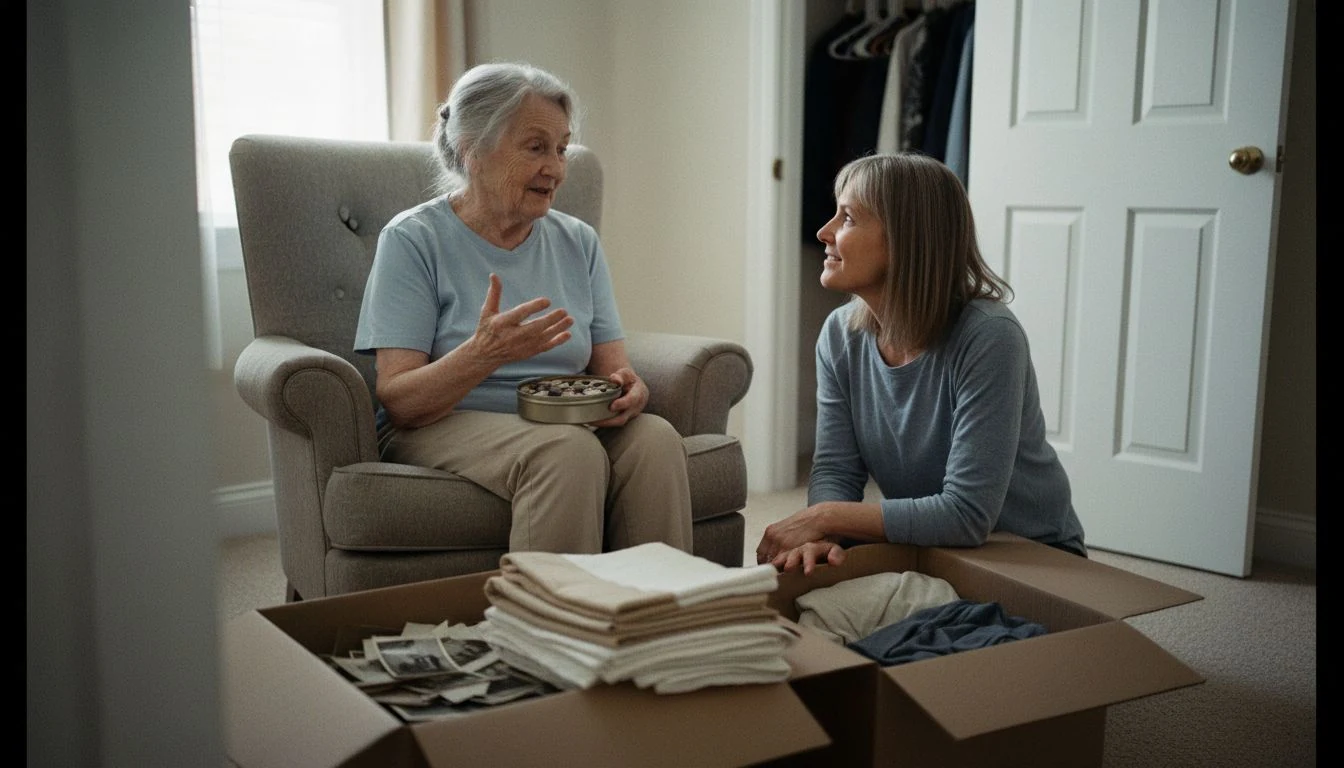
I called my mother’s tin of buttons junk on a Saturday in March, and she didn’t hand me another object for the rest of the day. She made tea. She answered questions. She just stopped participating. Most decluttering tips for seniors are written as if the hard part is the stuff, and after five months of Saturdays at her house I can tell you the hard part is the twenty seconds after you say the wrong thing.
Before you go further, make sure you’re in the right post. If the house you’re clearing is your own, my guide to how to declutter your home and the gentle decluttering method cover the systems and the pacing. This one is the other situation: two people in a room, one of whom owns everything in it, and only one of whom wants the room emptied.
Why most decluttering tips for seniors fail on the first Saturday
I showed up at my mother’s with my own system. Fifteen-minute blocks, one category at a time, keep the momentum. It works beautifully in my apartment. It failed in her spare room inside of an hour, and it took me weeks to understand why.
My stake in my apartment is a calmer room. Her stake in her house is something else entirely. The National Institute on Aging puts it plainly in its guide to aging in place: most people want to stay in their own homes, keep their independence as long as possible, and turn to family for help when they need it. Notice the order. Independence first, help second.
When I walked in with boxes and a plan, she read it as an audit, which is what it was. She defended the room the way anyone defends a room they might not get to keep.
I’ve run every session since off that one idea. She’s deciding something bigger than whether to keep a tin of buttons, and from the doorway that looks like slowness.
The sentence that ends the conversation
It arrives in three costumes at my mother’s house. “Mom, this is junk.” “You haven’t used that in years.” “You already have four of these.”
All three sound like statements about an object. None of them are. Each one is a verdict on her judgment, delivered by her kid, in her house. And once you become the person who grades her decisions, she stops showing you things. That’s self-protection, and it’s reasonable.
I watched it happen in real time with the buttons. Before the word junk, she’d been narrating: this one came off my father’s coat, this one I’ve had since the shop on Bridge Street. After, she was polite and closed.
What works instead is smaller than you’d think. Ask about the object. “Where did this one come from?” does two things at once: you get the information you need to help her decide, and the decision stays with her, where it already lived.
Sometimes the answer is a five-minute story about a coat. Let it run. The object usually goes in the box at the end of the story anyway, and it goes without a fight.
Start with the categories that carry nothing
Every argument I’ve had at my mother’s house was about an object with a person attached to it, so we stopped starting there.
The first three sessions were pantry expiry dates, cables for devices neither of us could identify, catalogs, chipped mugs, and towels that had gone stiff. Three hours across three Saturdays. Two carloads out. Zero arguments, because nobody’s mother is emotionally attached to a HDMI cable for a television she sold in 2019.
What we did not touch, on purpose: photographs, letters, my father’s things, the good china, her sewing supplies, anything in the cedar chest. Those are conversations, and they need a different day and probably a different year.
The order matters for the same reason it matters in your own house, which I’ve written about in what to declutter first. Easy decisions build the muscle. By session four she was the one saying “that can go” before I opened my mouth, and she was right about most of them.
One honest caveat. If a move is already scheduled, this order compresses and you don’t get the luxury of three warm-up sessions. That’s a different job, and decluttering before a move is the version with a deadline attached.
Decluttering tips for seniors that actually moved things
These are the rules I’d hand someone on their first Saturday. Nothing systematic about them. They’re just the things that stopped costing me sessions.
She holds it, she decides. Your job is hands and a back. If she can’t lift it, you lift it and hold it where she can see it, and you wait.
Bring boxes, not bags. This one is stupidly small and it changed the room. Black garbage bags read as trash even when they’re going to the church shop, and my mother started intercepting them at the door. We switched to cardboard boxes with the flaps open and she stopped watching me carry things out. Same objects. She just stopped reading them as trash.
Nothing leaves the same day without her saying so out loud. The pile sits in the hall until Sunday. She gets to pull things back, and twice she did, and both times it was worth the fifteen seconds it cost me.
Work to a clock, not to a room. Forty-five minutes with an actual stopping point beats “we’ll finish the spare room today,” which is how you end up at hour four with two tired people and a decision nobody’s happy about.
And say what today is for, before you start. “Today is just the pantry shelf.” A named ending is the difference between help and an ambush.
The photo, and when it’s condescending
The advice you’ll read everywhere is to photograph an object so the memory survives the object leaving. It does work. It worked twice at my mother’s, and one of those times was the christening gown, which she’d kept for forty years for a grandchild who never wore it. We photographed it on the bed, she wrote what it was on the back of the print, and it went to a charity that does infant burial gowns.
But the photo only works if the object has a story in it. Offering to photograph a stack of margarine tubs is patronizing, and she will hear it as you humoring her. I did that once. The look I got was deserved.
The other rule I’d add: offer it, don’t perform it. “Do you want a picture of it first?” is an option. Standing there taking pictures of everything she hesitates over turns her hesitation into a spectacle.
If the guilt in the room is yours rather than hers, that’s a separate knot and I untangled mine in decluttering guilt.
What to do with the things nobody can decide
There will be a pile that isn’t a keep and isn’t a go. Most decluttering tips for seniors stop at those two words. Leave that third pile in the middle of the floor and call it progress, and the room looks the same in October.
We use a maybe box, with three conditions that keep it from becoming a second attic. It’s labeled and dated. It stays in the house, in a normal place, not the garage. And we open it on a named day, which for us is the first Saturday of the following month.
First box had fourteen things in it. When we opened it in April she kept five, and the other nine she barely looked at. Nine things she didn’t miss for a month is an argument she made to herself, and it held in a way nothing I said held.
Separately, there’s a category that isn’t a maybe at all: the things that are hers alone to decide, on a timeline that isn’t mine. My father’s coats have been in that wardrobe for six years. They are not clutter. They are not on the list. Every time I’ve been tempted to raise them I’ve reminded myself that a room I clear at that cost is not a room either of us wins.
If the conversation has moved from clearing a room to an actual move, I wrote up our plan for how to help a parent downsize, with the 8-week timeline we used for my mother.
Grab the free printable: my one-page Gentle Sort Sheet, with the no-load categories to start on, a cut-out maybe box label with a date line, and the three questions that keep the conversation open when you’re tempted to say “it’s junk.” Get the free sort sheet →
What I said, and what I say now
This is the table I wish someone had handed me in March. The right-hand column is what actually changed in her behavior afterward, not what I was hoping would happen.
| What I used to say | What she heard | What I say now | What changed |
|---|---|---|---|
| “Mom, this is junk.” | Your judgment is bad and I’m here to correct it | “Where did this one come from?” | She went back to handing me things instead of guarding them. Took about two sessions |
| “You haven’t used that in years.” | I’ve been keeping score on you | “Is this one you’d want out where you can reach it?” | Turns it into a question about her daily life, which she answers fast, and she’s right |
| “You have four of these.” | You’re not managing well anymore | “Do you want all four out, or two out and two in the cupboard?” | Two yeses instead of one no. Nothing is being taken, something is being placed |
| “I’ll just run this out to the car.” | Things disappear from my house when she visits | “This pile goes Sunday. Pull anything back before then.” | She pulled two items back in five months, and stopped watching the front door entirely |
| “We can get the whole room done today.” | This is a job with a deadline and I’m the problem | “Let’s do forty-five minutes and see.” | Four short sessions across three weekends cleared more than the marathon day did |
Three mistakes I made in the first month
- I brought garbage bags. Six of them, the heavy black kind, because that’s what I use at home. Everything I put in one became trash in her eyes, including a coat that was going to a shop she likes. She started meeting me at the door. Cardboard boxes with the flaps open fixed it in a single afternoon, and it cost me nothing but a trip to the hardware store.
- I filled her silences. Three seconds of hesitation and I’d jump in with “we can toss it.” At seventy-eight, silence over an object is thinking, not indecision, and I was stepping on the exact process I wanted her to have. Now I count to ten in my head and let it get uncomfortable. She almost always finishes the thought herself.
- I moved things while she was in the kitchen. Only obvious ones, I told myself. Dead batteries, a broken lamp. She noticed the empty spot on the shelf before I’d finished the tea, and asked me directly what else I’d moved. The space I gained was worth maybe two minutes. The trust cost me three weeks.
When to stop, even if the room isn’t done
The tells are physical and they show up before either of you says anything. She starts re-explaining objects she already explained. She starts putting things back on the shelf instead of into a pile. She offers tea. The tea is an exit, and the correct answer is yes.
Stop at fatigue, not at the edge of the room. A half-cleared spare room that you’re both willing to return to next Saturday is worth more than a finished one that ends the project.
No list of decluttering tips for seniors covers the stopping part, and it decides whether there’s a next Saturday. The one place I’d push, gently and once, is the floor of the walkways.
The NIA’s room-by-room guidance on preventing falls at home is direct about it: keep the paths you walk tidy, and don’t leave books, papers, clothes or shoes on the floor or the stairs. That’s a safety argument, and it’s the only one I’ve found that a parent will take from a child without hearing a verdict in it. It also means a partial job is still a real result. Hallway and stair edges clear, spare room half done, come back next month.
Decluttering tips for seniors I’d skip entirely
The before-and-after photo. I took one in April and showed her, expecting her to be pleased. She looked at the “before” for a long moment and said “it looked like a nice room to me.” I hadn’t thought about who the before photo is for. It’s for me.
Bringing reinforcements. My sister and I both went one Saturday, thinking two of us would halve the time. Two adult children in a room turns a sort into a family meeting, and my mother spent the day outnumbered. We don’t do that anymore. One person, and the other one calls on Sunday.
The one-year rule. If you haven’t used it in a year, out. It’s a fine rule for a thirty-two-year-old with a full closet and a decent income. It’s a bad rule for someone who lived through a period where you kept the jar, and who can tell you the year she bought the coat and what it cost. Applying it to her is applying my scarcity to her history.
And any version of doing it while she’s out. I understand the temptation. Every story I’ve heard that starts that way ends with a relationship that took longer to repair than the room took to clear.
Frequently asked questions
How do you help an elderly parent declutter without a fight?
Give the decisions back. Your job is lifting, holding things where they can see them, and asking where something came from, not deciding what stays. Start on categories with nobody attached to them, work to a clock rather than to a room, and let nothing leave the house the same day unless they say so out loud. Most of the fights I caused came from one of three sentences: it’s junk, you never use that, you already have four. Ask a question instead of delivering a verdict and about half the friction disappears in the first two sessions.
What should seniors declutter first?
Most decluttering tips for seniors hand you a room order. Start instead with anything that has no person attached to it. Expired food, duplicate kitchen tools, cables for devices that are gone, catalogs and junk mail, stiff towels, chipped mugs. Save photographs, letters, a late spouse’s belongings and anything in the cedar chest for much later, or for never if that’s the answer. The volume was never the point. A few painless yeses are what make the harder ones possible later.
What if a parent refuses to get rid of anything?
Then stop, and narrow the ask to safety. The best decluttering tips for seniors are useless against a flat no, but almost nobody refuses to clear the floor of a hallway or the edge of a staircase, because that request isn’t about their belongings, it’s about them not falling. Clear the walkways, leave the rest, and come back in a month. If the refusal is total and the house is becoming unsafe, that’s past a decluttering question and worth raising with their doctor rather than pushing harder on a Saturday.
If you’re going over this weekend, pick one shelf and one clock setting. Forty-five minutes, the pantry, boxes not bags, and no opinions about anything with a person in it. You’ll get less done than you planned and you’ll be invited back, which after five months I’ve decided is the actual measure of a good session.
Get my free Home Reset Planner
The calm, room-by-room planner I use to reset my whole home without the overwhelm. Join the newsletter and I’ll send it straight to your inbox.
No spam, ever. Unsubscribe anytime. — Lena
Keep reading — more on Declutter Challenges
How to Declutter Sentimental Items (When Everything Feels Important)
How to Help a Parent Downsize (Without the Fights)
Where the Clothes Actually Go After You Clean Out Your Closet