
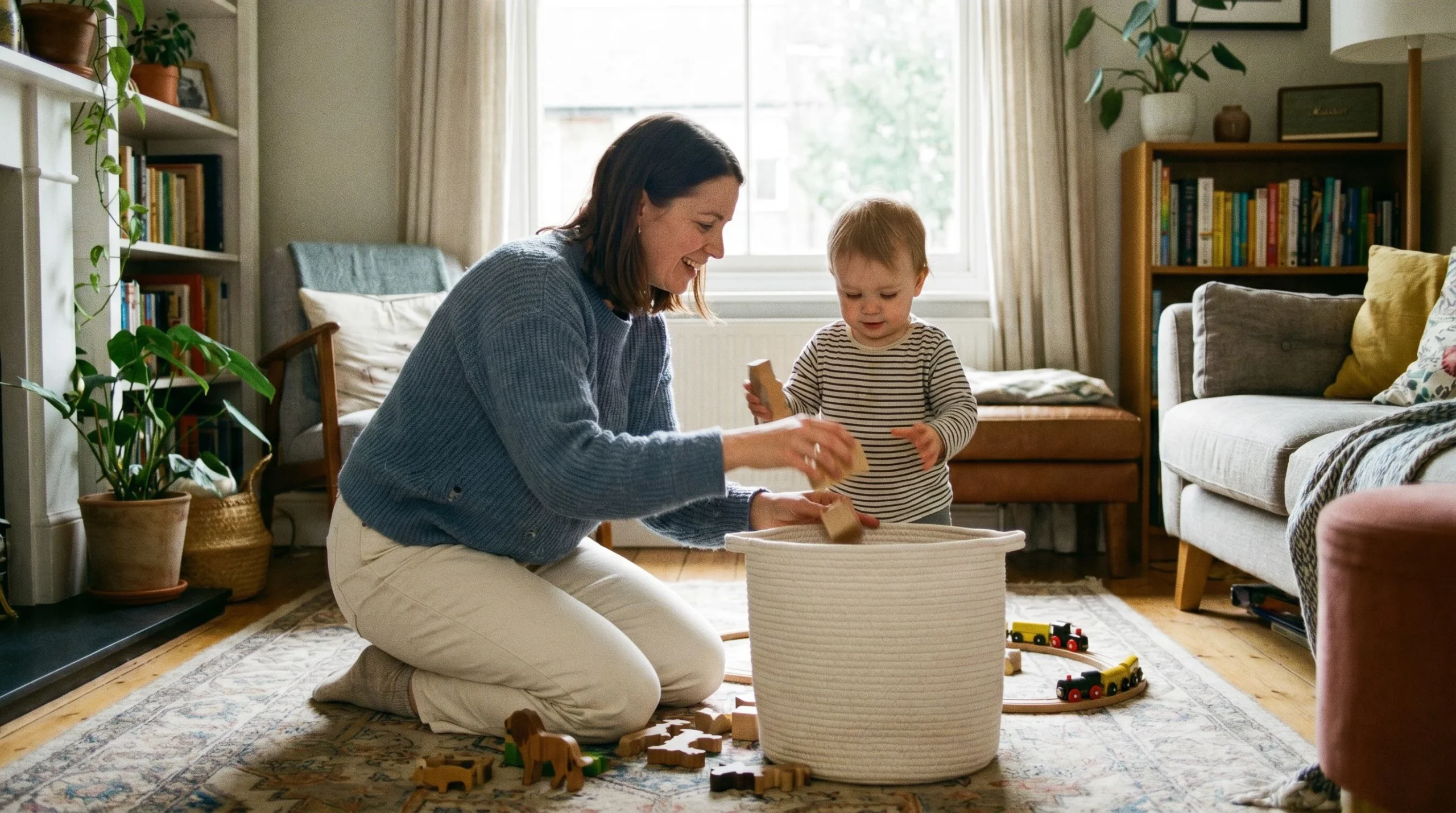
I once spent a full Saturday deep-organizing my kids’ playroom. Labeled bins, sorted by category, the whole color-coded fantasy. It stayed that way for roughly four hours. By bedtime it looked like a toy store had been robbed. I cried a little, not gonna lie. That was the day I stopped trying to keep a magazine house and figured out how to keep a tidy home with kids that actually holds up to real children doing real kid things.
So let’s get the lie out of the way first. You cannot keep a perfectly tidy home with young kids in it. Anyone selling you that on Instagram has either staged the photo or hidden the chaos just outside the frame. What you can have is a home that resets quickly, where mess is temporary instead of permanent, and where you’re not the only person holding it together. That’s the realistic system. Functional beats Instagram-perfect, especially here.
The mindset shift that fixed everything for me
For years I treated tidying as a state I was supposed to reach and then maintain. Clean house = success, messy house = I’m failing. With kids, that framing is a trap, because the house will be messy again in twenty minutes and you’ll feel like a failure on a loop.
The shift was this: stop chasing “clean” and start chasing “resettable.” A resettable home gets messy during the day, which is normal and fine, and then returns to a calm baseline quickly because the systems make resetting easy. I’m not aiming for a spotless living room at 3pm. I’m aiming for a living room that can go from disaster to calm in ten minutes, by a tired adult, without a deep clean. That goal is achievable. The first goal never was.
Once I stopped feeling guilty about daytime mess, I had way more energy for the systems that actually move the needle. Guilt is exhausting and it tidies nothing.
Fewer toys is the cheat code nobody wants to hear
I’ll be blunt because it’s the single highest-impact thing. The amount of mess in your house is directly tied to the amount of stuff your kids own. We had way too much. The toys had spilled out of every container because there was simply more volume than space.
I did two things. First, a real cull, donating the broken stuff, the duplicates, and the toys nobody had touched in months. A lot of it was in great shape, so it went to families who’d use it rather than the trash. (If you want the case for donating over tossing, the EPA on reducing and reusing lays it out, and it genuinely made me feel better about letting go.) Second, I started a toy rotation: half the toys live in a bin in the closet, and every few weeks I swap them. Less out at once means less to clean up, and bonus, the rotated-in toys feel new again, so the kids actually play longer.
The day I cut the toy volume roughly in half was the day cleanup stopped being a nightly battle. Fewer toys, less mess. It’s almost insultingly simple and it’s the truest thing in this post.
How to keep a tidy home with kids: the actual daily system
Here’s the rhythm we run. It’s three small resets a day, not one big clean. None of them take long, and that’s the entire point. A tired parent at 8pm cannot do an hour of cleaning, but a tired parent can do ten minutes.
| Reset | When | What happens | Time |
|---|---|---|---|
| Morning reset | After breakfast | Beds up, breakfast dishes cleared, one quick counter wipe | 10 min |
| Pre-dinner reset | Before the evening meal | Kids put toys in bins, clear the table zone together | 10 min |
| Bedtime tidy lap | After kids are down | One adult loop: surfaces clear, things back home | 10 min |
Thirty minutes total, broken into pieces small enough to actually happen. The magic is in the pre-dinner reset, because that’s where the kids do the work, not you. More on that next.
The 10-minute family pickup
Before dinner, everyone tidies for ten minutes. I set a timer and we go. With little ones I make it a game, “can you beat the timer,” “let’s race the blocks into the bin”, and with older kids it’s just the expectation. The timer matters more than I expected. It turns an open-ended “clean up” into a contained sprint with a clear finish line, which is way less daunting for everyone, me included.
A “home” for everything kids touch
Kids can only put things away if they know where things go, and the where has to be kid-height and kid-easy. Open bins beat lidded containers because lids are a barrier a four-year-old won’t bother with. Low hooks beat hangers. A picture label on the bin beats a written one for pre-readers. The whole game is reducing the friction between “done playing” and “put away” until it’s basically zero.
Make them part of it (yes, even the toddlers)
This was my hardest lesson because it’s faster to just do it myself. But if I do all the tidying, two things happen: I burn out, and my kids never learn that the person who makes a mess helps clean it. So even the toddler carries his cup to the sink. It’s slower now. It’s an investment in not being the family maid in five years.
What I tried that completely flopped
I want to be honest about the failures, because the internet only shows the wins.
The elaborate chore chart with stickers and rewards. Looked adorable on Pinterest. In practice I couldn’t keep up with administering it, the stickers became their own clutter, and the whole thing collapsed in two weeks. Simpler won. Now it’s just “this is what we do before dinner,” no chart, no reward economy.
Buying more storage to fix the mess. I genuinely thought the problem was not enough bins. It was too much stuff. Every container I bought just gave the clutter somewhere new to live. Decluttering fixed what no amount of storage could. If you’re tempted to buy organizers, cull first and you’ll need half as many.
Cleaning up after they went to bed, every night, alone. I did this for a year and quietly resented everyone. The family pickup fixed it. Spreading the work was the actual solution, not doing the work faster.
Keeping the calm beyond the daily reset
The daily rhythm handles the surface chaos. Two things keep the deeper clutter from creeping back. One, a small ongoing declutter habit so stuff doesn’t accumulate faster than it leaves, my small-kitchen organizing guide uses the same low-friction, renter-friendly thinking if your kitchen is the room that’s drowning. Two, a bigger seasonal reset a couple times a year to swap sizes and clear outgrown stuff. The new year home reset routine is the one I run every January to clear the holiday-toy avalanche before it becomes permanent.
Get the free Kids’ Tidy System printable
I turned this three-reset rhythm into a one-page printable, including the 10-minute family pickup and picture-label ideas for the bins. Stick it on the fridge so the whole family knows the routine, not just you.
Age-by-age tidy jobs kids can actually handle
Keeping a tidy home with kids works best when the jobs match what they can really do. Hand a toddler the right task and it sticks; hand them the wrong one and you both end up frustrated.
| Age | Tidy jobs they can own | How to keep it easy |
|---|---|---|
| 2-3 | Drop toys in a bin, put books on a shelf | Open bins, no lids, low shelves |
| 4-5 | Make the bed roughly, carry laundry to the basket | Picture labels on bins |
| 6-8 | Clear their plate, tidy their own room | A short, visible checklist |
| 9-12 | Wipe counters, sort laundry, vacuum a room | Same job, same day each week |
Where parents tend to trip up
- Redoing their work in front of them. Fixing the wonky bed teaches them not to bother. Let good enough stand.
- Too many steps at once. Clean your room overwhelms; put the blocks in the bin gets done.
- Storage that is too high or too fussy. If a kid cannot reach it or has to wrestle a lid, the toys end up on the floor.
FAQ
How do I keep my house tidy with a toddler who undoes everything?
Lower your bar and shrink your toy volume. With a toddler, aim for resettable, not clean, and accept that the house will be messy while they’re awake. Fewer toys out at once (try a rotation) means less to undo and less to redo. Then do one short reset after they’re down, not all day long.
At what age can kids actually help clean up?
Earlier than you’d think. Around 18 months to 2 years they can put toys in an open bin and carry a cup to the sink if you make it a game and keep the storage stupidly simple. They’ll be slow and imperfect for years. That’s fine, you’re building the habit, not getting free labor.
Is it even possible to have a tidy home with kids, or am I dreaming?
A perfectly tidy home, no, not while they’re little, and anyone claiming otherwise is hiding the mess off-camera. A home that resets quickly to calm, absolutely yes. Aim for that and you’ll feel like you’re winning instead of constantly failing. The goal was never spotless. It was calm-able.
My kids’ playroom still gets destroyed daily. The difference is now it resets in ten minutes with everyone pitching in, instead of swallowing my whole Saturday and my will to live. I stopped chasing the magazine house and started building a system that bends with real kid life. Pick one reset from the table, start there tomorrow, and let the rest of the house be a little messy for now. Tidy enough is genuinely enough.
Frequently Asked Questions
How do you keep a tidy home with kids?
Keeping a tidy home with kids means lowering the bar and building tiny systems. I do a five minute family pickup before bed where everyone grabs a few things, and I keep open bins kids can actually reach. The house is never spotless, and that is okay. Aim for functional and calm, not magazine ready. Tidy enough to relax in is the real goal with little ones around.
How do I get my kids to help clean up?
Make it small, visual, and routine rather than a lecture. I use open baskets so toys have an obvious home, play one cleanup song, and we race the clock together. Praise the effort, not perfection. Young kids genuinely want to help when it feels like play. My daughter sorts faster than I do some nights. Consistency and low pressure turn cleanup into a habit instead of a fight.
How do I manage toy clutter?
Fewer toys out actually means more play and less mess. I rotate them, keeping a portion in a closet and swapping every few weeks so they feel fresh. We declutter together a few times a year and donate what is outgrown. Open bins by category make tidying obvious. You do not need to control every toy, just keep the volume gentle so the floor is not a daily battlefield.
Is it even possible to keep a clean house with toddlers?
Clean in the perfect sense, not really, and chasing that will only exhaust you. Calm and reset-able, absolutely. I accept the mess during the day and do one tidy after bedtime so I wake to a fresh start. Some days even that does not happen. A home with toddlers is lived in by design. Give yourself the grace to let it be messy while they are small.
How often should I clean with young kids at home?
Little and often beats big and rare. I do a quick daily reset of high traffic zones, the kitchen and living room, and save deeper cleaning for one short weekly slot. Surfaces and floors near small kids need more frequent wiping for spills and sticky hands. Do not aim for a full clean every day. A nightly ten minute tidy keeps things sane far better than one exhausting marathon.
Get my free Home Reset Planner
The calm, room-by-room planner I use to reset my whole home without the overwhelm. Join the newsletter and I’ll send it straight to your inbox.
No spam, ever. Unsubscribe anytime. — Lena
Keep reading — more on The Calm Home

Minimalist Interior Design on a Budget (Without Making Your Home Feel Empty)

Simple Minimalist Home Tips for a Calmer, Clutter-Free Space