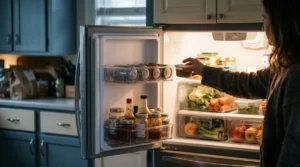

My first apartment kitchen had exactly four cabinets, no pantry, and a single drawer that stuck every time you opened it. I cried in it once, standing there holding a stockpot with nowhere to put it. If you’re trying to figure out how to organize a small kitchen without knocking down walls or buying a whole new set of furniture, I have been exactly where you are, and I have good news: the fixes that actually worked for me were cheap, renter-safe, and mostly involved using the space I already had better instead of buying more stuff.
I’m a renter, so everything below leaves zero holes in the walls and comes with me when I move. And it’s budget-first, because back then my “organizing budget” was whatever was left after groceries, which was usually about twelve dollars. You don’t need a magazine kitchen. You need every inch of yours working for you. Here’s exactly how I did it.
Start here: declutter before you organize a small kitchen
I know, I know, you came for storage hacks and I’m telling you to clean out a drawer first. But this is the step that makes everything else possible, and it’s free. You cannot organize your way around too much stuff in too little space. The single biggest “space gain” in my tiny kitchen came from getting rid of what I didn’t use, not from buying organizers.
Pull everything out of one cabinet at a time and be honest. The bread machine you used once. The fourteen mismatched travel mugs. The three half-used bottles of the same spice. When two-thirds of your cabinet is stuff you touch twice a year, no amount of clever storage will help. Clear it out and suddenly your real, everyday items have room to breathe.
For the things that are still good but you just don’t use, donating beats trashing. The EPA on reducing and reusing has a simple rundown on why passing usable items along (instead of landfilling them) is the better move, and it made me feel a lot less guilty about the bread machine finding a new home. Box up the duplicates and the never-used, drop them at a donation center, and you’ve just freed real estate for free.
My one-question declutter test
For every item I asked: “Have I used this in the last three months, and would I buy it again today?” If the answer was no to both, it left. That question alone cleared an entire cabinet in my old place. If you want the full overwhelmed-to-calm version of this, my approach to keeping a tidy home when you have kids uses the same gentle, no-shame logic for the whole house.
Go vertical: the small-kitchen rule that changed everything
Small kitchens are almost always short on counter and floor space but have totally wasted vertical space. The walls, the insides of cabinet doors, the gap above the cabinets, the empty air between a shelf and the shelf above it. That’s your unused square footage, and claiming it is where the magic happens.
Renter-safe vertical wins under $20
- Tension rods under the sink to hang spray bottles, or across a cabinet to file cutting boards and baking sheets upright. A few dollars, no tools.
- Adhesive hooks on the inside of cabinet doors for measuring cups, oven mitts, and pot lids. Peel them off clean when you move.
- Stick-on or tension-rod shelves to add a second tier inside a tall cabinet, doubling the storage in the dead air above your plates.
- A magnetic strip for knives or spice tins frees up a whole drawer and counter spot.
- An over-the-cabinet-door bin for foil, wrap, and trash bags, no installation needed.
The inside of your cabinet doors alone is probably a square foot of unused space per door. In a four-cabinet kitchen that’s serious storage you already paid for and never used.
How to organize a small kitchen with cheap organizers (and skip the pretty ones)
Here’s where small-kitchen advice usually goes wrong: it tells you to buy matching acrylic everything and a label maker. Beautiful, and also $200 you don’t need to spend. The organizers that actually earned their keep in my budget kitchen were the boring functional ones.
| Organizer | What it fixes | Rough cost |
|---|---|---|
| Drawer dividers (or cut-down boxes) | The chaos drawer where everything tangles | $0–10 |
| A simple shelf riser / cabinet shelf | Wasted vertical air above plates & mugs | $8–15 |
| Lazy Susan turntable | Spices & oils lost at the back of a cabinet | $6–12 |
| Stackable clear bins | Loose pantry packets & snacks | $3–8 each |
| Tension rod (vertical divider) | Baking sheets & boards stacked & stuck | $3–6 |
| Mug hooks under a shelf | Mugs eating an entire shelf | $5 |
Total to outfit a whole tiny kitchen from this list: well under $50, and you can do it one paycheck at a time. I started with just the turntable for spices and a single shelf riser, and even those two changed how the kitchen functioned.
The dollar-store and free option
Before you buy anything, raid your recycling. Sturdy boxes cut down to drawer height make perfect free dividers. Glass jars from pasta sauce, washed and labeled, store dry goods better than half the products sold for it. I ran my first organized kitchen almost entirely on cut-up boxes and saved jars. It didn’t match. It worked beautifully.
Set up zones so the kitchen runs itself
Organizing isn’t just about where things fit, it’s about where things make sense. In a small kitchen, putting items where you actually use them saves you steps and keeps the space from sliding back into chaos.
I group mine into rough zones: the prep zone (knives, cutting boards, mixing bowls) near my main counter space; the cooking zone (pots, pans, oils, cooking utensils) by the stove; the daily zone (everyday plates, mugs, glasses) at the easiest-to-reach height; and the rarely-used zone (the big roasting pan, the holiday platter) up high or in the back, since they barely come out.
The whole idea: the stuff you use every single day lives in the prime, easy-reach spots, and the once-a-year stuff gets exiled to the awkward corners. Most cramped kitchens have this backwards, with the everyday glasses fighting the never-used appliances for the good shelf.
Keep the counters as clear as you can
In a small kitchen, counter space is the kitchen. Every appliance sitting out is workspace you don’t have. Be ruthless: keep out only what you use daily (mine is the coffee maker, full stop), and store the rest. A clear counter makes a tiny kitchen feel twice as big and actually usable. This is also the one surface I wipe down every single night, because a clean clear counter resets the whole room.
🪺 Free Printable: The Small Kitchen Organizing Plan
Want a one-page plan that walks you cabinet by cabinet through decluttering, going vertical, and setting up zones, plus a budget shopping list of the cheap organizers that actually work? Grab the free Small Kitchen Organizing Plan printable and knock it out one cabinet at a time this weekend.
→ Download the free small kitchen organizing plan
Keep it organized (the part nobody talks about)
Organizing a small kitchen once is the easy part. Keeping it that way through real life is where it falls apart, and I’m not going to pretend mine stays perfect. It doesn’t. What keeps it functional is a tiny maintenance habit, not willpower.
Mine is a two-minute reset every night: everything back to its zone, counters wiped, sink emptied. Two minutes. Because each thing already has a home, putting it back is fast, and the kitchen never gets the chance to spiral into the cried-in-it state again. If you’re heading into a season of bigger changes, a full once-a-quarter refresh helps too. My fall home reset checklist walks through that room-by-room when you want to reset the whole place, kitchen included.
For the bigger picture, see the real statistics on home organization and clutter (UCLA, Princeton, and the BLS).
Zone-by-zone storage for a small kitchen
In a small kitchen, what goes where matters more than how much storage you have. Grouping things by the job they do cuts the steps you take and the clutter on the counter.
| Zone | What lives here | Small-kitchen tip |
|---|---|---|
| Prep zone (near the counter) | Knives, cutting boards, mixing bowls | A wall rail frees up drawer space |
| Cooking zone (by the stove) | Pots, pans, oils, spatulas, salt | Hang pans; keep daily oils within reach |
| Cleanup zone (around the sink) | Dish soap, sponges, trash, towels | Use the under-sink door for sprays |
| Daily-dishes zone | Plates, mugs, glasses, cutlery | Closest cabinet to the dishwasher |
| Pantry zone | Dry goods, snacks, canned food | Clear jars so you see what is low |
Small-kitchen habits that backfire
- Buying organizers before decluttering. You will size bins for stuff you do not need. Clear out first, then measure.
- Storing daily items up high or down low. Keep the everyday things between shoulder and knee; save the corners for rare stuff.
- Letting the counter become storage. Every appliance left out shrinks your prep space; only keep what you use daily.
FAQ
How do I organize a small kitchen with almost no cabinet space?
Go vertical and go off-cabinet. Use the walls (magnetic knife strip, hanging rail or hooks for utensils and mugs), the insides of cabinet doors (adhesive hooks, over-the-door bins), and the dead air inside cabinets (shelf risers to add a second tier). Then declutter hard so only what you use daily takes up the limited cabinet space you do have. The space is usually there, just up high or on surfaces you weren’t using yet.
What’s the cheapest way to organize a small kitchen?
Start with what’s free: declutter and donate what you don’t use, then repurpose cut-down boxes as drawer dividers and washed glass jars for dry goods. After that, the highest-value cheap buys are a turntable for the spice cabinet, a shelf riser to double your vertical space, and a tension rod to file baking sheets upright. You can organize an entire tiny kitchen for under $50, and even less if you raid the recycling first.
How do I keep a small kitchen organized once it’s done?
Give every item a clear home (use your zones), keep counters as clear as possible, and do a two-minute reset each night, putting things back, wiping counters, emptying the sink. Because everything already has a spot, the nightly reset is genuinely quick, and it stops the slow slide back into clutter. The system maintains itself far more than you’d think once the homes are set.
That four-cabinet apartment taught me more about organizing than any big kitchen ever could, because it forced me to use every inch on purpose. You don’t need more space. You need the space you have to work harder, and most of the fixes cost less than lunch. Pick one cabinet this weekend, clear it out, claim the vertical air, and watch how much room you actually had the whole time. Your future self, not crying while holding a stockpot, will thank you.
Get my free Home Reset Planner
The calm, room-by-room planner I use to reset my whole home without the overwhelm. Join the newsletter and I’ll send it straight to your inbox.
No spam, ever. Unsubscribe anytime. — Lena
Keep reading — more on Kitchen & Pantry

Airtight Containers for Pantry: What’s Worth Decanting
How to Organize Deep Kitchen Drawers (So the Bottom Isn’t a Mystery)
Pantry Organization Ideas for Real Kitchens (No Perfect Aesthetic Needed)