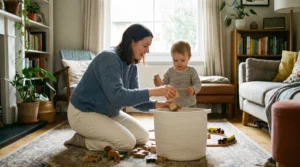

For about a year I collected minimalist home tips the way I used to collect throw pillows. I had a Pinterest board called “calm” with 340 pins on it. Empty white rooms, single stems in glass vases, a wooden bowl holding exactly three lemons. I looked at those pictures at night and felt worse, not calmer, because my actual living room had a laundry basket that had been “in transit” since March.
So this is the honest version. Not a bare gallery you’ll never live in, just the handful of small changes that made my small home feel lighter and reset in minutes instead of a whole Saturday. I still own plenty of stuff. I just stopped letting it own the surfaces.
Jump to:
Why most minimalist home tips make you feel worse
Here’s my mild enemy for the day: the aesthetic. Most minimalist home tips online are really interior photography tips. They show you a finished, styled, professionally lit result and quietly imply that if your home doesn’t look like that, you’ve failed at being calm. It’s a shopping mood dressed up as a lifestyle.
Real minimalism at home isn’t about how few things are visible in a photo. It’s about how little friction there is between you and living. Can you find your keys in one motion? Can you clear the kitchen counter in two minutes? Does opening a drawer make you sigh? Those are the questions that matter, and none of them require a white couch.
We spend an enormous share of our lives indoors, in the rooms we’ve built around ourselves, so the state of those rooms is not a small thing. The U.S. Environmental Protection Agency notes that people spend roughly 90% of their time indoors. If that’s true, a home that fights you all day is a slow, steady tax. I’d rather pay it down.
Start with surfaces, not closets
Everyone tells you to start decluttering with a closet or the garage. I did that for years and it never showed. You spend a whole weekend in a closet nobody sees and walk back into the same visually loud living room. Discouraging.
Flip it. Start with the flat surfaces at eye level: the kitchen counter, the coffee table, the entryway table, the top of the dresser. These are the things your brain reads as “the state of the house” every time you walk in. Clear one of them completely, wipe it, and put back only what genuinely lives there. My kitchen counter now holds a kettle, a soap pump, and a small board. That’s it. Everything else found a drawer.
The change was instant and it was free. That’s the whole point. A cleared surface gives you a fast, honest win, and the win is what keeps you going into the boring closet later. If you want the deeper version of this, my room-by-room decluttering guide walks the same order through the whole house.
The minimalist home tips that actually stuck for me
A lot of what I tried was fun for a weekend and gone by Wednesday. A few things stuck for over a year now, and they all share one trait: they lower the effort of daily life instead of raising the standard of it.
Give everything a home, or it’s homeless in your house. The pile on the stairs isn’t a discipline problem. It’s a housing problem. Nothing on that pile has an address. Once the phone chargers had a single labeled tray and the mail had one basket, the piles mostly stopped forming, because the stuff had somewhere obvious to go.
Own fewer of the things you own too many of. I didn’t need eleven mugs and four of us don’t drink coffee. I kept six, donated the rest, and the cabinet went from a tetris game to a shelf you can grab from without looking. Do this with the category you fight most. For me it was mugs and reusable bags. For my sister it’s water bottles.
Buy the container last, if at all. The old me bought bins to organize clutter, which just gave the clutter a nicer home and a reason to stay. Now I purge first and see what’s actually left. Half the time the “storage problem” was a “too much stuff” problem wearing a costume. When I do buy, I lean on baskets I already own, which I got into after writing about organizing without plastic bins.
One in, one out, but make it real
The one-in-one-out rule gets repeated on every minimalism list, and I used to nod at it and change nothing. It only worked once I made it physical and slightly annoying, which is the point.
Now when something new comes in, the thing it replaces goes straight into a donation bag that lives in the hall closet, not “somewhere to deal with later.” New sweater in, old sweater in the bag today. When the bag is full it goes in the car, and when I’m already driving past the donation center it goes in. No sorting ritual, no guilt pile in the garage growing for two years. The friction is on purpose. If getting rid of something is easier than storing it, you’ll actually do it.
I’ll be honest that this took me a while to stop treating as a scoreboard. Minimalism can quietly become another thing to be perfect at, and that’s just clutter in your head. The goal was never the lowest number of possessions. I only wanted a home that stopped nagging me.
Keep the calm with a 15-minute reset
Decluttering is the one-time push. The reset is what keeps a minimalist home from sliding back, and it’s the part the pretty photos never show because it isn’t photogenic. It’s just fifteen minutes.
Every evening I set a timer and do a lap. Surfaces cleared, the “in transit” laundry basket carried to its room for once, three or four things returned to their homes, dishes started. That’s it. A home with less stuff resets faster, and honestly that recovery time is the reward I didn’t see coming. The look was never really the point. A cluttered kitchen takes forty minutes to reset. Mine takes about eight now, and I timed it because I didn’t believe it either.
There’s a decent body of thinking from psychologists on how a chaotic environment feeds a chaotic head. The American Psychological Association’s material on everyday stress is a reasonable place to start if you want the why behind the calmer-home feeling. I mostly just noticed I stopped bracing when I walked in the door.
Minimalist home tips, room by room
If you want one place to start per room instead of a whole overhaul, this is the cheat sheet I’d hand a friend. Each room has one clutter magnet that does most of the damage, and one small fix that buys back the most calm.
| Room | The clutter magnet | My 10-minute fix | Reset time after |
|---|---|---|---|
| Kitchen | Counter appliances used once a month | Move all but daily-use items into a cabinet | ~8 min |
| Entryway | Shoes, mail, and “set it here” objects | One basket for mail, one tray for keys | ~3 min |
| Living room | Surfaces: coffee table and side tables | Clear tables to one object each | ~5 min |
| Bedroom | The chair that becomes a clothes mountain | Two hooks: worn-again vs. laundry | ~4 min |
| Bathroom | Half-empty bottles in the shower | Keep what you use weekly, toss the rest | ~3 min |
Three minimalist mistakes to avoid
- Decluttering to a photo instead of to your life. If you purge things you actually use because they don’t fit an aesthetic, you’ll just re-buy them in a month. Keep the ugly, useful stuff. Minimalism serves you, not the grid.
- Doing a giant purge with no maintenance plan. I did the big one-weekend clear-out twice and both times it crept back within months, because I never built the daily reset. The reset matters more than the purge.
- Turning “less” into a competition. Counting your possessions or racing to a magic number just moves the clutter into your head. You’re after a calm home, not a high score.
Grab the free printable: my one-page Room-by-Room Calm Starter, the same one-magnet-one-fix walkthrough from the table above, with a spot to note what you cleared and how long your reset took. Get the free starter →
What didn’t work for me
Plenty of the popular minimalist home tips went nowhere for me. The “touch everything you own and ask if it sparks joy” full-house method was one. It’s a beautiful idea and I lasted about a day and a half before I was sitting on the floor surrounded by every sock I owned, overwhelmed and slightly resentful. The all-at-once approach assumes you have a free weekend and a calm baseline. I had neither.
Capsule-everything was another. I tried to minimalize my whole kitchen to a tiny curated set and then spent two weeks annoyed that I’d donated the second baking sheet I needed at Thanksgiving. Minimalism that ignores how you really live isn’t calm, it’s just a different kind of inconvenient.
What worked was small, surface-first, and forgiving. One counter, one drawer, one fifteen-minute lap. If you’re starting from genuinely overwhelmed, my gentle decluttering method is the slower on-ramp, and declutter to clean less makes the case for why owning less is really about future-you doing less work.
Frequently asked questions
What are the easiest minimalist home tips to start with today?
Clear one flat surface completely, wipe it, and put back only what truly lives there. The kitchen counter or the entryway table gives you the fastest visible win, it costs nothing, and that quick win is what carries you into the harder spots later. Skip the closet on day one, since nobody sees it and the payoff feels invisible.
Do I have to get rid of most of my stuff to have a minimalist home?
No. Minimalism at home is about friction, not a possession count. I still own plenty. The goal is clear surfaces, a home for every object, and a fast daily reset, not empty rooms. If a thing is useful and has an address in your house, it can stay, even if it wouldn’t make a magazine.
How do I keep a minimalist home from filling back up?
Two habits: a real one-in-one-out rule with a donation bag that lives by the door, and a 15-minute evening reset. The purge is the one-time push; the reset is what actually keeps it calm. Without maintenance, any clear-out creeps back within a few months, which is the mistake I made twice before it stuck.
Get my free Home Reset Planner
The calm, room-by-room planner I use to reset my whole home without the overwhelm. Join the newsletter and I’ll send it straight to your inbox.
No spam, ever. Unsubscribe anytime. — Lena
Keep reading — more on The Calm Home

Minimalist Interior Design on a Budget (Without Making Your Home Feel Empty)

Time Management Tips for Busy Moms (Calm, Not Hustle)