The first person who saw my living room after the big declutter asked, kindly, whether I was in the middle of moving out. It was February. Five weeks of work had gotten that room down to a sofa, a coffee table, one lamp, and a bare wall, and I was so pleased with the empty that I had stopped looking at the room. She was right, though. My attempt at minimalist interior design had produced a place that felt like a waiting room, somewhere you sit until a receptionist calls your name.
Everything below is the second half of that job. If your rooms are still in the taking-away stage, my minimalist home tips cover the habits that keep a room clear, and how to declutter your home goes room by room. What I put back into that living room took six weeks and $363, and the order I did it in was wrong twice.
Why minimalist interior design on a budget goes cold
Removing things is free, which is where the budget version of this style usually stops. You clear the surfaces, the room gets quiet, and for about two weeks it feels like an achievement. Then the quiet turns into an echo and you cannot work out what is missing, because on paper nothing is.
What was missing in my room was anything soft, anything with a grain, and anything that broke up the wall. A furnished room hides its own hard surfaces behind stuff. Take the stuff away and you are left looking at flat paint, a bare floor, and one large piece of upholstery. Sound bounces. Light bounces. The room reads as unfinished rather than calm, and the fix is not more objects, which is what I assumed for an embarrassing month.
The rooms that get this right in photographs have three or four things in them and every one of those things is carrying color, texture, or light. Which is the hard part on a budget, because the few pieces you own have to be well chosen rather than cheap and forgettable. It also means the whole thing can be done for a few hundred dollars, and that part surprised me.
Paint first, and stop buying white because it is called white
My walls were the flat builder white the apartment came with. Under a ceiling fixture with a cool bulb in it, that white went slightly grey-blue by four in the afternoon and completely lifeless after dark. I had blamed the emptiness for how the room felt. Half of it was the paint.
White is not one color, and the difference between two of them at the store is invisible until it is on your wall. I bought three sample pots for about $8 each and painted squares the size of a dinner plate on two different walls, then looked at them at 9am, at 3pm, and at 9pm with the lamps on. The one I had been sure about in the shop turned faintly grey at night. The one I nearly skipped, a white with a yellow-beige undertone, held its warmth after dark, and that is the one that went up.
If you are painting yourself, the low-VOC and zero-VOC lines cost a few dollars more per gallon and the room is usable much sooner, which matters when the room you are painting is the one you live in. The EPA’s overview of volatile organic compounds and indoor air quality is worth two minutes before you buy, especially in a small apartment where airing the place out means opening one window.
One gallon covered my walls with enough left for touch-ups. With the samples, paint came to $64, and it changed the room more than any object I bought afterwards.
Texture is what replaces the things you took out
This was the idea that finally made the room work, and it took me until April to find it. An emptied room does not need more objects. It needs the few surfaces that are left to feel different from each other.
My living room in February was: smooth painted wall, smooth painted ceiling, smooth laminate floor, smooth cotton sofa, glass-topped coffee table. Five surfaces, all of them flat and slightly shiny, which is why the room felt like a lobby. Now the same room has a jute rug you can feel through socks, linen curtains that move when the heating comes on, a wool throw over one arm of the sofa, and a small oak table with visible grain. Same number of items, roughly. Completely different room.
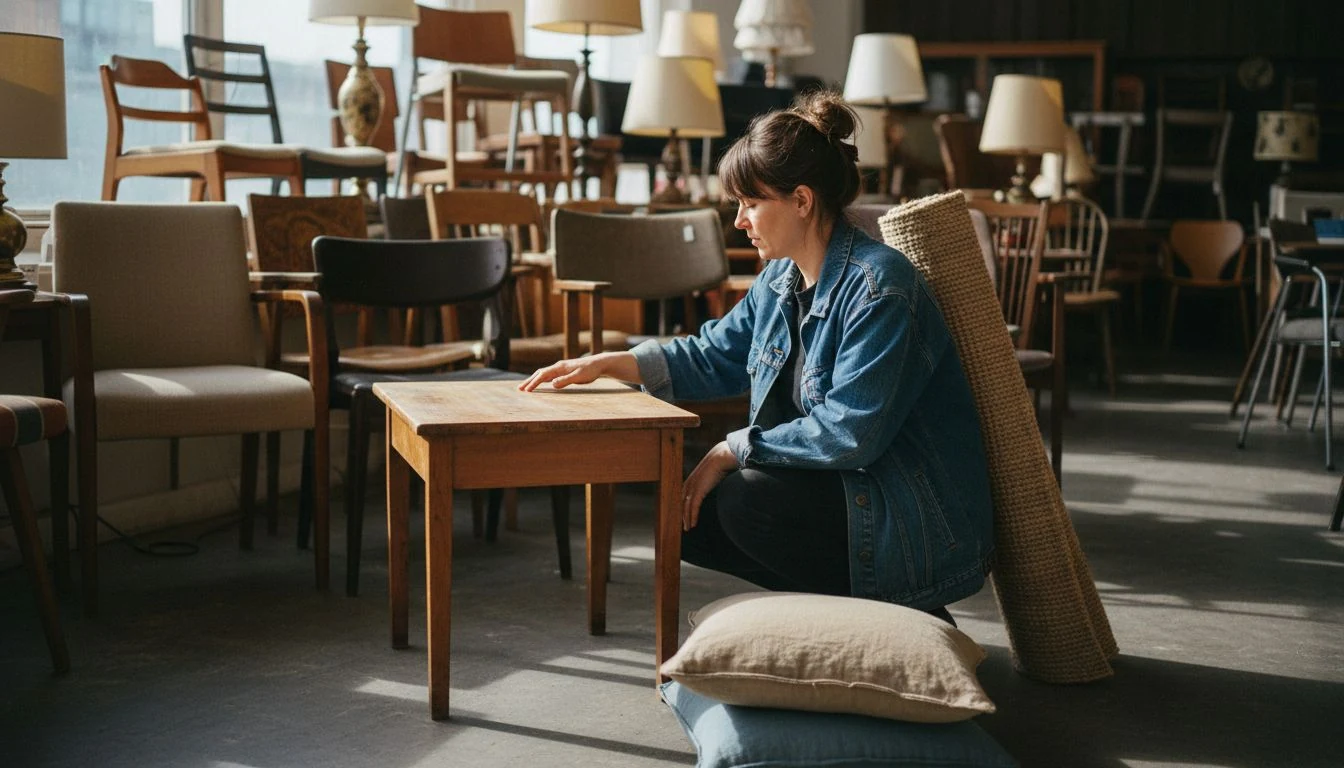
Texture is cheap to buy used, because it does not date the way a shape or a finish does and the price tags rarely reflect it. Wool, linen, jute, unfinished wood, matte ceramic. All of them cost less secondhand than new and improve with wear, which is the reverse of the glossy budget furniture I spent my twenties buying. I look for matte over shiny now, and for anything where you can see how it was made.
If your instinct at this point is to buy a set of storage baskets to hold the texture quota, I would read organizing without plastic bins first. Bins solve a storage problem. They do not solve a room that feels cold, and I have bought them for the wrong reason more than once.
Grab the free printable: my one-page Warm Minimal Card, with the three paint undertones I test for, the buying order that fixed my room, and the spend-versus-save list I check before anything comes through the door. Get the free warm minimal card →
The three pieces that changed the room most
If I had to redo the whole thing on a hundred dollars, I would buy these in this order and stop.
A rug too big for the room, first. I owned a 5×7 for two years and it sat in the middle of the floor like a bath mat that had lost its way, which made the whole room look smaller than it is. The 8×10 jute I found secondhand for $89 runs under the front legs of the sofa and stops a hand’s width from the walls, and it is the reason the echo went away. Rug size is where budget rooms give themselves away. Measuring costs nothing, and the rule I use is that the front legs of the seating have to land on it.
Then a lamp at eye level or lower. My ceiling fixture was doing all the work in there, and overhead light flattens a room the way a supermarket aisle is flattened. A thrifted floor lamp plus two warm bulbs came to $42. I have not switched the overhead on after dark since April.
Curtains last, hung high and wide. Mine sit about eight inches above the window frame and reach past it on both sides, so the window looks much bigger than the hole in the wall it actually is. Two linen-blend panels, $58. This is the one where visitors assume I had something built.
The cheapest change in minimalist interior design is a light bulb
Bulbs are where the cold look comes from, and I had never once read the box. The number to look for is the color temperature, printed in Kelvin. Anything around 2700K reads warm and yellow, like the old incandescents. Go up to 4000K or 5000K and you are lighting a room the way a dental office is lit, which is a fair description of what I had been doing to mine for two years.
Swapping the bulbs cost me under twenty dollars and took ten minutes. The other change was where the light comes from: two or three low sources around the room instead of one bright circle on the ceiling. LEDs make this cheap to run, since ENERGY STAR notes that LED lighting produces light up to 90% more efficiently than incandescent bulbs, so leaving three lamps on all evening is not the electricity bill it once was.
Dimmable bulbs are worth the extra couple of dollars if your fixtures take them. Being able to drop the level after nine at night does more for how a room feels than anything I bought.
Where to spend and where to save on minimalist interior design
With four things in a room, each one is visible from every angle, so the standard advice to buy nothing expensive at all falls apart a bit. My rule ended up being simple. Spend where the thing is large, or where my hands touch it every day.
That means the rug, since size is the part you cannot fake and a small one undoes everything else in the room. It means the lamp and the bulbs. And it means one wood or ceramic piece I handle daily, because cheap materials feel cheap fastest through your fingers.
Everything decorative can wait or come used. Art is where secondhand shops are absurdly generous, and I have paid more for frames than for anything inside them. Cushions and throws are seasonal. Side tables and small storage turn up constantly. The small decorative objects I would skip entirely for a while: in a room with four things in it, a little ceramic figure does not read as a considered choice, it reads as clutter with better lighting.
One caution about secondhand upholstery, which I learned from a friend rather than from my own sofa: check it properly before it comes inside. The EPA’s guide on how to find bed bugs covers the seams and folds to look at, and it takes about three minutes in the shop. Hard furniture is a safer secondhand bet than anything padded.
What didn’t work for me
The all-white phase lasted six weeks and I hated it by week two. White walls, white bedding, pale wood, and a room that felt like it belonged to nobody. Warm neutrals, one muted color, and something dark in the room for contrast is what I ended up with, and the dark piece matters more than it sounds. A black lamp base or a dark wood frame stops a pale room from floating away.
The gallery wall was a mistake of the same kind. I filled the bare wall with nine small frames because the wall bothered me, and it turned into visual noise in a room I had just spent five weeks quieting. One larger piece replaced all nine and cost less than the frames had.
I also bought a sculptural chair for $70 secondhand because it looked like the rooms I was saving pictures of. Nobody has ever sat in it. It is a very good-looking object that made my living room worse, and I have moved it to the bedroom twice while deciding whether to admit that.
The last thing that failed was a large plant in an unglazed pot by the window. Plants are the standard answer to a room that feels bare and they are genuinely good at it, but I bought one that wanted more light than that corner gets, and a dying plant is worse than an empty corner. Something more forgiving in the same spot has been fine for a year.
All told, six weeks and $363, spread out so it never felt like a project with a budget. Here is exactly where it went.
| What I bought | What I paid | What it was for | Would I buy it again |
|---|---|---|---|
| Jute rug, 8×10, secondhand | $89 | Killing the echo, defining the seating area | First thing I’d buy. The size is the whole point |
| Warm white paint, 3 samples plus 1 gallon | $64 | Fixing a builder white that went grey after dark | Yes, and I’d test the samples at night again |
| Linen-blend curtain panels, hung high and wide | $58 | Making a small window look like a feature | Yes. Most-commented-on change in the room |
| Oak side table, secondhand | $55 | Grain and warmth next to a smooth sofa | Yes, though I’d hunt longer for a lower price |
| Floor lamp, thrifted, plus two 2700K bulbs | $42 | Getting the evening light off the ceiling | Yes. Cheapest change with the biggest effect |
| Wool throw and two cushion covers | $37 | Soft texture against flat painted walls | Yes, but I’d buy these last, not first |
| Two matte ceramic pieces | $18 | Surface interest without adding objects | One of them. The second is in a cupboard |
Three mistakes I’d undo
- I treated empty as the finish line. The declutter was the easy half and I stopped there for two months, then blamed the style for how the room felt. Emptying and furnishing are two different projects, and the second one needs its own small budget or the room stalls looking unfinished.
- I bought the rug that fit my budget instead of the room. That 5×7 cost $34 and made the space read smaller for two years, which is an expensive kind of cheap. Waiting three weeks for a secondhand 8×10 would have saved me the first purchase entirely.
- I judged paint under shop lighting. Every white looks warm under those fixtures. The only test that told me anything was a plate-sized square on my own wall, looked at after dark with my own lamps on.
Frequently asked questions
How do I do minimalist interior design on a budget without the room feeling cold?
Put texture back before you put objects back. A room with few things in it is mostly flat surfaces, and flat surfaces are what make a space feel like a lobby. Something woven on the floor, something soft at the window, one piece with visible wood grain, and warm bulbs will do more than five more decorative items will. Warm paint matters here too. A white with a yellow or beige undertone stays warm at night, while a cool grey-based white goes flat the moment the sun drops.
What should I buy first if I only have a hundred dollars?
A rug that is properly sized for the room, hunted secondhand, and warm bulbs for the lamps you already own. Those two changes fixed more in my living room than everything else combined, and the bulbs cost under twenty dollars. If the room has no lamp at all, buy a thrifted floor lamp before the rug and get the evening light off the ceiling. Curtains hung high and wide come next, and after that I would stop and live with it for a month before spending anything else.
Does minimalist design mean white walls?
No, and the all-white version is the one most likely to feel unfinished on a budget, because it leans on expensive materials and good natural light to carry it. A warm neutral on the walls, one muted color you like enough to live with, and one dark object for contrast will read as deliberate instead of unfinished. Home interiors have been moving toward warmer and calmer palettes rather than cold gallery white, so the warm neutral is also the safer bet against looking dated in a couple of years.
What I would tell February me is that the empty room was not the achievement. It was the blank page. If you have already done the hard part and your place feels more like a waiting room than a home, you are not doing this wrong, and you are much closer than it looks. Add a rug, change three bulbs, and give it a week. For the seasonal version of this, my fall home reset checklist covers the warmth changes that only take an afternoon.
Get my free Home Reset Planner
The calm, room-by-room planner I use to reset my whole home without the overwhelm. Join the newsletter and I’ll send it straight to your inbox.
No spam, ever. Unsubscribe anytime. — Lena
Keep reading — more on The Calm Home
Simple Minimalist Home Tips for a Calmer, Clutter-Free Space

Time Management Tips for Busy Moms (Calm, Not Hustle)