
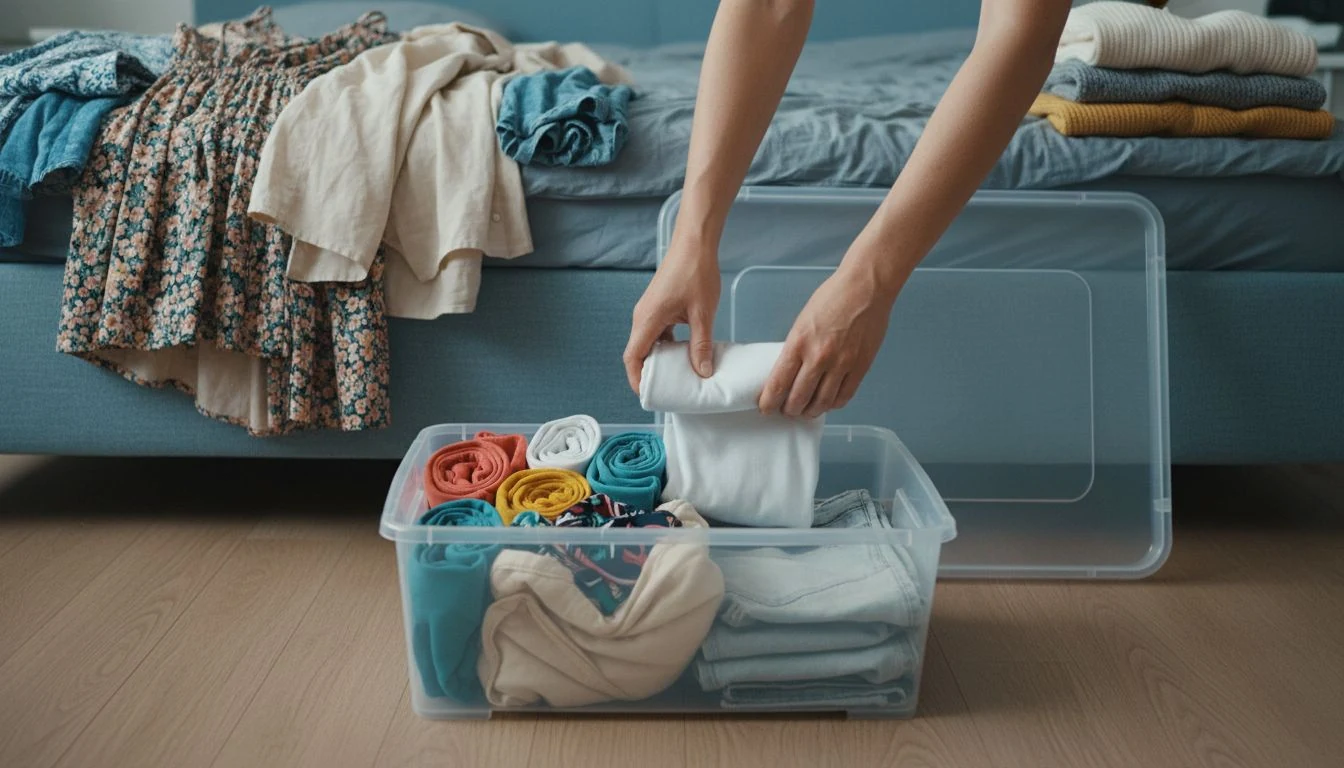
Last October I opened the bin under our bed, pulled out my favorite white linen shirt, and found a ring of yellow under each arm and two orange dots on the collar. It had looked clean when I folded it in September. Sweat and sunscreen don’t show on the day you put a shirt away. They show six months later, when they’ve had time to set.
That shirt is why I changed how to store summer clothes in our house. This weekend I did the fall swap again: one queen bed covered in shorts, sundresses and swimsuits, two under-bed bins, and about 90 minutes from start to lids on. My routine is all in here, with, the fabric-by-fabric table taped inside our closet door, and the things I got wrong for years.
Why a closet swap is worth one Saturday
Our bedroom closet is a reach-in, 5 feet wide. It holds one season of clothes for me without a fight. It does not hold two. Every year I used to leave the summer stuff hanging “just in case we get a warm week,” and every year I’d dig through tank tops in December to find a sweater.
So now the swap happens the first weekend of October, when the forecast stops hitting 75. I want to open the door and see only things I can wear this week. It saves me a few minutes each morning until April, and I stop buying a second gray sweater because I forgot I owned the first.
If you don’t have a real closet at all, the same steps work. My notes on clothes storage ideas when you have no closet cover where the off-season bins can live instead.
First, decide what goes back in the bin at all
Before anything gets washed, everything gets judged. I learned this the expensive way: I used to launder and fold clothes I then donated in spring, which is a lot of detergent for a bag at the thrift store.
I pull every summer piece out and sort it into three piles on the bed:
- Wore it this summer and want it next year
- Didn’t wear it once since June
- Stained, stretched, or pilled past saving
The middle pile is the honest one. This year it had 11 things in it, including two dresses with the tags still on (old shopping habits, I know). Those went straight into the donation bag by the front door. If you want the longer version of this, my guide to cleaning out your closet has the questions I ask about each piece.
What made it into the keep pile this year: 34 pieces, plus four swimsuits and three pairs of sandals.
How to store summer clothes so they come back clean
This is the step that would have saved my linen shirt. Everything that goes into storage gets washed, even the things that look fine. Body oil, deodorant and sunscreen stay in the fibers where you can’t see them, and over a winter in the dark they turn yellow or orange.
The UC Integrated Pest Management program says it in its guide to clothes moths: when you store susceptible items, make sure they are clean and pest free, then put them in an airtight container. Moths go for wool and silk, and food or sweat stains make other fabrics more tempting too.
My order on swap day:
- Pretreat collars, underarms and anything that touched sunscreen. I rub a little dish soap in and let it sit 15 minutes.
- Wash on the warmest setting the care label allows.
- Skip fabric softener and starch on anything going into a bin. Both leave a residue that can attract bugs.
- Dry everything all the way through, seams and waistbands included.
I used to skip that last one. A pair of denim shorts with damp seams smelled like a basement by Christmas, and I never wore them again.
Fold, roll or hang: what works for each piece
I fold almost everything. Hanging summer clothes for six months stretches the shoulders of knit tops, and a closet full of hangers holding things I can’t wear defeats the point of the swap.
The exceptions are the two linen dresses and one silky blouse that crease badly. They go on padded hangers inside a cotton garment bag at the far end of the hall closet, where they’re out of my way.
T-shirts and tank tops get rolled. Rolled shirts stand up in the bin like files, so in April I can see every one of them without unpacking. Shorts get folded in half once. Swimsuits go flat in a pillowcase so the straps don’t snag on zippers.
Where to store summer clothes in the off-season
Ours live under the bed. Two clear plastic bins with snap lids, about 6 inches tall, slide under the frame on the side nobody sees. I like clear because I can check on them without pulling them out.
What I avoid now is the basement. We tried it one year. The bins came up smelling musty in April, and two cotton dresses had small gray spots on the hem. The EPA’s guide to mold and moisture recommends keeping indoor humidity below 60 percent, ideally between 30 and 50. Our basement sits well above that most of the year, according to the $12 humidity meter I bought after the spots showed up.
Good spots, in the order I’d pick them: under a bed, the top shelf of a closet, the back of a linen closet, and a dry storage space under the stairs. Bad spots: an attic (heat), a garage (heat, damp and mice), and anywhere near a water heater or washing machine.
If you’re short on space in general, my roundup of storage ideas for small spaces has the bin sizes that fit under most bed frames.
How to store summer clothes by fabric: my chart
This is the table taped inside our closet door. I made it after the linen shirt, and I check it every October so I’m not guessing.
| Piece | Before it goes in | Fold, roll or hang | Where it goes | What goes wrong if you skip a step |
|---|---|---|---|---|
| Cotton T-shirts and tanks | Wash, pretreat underarms | Roll | Under-bed bin | Yellow underarm rings that set by spring |
| Linen shirts and dresses | Wash, check collar for sunscreen | Hang on padded hanger | Cotton garment bag, closet | Deep creases, orange sunscreen spots |
| Denim shorts | Wash, dry fully (seams last) | Fold in half | Under-bed bin | Musty smell from damp seams |
| Swimsuits | Hand rinse to get chlorine out, dry flat | Lay flat | Pillowcase inside the bin | Stretched elastic, snagged straps |
| Silk or rayon tops | Hand wash or dry clean | Hang | Garment bag, closet | Water marks, moth damage on silk |
| Sandals | Wipe soles, air out a day | Pair them, toes together | Shoe box on the top shelf | Odor and dust inside the straps |
| Light cardigans | Wash or air out a day | Fold, never hang | Top layer of the bin | Stretched shoulders on hangers |
Three mistakes that ruin stored summer clothes
- Packing “clean enough” clothes. A shirt worn for one afternoon still has deodorant and sunscreen in it. Wash everything, even the things that smell fine.
- Sealing clothes that are still a bit damp. An airtight bin traps that moisture with the fabric for months. Give the thick seams an extra hour on the rack.
- Choosing the basement or attic because there’s room. Heat and humidity do more damage over a winter than anything in a closet. Pick the dry, boring spot over the big one.
What didn’t work for me
Vacuum bags. I bought a pack of six two years ago because they looked so tidy online. They did shrink a pile of shorts down to a flat brick. They also pressed creases into my linen that took two washes to relax, and three of the six bags had lost their seal by January. Now I use them only for extra pillows, which don’t care.
Cedar blocks didn’t do what I thought either. I’d tossed one into each bin and assumed I was covered. The same UC IPM guide says the effect of cedar on moths is debatable and fades after a few years. Mine were at least five years old. They smelled nice. That’s about all I can say for them, and the clean clothes in a sealed bin are what kept the moths away.
And I used to store sandals in the bottom of the clothes bins. One pair still had a little sand in the footbed, and it ended up inside a folded white tank. Shoes get their own box now.
Grab the free printable: my one-page Seasonal Closet Swap Checklist, with the keep-donate-toss sort, the fabric chart above, and a spring “unpack” list so nothing comes out of the bin wrinkled and surprising. Get the free checklist →
Once the swap is done, the closet only has to hold fall. That’s when I build out my fall capsule wardrobe from what’s left, and it’s a lot easier to see what’s in there.
FAQ
How do you store summer clothes so they don’t turn yellow?
Wash everything before it goes into storage, even pieces that look clean, and pretreat underarms and collars. The yellowing comes from deodorant, body oil and sunscreen that oxidize over months. Make sure clothes are fully dry before you close the bin.
Is it better to store summer clothes in plastic bins or fabric bags?
For folded clothes in a dry room, I use clear plastic bins with tight lids, because they keep dust and bugs out and let me see what’s inside. For linen and silk pieces that crease, a breathable cotton garment bag on a hanger works better. Avoid sealing anything that isn’t fully dry.
Where should I not store off-season clothes?
Skip attics, garages and damp basements. Heat, humidity and pests do the most damage there. A spot under a bed or on a high closet shelf in the main living space is usually safer, since it stays closer to the temperature and humidity you live in.
If you’re figuring out how to store summer clothes this weekend, start with the three piles on the bed before you wash a single thing. You’ll do less laundry, and the bins will hold only what you’ll be happy to see in April.
Get my free Home Reset Planner
The calm, room-by-room planner I use to reset my whole home without the overwhelm. Join the newsletter and I’ll send it straight to your inbox.
No spam, ever. Unsubscribe anytime. — Lena
Keep reading — more on Closet & Wardrobe
The Coat Closet Nobody Fixes Until It’s Already Cold

Building My Own Closet System: The Weekend Version of a $3,000 Quote

Custom Closet Storage Solutions: What They Really Cost (and When a Kit Wins)