Last Saturday I mowed the lawn for what I hope is the last time this year, rolled the mower back to the shed, and it didn’t fit by a good three feet. Somewhere between April and October, the patio cushions, two bags of potting soil and a kiddie pool had taken over the spot where the mower lives.
So I spent the afternoon on a fall clean-out. Our shed is 8 by 10 feet, wood, with one window and no electricity. These are the shed organization ideas that worked in that space, what I paid for each one, and the one thing I found in a bag of grass seed that changed how I store everything.
First, empty the whole shed onto a tarp
I tried to organize around the stuff first. It took twenty minutes to admit that doesn’t work in 80 square feet. Everything came out onto a tarp on the lawn, and the empty shed got swept and looked at with fresh eyes.
Out on the lawn, I sorted the pile into a few groups in about fifteen minutes:
- Lawn: mower, string trimmer, leaf rake, spreader.
- Garden: pots, soil, hand trowels, gloves, the hose.
- Long tools: shovels, a hoe, the pole saw.
- Summer stuff: cushions, pool toys, the folded umbrella.
- Stuff that shouldn’t be there at all: a cracked pot, two broken sprinklers, half a can of paint from 2021.
The last group filled a bag and a half. Getting rid of it took ten minutes and made the rest of the job easier.
Check for mice before you put anything back
This is the part nobody puts in a pretty shed photo. When I picked up the half-used bag of grass seed, it had a hole chewed in the corner and droppings inside. There were more along the back wall, under the shelf.
I didn’t know until that afternoon that you shouldn’t sweep or vacuum mouse droppings. The CDC’s rodent clean-up guidance says to open the doors and windows for 30 minutes and stay out while it airs. Then you spray the droppings with a bleach solution (1.5 cups of bleach to a gallon of water, mixed fresh), let it soak about 5 minutes, and wipe it up with paper towels while wearing gloves.
So the seed bag went in the trash, sealed. I followed the steps, and from then on anything a mouse would eat goes in metal or hard plastic with a lid. That’s the rule the whole shed is built around now.
Shed organization ideas that worked in 80 square feet
A small shed has more room on the walls and above your head than on the floor. These are the ideas I used, roughly in the order I put them up.
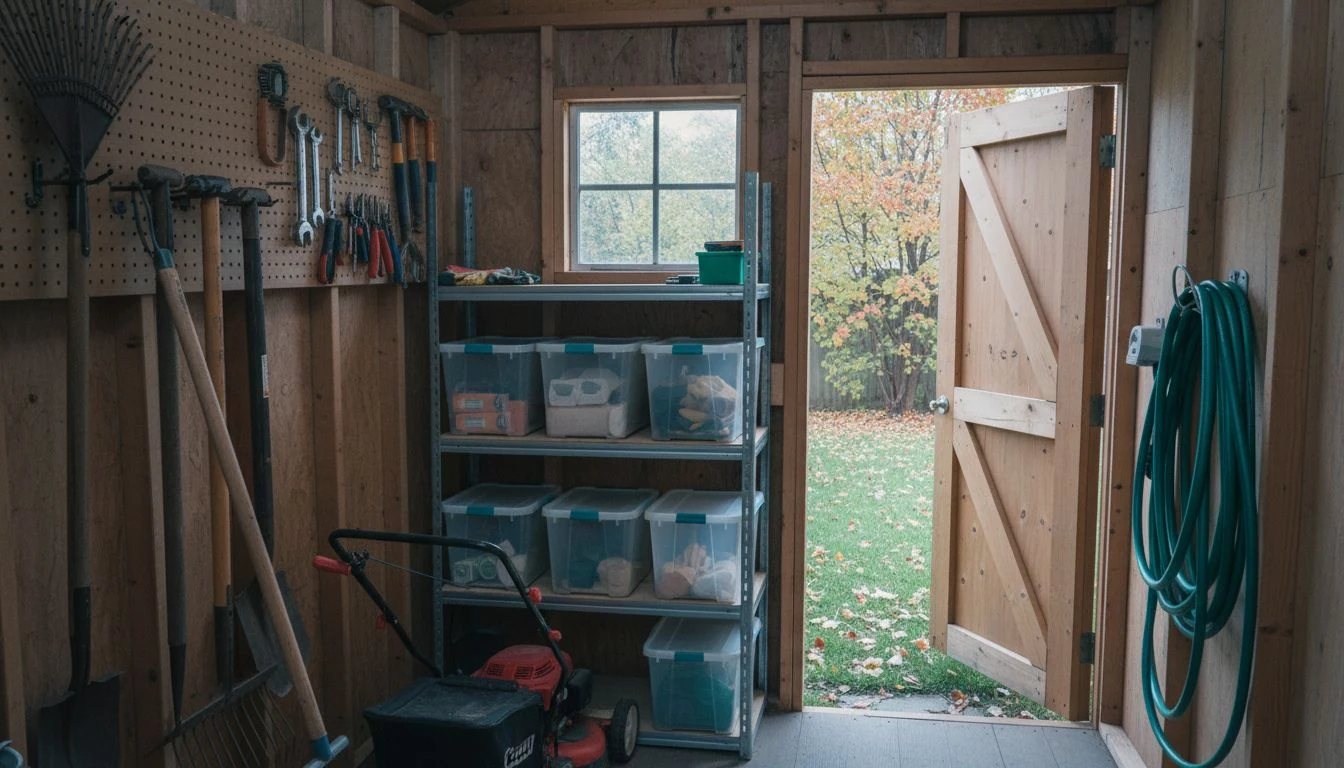
- A tool rail for the long-handled tools. A 48-inch rail with six hooks on the left wall holds the shovels, the rake, the hoe and the pole saw, heads up. Before, they leaned in a corner and fell on whoever opened the door.
- A pegboard over the potting area. A 4 by 4 foot panel holds the trowels, pruners, gloves and twine. I traced each tool with a marker so everything goes back in the same spot.
- One metal shelf unit, five shelves. Bins on top for the stuff I use once a year, heavy things like soil and fertilizer on the bottom shelf.
- Clear bins with snap-on lids. Six of them. Clear so I can see what’s inside without opening every one, lids because of the mice.
- A galvanized can with a lid for birdseed and grass seed. Mice can chew through a paper bag in a night, and I haven’t seen one get into the steel can yet.
- The rafters for light, bulky things. Two lengths of rope and a couple of hooks hold the folded patio umbrella and the deflated pool across the rafters until May.
- The floor is only for things with wheels. The mower and the spreader, with a clear path from the door to each one. If it doesn’t roll, it goes on a wall or a shelf.
Most of the ideas are borrowed from what I did in the garage this summer. My summer garage reset covers the zone method in a bigger space, and the garage storage ideas post has more wall systems if your shed is larger than mine.
Store garden chemicals up high and locked
The shed is where the weed killer, the slug bait and the lawn fertilizer live, and I have two kids who think the shed is a clubhouse. The EPA’s page on storing pesticides safely says to keep them in their original labeled containers, locked up and out of reach of kids and pets, away from anything that looks like food or animal feed. It also says never to pour them into drink bottles.
I bought a small plastic cabinet with a hasp and a padlock and screwed it to the wall at shoulder height. Everything with a warning label goes in there. The key hangs on a hook in the kitchen, not in the shed.
The half can of old paint and a jug of something from the previous owners that had lost its label are not going in the trash. The EPA’s guide to household hazardous waste says paint, oils and pesticides shouldn’t go down a drain or into regular trash, and to check with your city for a drop-off day. Ours is the first Saturday in November.
What the shed clean-out cost me
I set a $300 budget and came in just under. This is what I bought, matched to the problem it fixed.
| Problem in the shed | What fixed it | What I paid |
|---|---|---|
| Long tools falling over in the corner | 48-inch tool rail with 6 hooks | $29 |
| Hand tools lost in a bucket | 4×4 pegboard panel plus a hook kit | $37 |
| Bags and boxes piled on the floor | 5-shelf metal unit | $68 |
| Mice in the seed and cushions | 6 clear lidded bins and a galvanized can | $86 |
| Chemicals on an open shelf | Small lockable cabinet and a padlock | $74 |
| Umbrella and pool taking floor space | Rope and 4 ceiling hooks | $0, from the garage |
The mower fits again, with about two feet to spare. That was the whole goal.
Three shed mistakes I’d skip
- Buying bins before emptying the shed. I’d bought four bins in the spring. They were the wrong size for the shelf I ended up with, and two went back.
- Keeping seed in its paper bag. One chewed bag cost me $24 of grass seed and an afternoon of cleaning.
- Putting the heavy stuff up high. A 40-pound bag of soil on the top shelf is a bad idea when someone has to get it down. Heavy goes low.
What didn’t work for me
Two summers ago I tried one of those shed kits with a slatwall system and a dozen special hooks and baskets. It cost almost as much as this whole clean-out, and half the hooks didn’t fit our tools. The slatwall also took up the only wall with a window. It went to a neighbor in the spring.
The other thing that didn’t work was storing the patio cushions in the shed without bins. They smelled like a damp basement by April, and one had a mouse nest in the corner. They now go in two big lidded bins on the top shelf. If you’re short on room for them, my storage ideas for small spaces post has a few spots in the house that work for cushions too.
Grab the free printable: my one-page Fall Shed Clean-Out Checklist, with the five sorting groups, the mouse clean-up steps, a shopping list, and a spot to write your city’s hazardous waste drop-off day. Get the free checklist →
FAQ
What is the best way to organize a small shed?
Empty it, sort into groups, then use the walls and the space overhead. In our 8×10 shed, long tools hang on a rail, hand tools on a pegboard, bins on one metal shelf, and only things with wheels stay on the floor.
How do I keep mice out of my shed?
Store anything they’d eat or nest in, like seed, birdseed and cushions, in metal cans or hard plastic bins with lids. Keep the floor clear so you can spot droppings. If you find any, follow the CDC’s clean-up steps and don’t sweep or vacuum them.
Are there cheap shed organization ideas?
Yes. Rope and hooks on the rafters cost almost nothing, a pegboard panel is around $20, and a clear-out alone frees a lot of space. Our bag and a half of junk was the biggest win of the day and cost nothing.
If your mower doesn’t fit in the shed anymore, pick a dry Saturday this month and start with the tarp. Empty the shed first and buy things after. The rest takes one afternoon.
Get my free Home Reset Planner
The calm, room-by-room planner I use to reset my whole home without the overwhelm. Join the newsletter and I’ll send it straight to your inbox.
No spam, ever. Unsubscribe anytime. — Lena
Keep reading — more on Storage Solutions
Wrapping Paper Storage Ideas That Stop the Crushed-Roll Problem
Floating Shelves for Small Spaces: Where They Work (and Where They Fall Off the Wall)
Shoe Storage Ideas for Every Room (Not Just the Front Door)