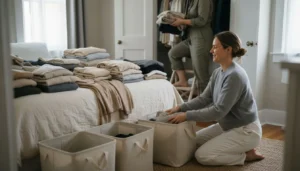
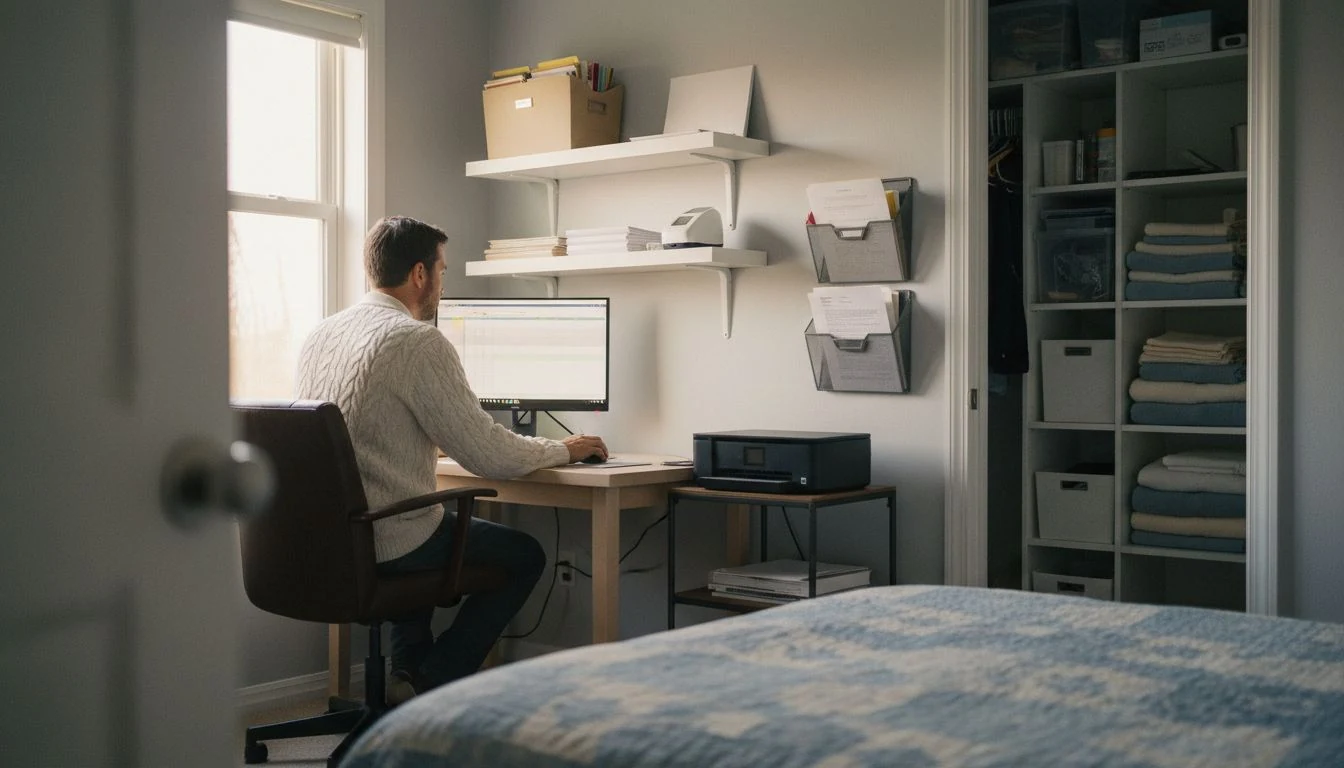
Most home office organization ideas assume the office is only an office. Mine is a 9 by 10 foot spare room that is also, a few weekends a year, the guest room. In September my sister came for four nights. I spent the evening before she arrived carrying a printer, two bankers boxes and a bag of cables into the hallway, and the hallway stayed like that until she left.
That was the push. I’d already sorted out the desk itself, but the room around it was still a mess, and I gave it two Saturdays. Below is what held up in a small room with two jobs, what each fix cost, and the one I’d skip if I did it again.
Start with the whole room
Last spring I wrote about desk organization ideas, and that post is about the top of the desk and the drawer under it. This one is about everything else: where the desk sits, where paper goes, what lives in the closet, and how the room turns back into a bedroom without a moving day.
The first Saturday I took everything out that wasn’t furniture. It filled most of the hallway. Then I made a list of what the room has to do in a normal week:
- Work at the computer about six hours a day, four days a week.
- Hold the household paper: bills, tax folders, the kids’ school forms.
- Store the printer, the shredder and office supplies.
- Sleep one guest, a few times a year.
That’s four jobs in 90 square feet. Writing it down made one thing obvious. The guest part happens maybe ten nights a year, and I had been arranging the room around it all the time.
Put the desk where the light works
My desk used to face the window because it looked nice. It wasn’t nice to work at. On sunny afternoons the screen washed out and I’d close the blinds and turn on the overhead light, which put a glare stripe right across the monitor.
OSHA’s computer workstation guidance on monitors says to set the screen at a right angle to the window, keep it 20 to 40 inches from your eyes, and have the top of the screen at or a little below eye level. Cornell’s ergonomic guidelines say the same thing about windows: don’t put the screen in front of a bright one or with its back to one.
I moved the desk to the side wall, with the window on my left. It took ten minutes and cost nothing. I added a clamp lamp on the right side of the desk for cloudy days ($24), and I haven’t closed the blinds during work since.
One more thing about where it goes. The desk now sits in the corner farthest from the door. When a guest comes, the bed side of the room is the side you see first, and the work side is out of the way.
Home office organization ideas for paper
Paper was the real problem in this room. It came in from the mail, from school, from the printer, and it had nowhere to go but flat surfaces.
What worked was giving paper a path with three stops:
- An inbox on the wall by the door. A metal wall file with three pockets ($19). Everything that comes in goes in the top pocket. Nothing goes on the desk.
- One open file box on the shelf for this year. Bills, receipts, school forms, anything I might need in the next twelve months.
- The closet for everything older. Tax years and the house folder, in two lidded boxes on the top shelf.
Once a week, on Sunday, I empty the inbox. It takes about ten minutes. I go through how I decide what to keep, shred or scan in my post on how to organize paperwork at home, so I won’t repeat it here. The shredder now sits under the desk next to the recycling bin, so I shred right where I sort.
Home office organization ideas for the walls
In a small room the floor is for the desk, the chair and the bed. Everything else has to go up.
I put two floating shelves above the desk, 36 inches long, about 14 inches apart. The lower one holds the printer paper, the label maker and the file box for this year. The top one holds things I need once a month or less. If you’re thinking about shelves like these, my floating shelves for small spaces post covers how much weight they hold and how I hung mine into studs.
The printer was the hard one. It’s big and ugly and I use it twice a week. It now sits on a small rolling cart ($39) that tucks under the end of the desk. When I print, I pull it out. When a guest comes, it rolls into the closet.
Make the closet do the hiding
The closet in this room used to be full of coats nobody wore and a vacuum. I moved the coats to the hall closet and gave this one a single job: hold everything the office has to hide when the room becomes a bedroom.
A 5-shelf unit went inside the closet ($54). From the bottom up:
- Floor: the printer cart parks here when there’s a guest.
- Shelf one: shredder overflow, spare ink, the laptop stand.
- Shelves two and three: office supplies in four clear bins, one for paper goods, one for cables and chargers, one for mailing supplies, one for the kids’ craft stuff that keeps migrating in.
- Top shelves: the old tax boxes and the guest sheets and towels.
The guest linens being in the same closet is the part I like most. My sister had everything she needed in one place, and I didn’t have to explain where the extra blanket was.
The 20-minute switch from office to guest room
This was the goal: turn the room over without the hallway pile. Here is what the switch looks like now.
- Clear the desk top into one bin. It’s mostly clear anyway.
- Roll the printer cart into the closet.
- Unplug the monitor and lay a throw over it. My sister said it was fine, and it’s less work than moving it.
- Pull the guest sheets from the top shelf and make the daybed.
- Empty the wall inbox into the file box so no mail is sitting out.
I timed it the second time I did it: 20 minutes, most of it making the bed. Before, it was an evening and a hallway full of boxes.
What it cost, problem by problem
| What was wrong | What I did | Cost |
|---|---|---|
| Glare on the screen every afternoon | Moved the desk to the side wall, window on my left | $0 |
| Dark desk on cloudy days | Clamp lamp on the right side of the desk | $24 |
| Mail piling up on the desk | Three-pocket wall file by the door | $19 |
| Supplies on every surface | Two 36-inch floating shelves above the desk | $46 |
| Printer in the way | Small rolling cart that parks under the desk or in the closet | $39 |
| Closet full of coats and a vacuum | 5-shelf unit plus four clear bins | $82 |
| Old tax papers loose in a drawer | Two lidded file boxes on the top closet shelf | $22 |
Three home office organization mistakes I’d skip
- Buying organizers before deciding where the desk goes. I bought a desk hutch first. It didn’t fit on the side wall, and it went back.
- Letting the desk be the inbox. If paper can land on the desk, it will. Give it a stop by the door instead.
- Arranging the room for the guest. The office is what the room does most days. Set it up for that, and make the guest switch fast.
What didn’t work for me
I tried a folding desk that hooks onto the wall, the kind you close up when you’re done. The idea was that the office would disappear every evening. In practice I never closed it, because closing it meant clearing it, and a fold-down desk is about 20 inches deep, too shallow for my monitor at a decent distance. It’s in the garage now, holding seed packets.
The other thing was a pretty set of matching magazine files for the shelf. They looked great for a week. But I couldn’t see what was in them, so paper went back to piles. The open file box is uglier, and it works because I can see every folder tab from the chair.
Grab the free printable: my one-page Small Home Office Setup Checklist, with the four-jobs list, the three-stop paper path, a closet shelf plan, and the 20-minute guest room switch. Get the free checklist →
FAQ
How do I organize a small home office?
Start with what the room has to do each week, then place the desk for the light, give paper a path (inbox, this year, older), and use the walls and closet for storage. In my 9×10 room the floor only holds the desk, the chair and the daybed.
Where should a desk go in a small home office?
Put the screen at a right angle to the window, not facing it or with its back to it. OSHA’s guidance says that cuts glare, and moving my desk to the side wall fixed the washed-out screen I had every afternoon.
Can a home office double as a guest room?
Yes, if the office things can hide fast. A printer on a rolling cart, a closet with shelves for supplies and guest linens, and a clear desk let me turn my office into a guest room in about 20 minutes.
If your office is also the place where everything else ends up, start by writing down the jobs that room does in a normal week. Then move the desk for the light. Of all the home office organization ideas in this post, those two cost me nothing, and I set up the rest of my room around them.
Get my free Home Reset Planner
The calm, room-by-room planner I use to reset my whole home without the overwhelm. Join the newsletter and I’ll send it straight to your inbox.
No spam, ever. Unsubscribe anytime. — Lena
Keep reading — more on Home Organization
Small Apartment Organization Ideas (Renter-Friendly, No Drilling)

Mudroom Organization Ideas That Survive Wet-Boot Season
Storage Unit Sizes: What Actually Fits in a 5×10, 10×10 and 10×20