
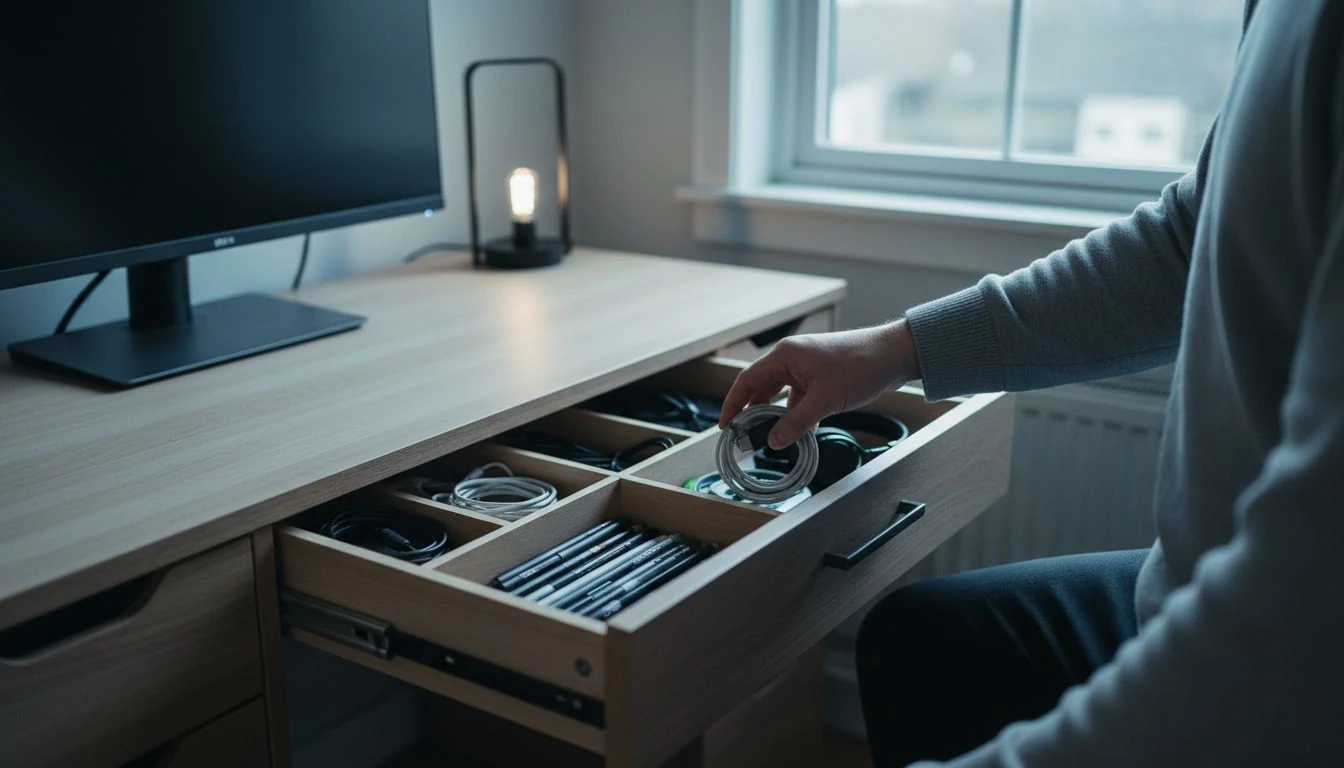
I counted fourteen cables in my desk drawer last spring. Three of them didn’t match a single device I own anymore. That drawer was the reason every desk organization ideas post I’d ever tried on my own desk quietly failed by the second week: I kept rearranging the top of the desk and never touched what was underneath it.
This is the version that held. It took one Saturday afternoon, cost me about nine dollars, and my desk has stayed clear for four months now through two deadline weeks. I want to be precise about that word, though: clear, not styled. Nothing in this post will make your desk photogenic. It will make it empty at 6pm, which turned out to be the thing I actually wanted.
Jump to:
- Why desk organization ideas fall apart by Thursday
- Empty the surface before you organize anything
- The three-zone reach map that finally held
- Desk organization ideas for cables and chargers
- Desk organization ideas for a small home office corner
- The 90-second end-of-day reset
- What didn’t work for me
- Frequently asked questions
Why desk organization ideas fall apart by Thursday
A desk isn’t storage. It’s a work surface that things pass across on their way somewhere else, and that’s the part most organizing advice gets backwards. You can give every pen a matching cup and the desk will still be buried on Thursday, because the mess isn’t pens. It’s the mail you opened Tuesday, the mug, the charger, the notebook you needed for one call in March.
Those things pile up because they have no next stop. So they idle on the desk. Any system built to make the surface pretty, instead of making the surface empty out, is going to lose to a normal week. Mine lost about six times before I figured that out.
Empty the surface before you organize anything
Take everything off. The monitor and the lamp can stay. Everything else goes onto the floor or the bed, including the things you’re sure belong there. I know it feels like a pointless extra step when you were planning to just tidy. It isn’t. You cannot see what a desk actually needs while the last two years of accumulation are still sitting on it.
Then wipe the whole thing down and sit at it for a second while it’s bare. That empty surface is the target, and it’s worth looking at once so you know what you’re aiming for. When I did this I found my desk is 47 inches wide and I had been using maybe 20 of them. The rest was storage I never agreed to.
Now sort the pile on the floor into three groups: things you used this week, things that belong in another room, and things you’re keeping out of vague guilt. That third group is usually the biggest. Mine had eleven pens in it, and four of them wrote.
The three-zone reach map that finally held
Here’s the piece that changed it. Instead of deciding where things look good, I decided where things could physically live based on how often I reach for them. Elbows on the desk, sweep your forearm in an arc. Whatever that arc covers is prime real estate and almost nothing deserves it. OSHA’s workstation guidance makes the same point from the ergonomics side: the items you use constantly belong in the closest reach zone so you’re not stretching and twisting all day (OSHA computer workstation eTool).
| Zone | Reach test | What earns a spot |
|---|---|---|
| Zone 1: daily | Forearm arc, elbow stays on the desk | Keyboard, mouse, one pen, current notebook, water |
| Zone 2: weekly | Lean forward or open a drawer, still seated | Chargers in use, headphones, sticky notes, one folder |
| Zone 3: rarely | You have to stand up | Backup cables, spare paper, manuals, archive files |
Zone 1 held five things for me. Five. Everything else moved down, and the surface stopped filling up because a wandering object had nowhere on the desk it was allowed to land. Fewer parking spots did more for me than any container ever has.
Papers were the exception that needed their own answer, because a folder in Zone 2 fills fast and then spills. If your desk is really a paper problem wearing a desk costume, my guide to organizing paperwork at home handles the filing side properly and this post will work a lot better afterward.
Desk organization ideas for cables and chargers
Back to the fourteen cables. I laid them all out and plugged each one into something to find out what it was. Three matched nothing. Two were duplicates of a charger already in the wall. That left nine, and only four were things I use in a given month.
The four active ones got clipped to the back edge of the desk with adhesive cable clips, about two dollars for a pack, so the ends stay up on the surface instead of sliding down behind it forty times a week. That single change is the best desk organization idea I have ever tested against the effort it took. Ten minutes. The daily fishing-behind-the-desk ritual just ended.
The five backups got coiled, and here I’ll admit the small thing that finally worked after several failures: one cable per compartment in a cheap divided drawer insert, not a shared bag. Bags become knots. Compartments don’t. Mine was nine dollars and it’s the only thing I bought for this entire project. And the three dead cables plus a drawer of old chargers went to e-waste rather than the bin, since electronics hold recoverable metals and shouldn’t go in household trash (EPA on electronics donation and recycling).
Desk organization ideas for a small home office corner
My desk isn’t in an office. It’s the short wall of a bedroom, which I think is where most people’s desks actually are, whatever the catalog photos suggest. A corner desk has a specific problem: no room to expand sideways, so everything grows upward into a wobbling tower or outward onto the floor.
That bedroom is our spare room, and this fall I gave the rest of it the same treatment: the printer, the closet and where paper goes. That part is in my post on organizing a small home office that doubles as a guest room.
Go vertical, but only once. One shelf above the desk, mounted high enough that you can’t reach it without standing, which makes it a genuine Zone 3 and keeps it from becoming an overflow ledge at eye level. Under the desk, a single rolling drawer unit that tucks fully underneath. If it sticks out, it collects things on top of it. Ask me how I know.
The other small-space rule I follow: nothing on the floor except the chair and the drawer unit. A bag on the floor becomes a permanent bag on the floor within about a week. For the wider version of this thinking, my post on storage ideas for small spaces covers the same vertical logic across a whole room. And if the desk is shared with a kid doing schoolwork, that’s a genuinely different setup with different rules, which I worked through separately in my kids’ homework station guide.
The 90-second end-of-day reset
Every system I’ve ever built has needed one small habit holding it up, and for the desk it’s this. Before I close the laptop, I put Zone 1 back to five things. That’s it. Mug to the kitchen, papers into the folder, pen in the tray, cable clipped.
I timed it out of curiosity. Ninety seconds on an ordinary day, closer to three minutes after a bad one. Compare that to the forty-five minute excavation I used to do every few weeks when the desk became unusable, and it’s not a close call. The reset also means I start the next morning at a clear desk, which does something for my head that I didn’t expect and can’t entirely explain.
If you want it to stick, attach it to something you already do without thinking. Mine runs when I close the laptop lid. That anchoring idea is the backbone of how I build every routine, which I get into in organizing around your routine.
Common desk organization mistakes to avoid
- Buying the organizers first. I did this twice. You end up sizing your system to the containers instead of to what you actually keep, and the extra compartments quietly invite you to fill them. Sort everything, then buy one thing, if you still need it.
- Treating the desk as storage. Anything you use less than weekly does not belong on or in the desk, no matter how neat it looks in a drawer. Give it a shelf or a closet and let the desk be a surface you work on.
- Organizing the top and skipping the drawers. The drawer is where the dead cables, the four dry pens, and the guilt objects live, and an untouched drawer refills the surface within a month. Empty it in the same session or you’re just moving the pile around.
What didn’t work for me
The matching desk set was my prettiest failure. Pen cup, letter tray, little drawer box, all the same color. Within three weeks the letter tray held four months of paper because a tray tells you it’s fine to put paper down and never says when to deal with it. I gave it away and the paper problem shrank immediately.
Cable sleeves also lost. I bundled every cord into one neat wrapped tube, which looked great and meant that unplugging one thing required unwrapping all of it. Two weeks in, the sleeve was hanging open with cables spilling out. Individual clips beat one tidy bundle, every time.
And I tried a full label-maker pass on the drawer compartments. They were peeling by the following month, mostly because there were only six compartments and I could plainly see what was in each one. Labels solve a problem you have when a system is too complicated. Better to make the system simpler.
Grab the free printable: my one-page Desk Reset Map, the fill-in sheet I use to assign every item on my desk to Zone 1, 2, or 3 and to log what leaves the room entirely. Get the free desk reset map →
Frequently asked questions
How do I organize a desk with no drawers?
Give Zone 2 and Zone 3 a home off the desk instead of trying to fit them on it. A single rolling cart beside the chair covers weekly items, and one high shelf covers the rare ones. Keep the surface itself to the five daily things and let the vertical space absorb everything else. A drawerless desk is genuinely easier to keep clear, because there’s nowhere to hide the stuff you should have dealt with.
What should I keep on my desk at all times?
Whatever you touched today, which for most people is five or six items: keyboard, mouse, one pen, the current notebook, a drink, and possibly a lamp. Everything else earns its place by daily use, not by seeming useful. If you’re unsure about an item, move it to a drawer for a week and see whether you go looking for it. Most things, you won’t.
How often should I reset my desk?
Ninety seconds at the end of each working day, plus a real empty-it-out sort about twice a year. The daily reset is what actually keeps the surface clear; the twice-yearly sort catches the slow drift, like the cables that stopped matching anything and the pens that dried out months ago. Skip the daily one and the seasonal sort turns back into a whole Saturday.
Get my free Home Reset Planner
The calm, room-by-room planner I use to reset my whole home without the overwhelm. Join the newsletter and I’ll send it straight to your inbox.
No spam, ever. Unsubscribe anytime. — Lena
Keep reading — more on Home Organization

Small Apartment Organization Ideas (Renter-Friendly, No Drilling)

Mudroom Organization Ideas That Survive Wet-Boot Season

Home Office Organization Ideas for a Small Space