For about three years I organized my house the way every tutorial told me to: by category. All the batteries in one labeled bin. Every charger coiled in a drawer I opened twice a year. It looked great in photos and fell apart within a week, every single time. Then last winter I tried the thing home editors keep calling the 2026 fix. You organize around your routine, not around neat categories. For once, the kitchen counter stayed clear past 8 a.m.
So here is the honest version of how that switch went. What organizing around your routine actually means, how I mapped mine in one afternoon with a notepad and a coffee, the four daily moments I rebuilt my storage around, and the two spots where plain old category sorting still won. No marathon purge. Just moving things to where my hands already reach for them.
Why category-based organizing kept failing me
Category sorting feels right because it looks right. One bin, one label, everything that “belongs together” in the same place. The problem is that I don’t live my life in categories. I live it in moments.
Here is a real example. I kept all our medicine in a single tidy box in the bathroom, the way the experts say to. But the only time anyone needed cough syrup was 6:40 a.m. on a school morning, standing in the kitchen, already late. So every cold season I’d be running down the hall in my socks. The bin was organized. My morning was chaos.
That gap is the whole reason category systems collapse. The stuff lives where it logically belongs, not where you actually use it. Once I noticed that, I couldn’t un-see it. My “office supplies” drawer was a museum. My junk drawer, the one I’d been ashamed of for years, was actually the most-used spot in the house because it sat exactly where my hands landed.
What it really means to organize around your routine
To organize around your routine means you build storage around the things you do every day, in the order and the place you do them, instead of grouping objects by what they are. A category system asks “what is this?” A routine system asks “when and where do I reach for this?”
Home editors at Homes & Gardens flagged behavior-based organizing as one of the defining 2026 trends, and there’s decent science under the hype. The idea overlaps with what researchers call reducing decision fatigue. Every time you have to hunt for something or decide where it goes, you spend a little willpower, and the American Psychological Association notes that willpower is a finite, drainable resource. Put the thing where the routine happens and you skip the decision entirely.
This is also why it sticks. A system that matches what you already do doesn’t need discipline to maintain. I learned that the hard way years ago with a gorgeous color-coded closet that lasted nine days. The calm version of organizing is just the lazy option, in the best sense, and that’s exactly why it holds.
How to map your routine before you buy a single bin
Do not start by shopping. I made that mistake first and came home with four baskets that are still empty in the garage. Start with a notepad instead. This part took me one nap-time, maybe 40 minutes.
Walk through a normal weekday in your head and write down every spot where you stop and do something. Not rooms. Moments. Mine looked like this:
- 6:30 a.m. kitchen counter: coffee, vitamins, kids’ meds, lunchbox packing
- 7:45 a.m. front door: shoes, backpacks, my keys, the one jacket nobody can ever find
- 5:00 p.m. entry again: mail, the dog leash, after-school snacks
- 8:30 p.m. living room: chargers, the TV remote graveyard, my reading glasses
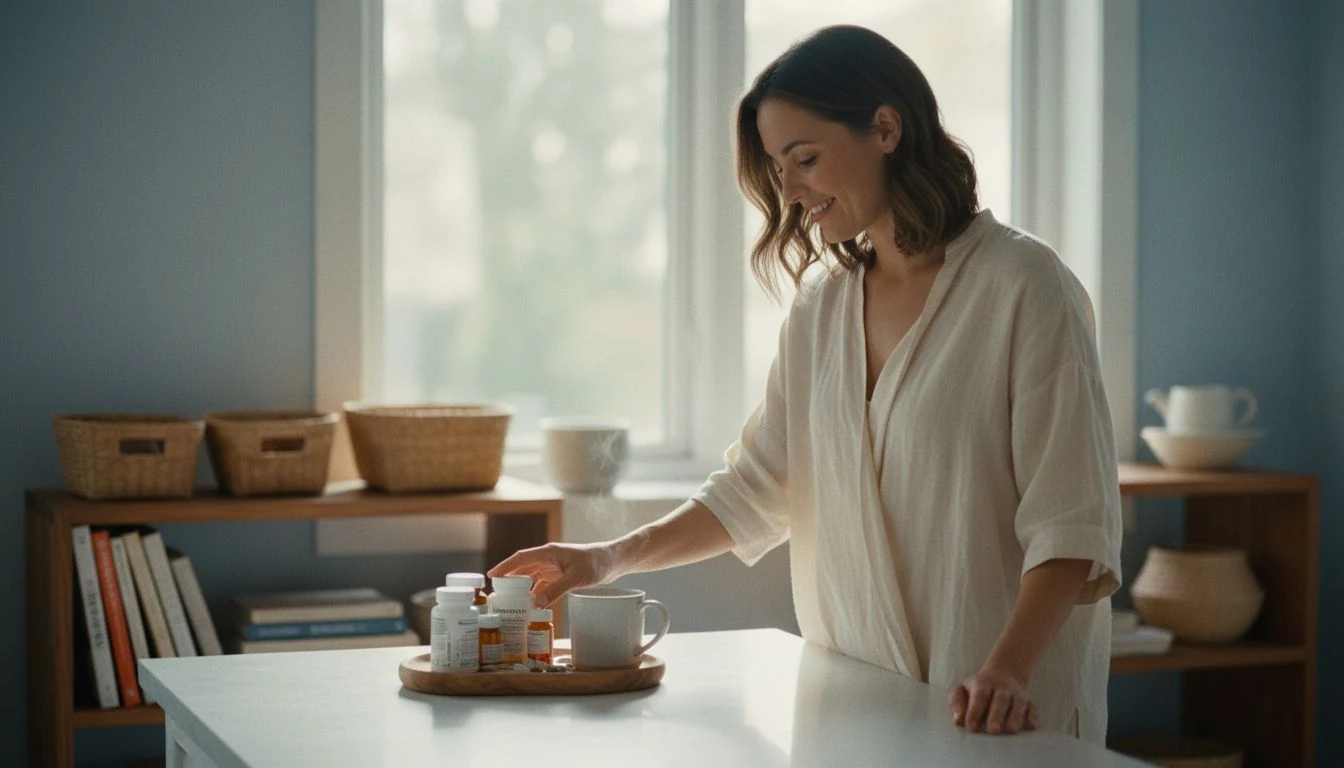
Then I asked one question at each moment: what do I always need here, and what is currently somewhere stupid? The answers basically told me where to move things. The meds went into a small lidded tray on the kitchen counter. The morning panic stopped that week. Total cost so far: zero dollars.
If you want a head start, my Sunday reset method pairs well with this, because it gives you a weekly moment to put strays back into their routine zones.
Grab the free Daily Flow Map
I turned my notepad scribbles into a one-page printable: four routine moments down the side, a “what I always need here” column, and a “where it lives now” column so you can spot the mismatches fast. Stick it on the fridge and fix one moment at a time. No full-house overhaul required.
How to organize around your routine, moment by moment
Once the map existed, I rebuilt four zones. I did one a week so it never felt like a project, just a small Saturday tweak. Here’s what each one actually holds now.
The morning launch (kitchen counter). A small wooden tray holds vitamins, the kids’ meds, and a pen. The lunchbox stuff lives in one fridge bin I can grab whole. I stopped storing the coffee filters “with the coffee things” in a high cabinet and moved them next to the machine. Silly. Should have done it in 2021.
The exit (front door). This is the zone that changed my mornings most. One basket per kid for shoes, hooks at their height for backpacks, and a tiny bowl for my keys that I will defend with my life. When I built it around the act of leaving instead of around “outerwear,” the lost-jacket fights mostly ended.
The re-entry (5 p.m.). Mail goes in a slim wall file, not a pile. Snacks live in a low drawer the kids can reach so I’m not the snack vending machine. This overlaps with my tidy-home-with-kids system, where the rule is always “put it where the kid uses it, not where it looks neat.”
The wind-down (living room). A charging tray on the side table killed the cable spaghetti. Remotes in one shallow basket. Reading glasses on a hook. Nothing fancy, but I stopped losing 10 minutes a night to the “where did I put it” hunt.
The 15-minute way to organize around your routine
You do not need a free weekend or a cart full of containers to organize around your routine. You need one moment fixed at a time. This is the part the aesthetic blogs skip, and it’s the only reason mine lasted.
Pick your worst daily moment, the one that reliably makes you swear under your breath. For most people I know it’s either the morning launch or the front door. Spend 15 minutes moving the three things you always need there to within arm’s reach of where it happens. That’s it. Don’t buy anything yet. Use a bowl, a shoebox, a drawer you empty.
Live with it for a week. If the routine got smoother, then buy the basket that fits. Building habits this small is exactly what the NIH says makes new routines actually stick, because tiny repeatable cues beat willpower every time. A weekly anchor helps too, which is why I lean on a simple room-by-room schedule to keep the zones honest.
Where organizing by category still makes sense
I’m not here to tell you categories are evil. That would be the kind of all-or-nothing advice I can’t stand. Some things genuinely belong grouped by type, and pretending otherwise just creates a different mess.
Deep storage is one. Holiday decorations, off-season clothes, the spare bedding I touch twice a year. Those have no daily routine, so “all the Christmas stuff in two labeled bins in the garage” is exactly right. Reference items are the other: warranties, manuals, tax papers. There’s no “moment” for a warranty, so a single filing spot wins. When you’re first deciding what stays at all, my guide on what to declutter first sorts the daily-use stuff from the deep-storage stuff before you place anything.
The real method, then, is a blend. Organize around your routine for everything you touch daily, and fall back to categories for the stuff you rarely do. That mix is what finally stuck for me after a decade of redoing the same closets.
A Quick Audit for Organizing Around Your Daily Routine
Organizing around your daily routine works best when your stuff lives where you actually use it. Walk through this short audit and check where each daily habit currently keeps its supplies.
| Daily habit | What should live nearby | On track? |
|---|---|---|
| Morning coffee | Mugs, filters, and beans in one reachable spot | Yes / Fix |
| Getting dressed | Tomorrow outfit decided the night before | Yes / Fix |
| Leaving the house | Keys, bag, and shoes by the door | Yes / Fix |
| Winding down | Chargers and a book at the bedside | Yes / Fix |
| Quick tidy | A basket per room for stray items | Yes / Fix |
Slip-ups when organizing around a routine
- Organizing by category, not use. Group by the moment you reach for things, not by type.
- Storing daily items out of reach. If you use it every day, it should take one motion to grab.
- Copying someone elses system. Your routine is yours; build the system around your real day.
FAQ
What does it mean to organize around your routine?
It means you store things based on when and where you actually use them in your day, not by what kind of object they are. Instead of one bin labeled “medicine” in the bathroom, you keep the morning meds on the kitchen counter where you take them at breakfast. You map your daily moments first, then move your most-used items within arm’s reach of each one. The system sticks because it matches what you already do.
Is organizing by routine better than organizing by category?
For anything you use daily, yes, routine-based organizing almost always works better because it removes the small daily friction of hunting for things. But categories still win for deep storage and reference items: holiday decor, off-season clothes, warranties, and manuals have no daily moment, so grouping them by type is smarter. The best system is a blend of both rather than one rule for the whole house.
How do I start organizing around my routine if I have no time?
Pick your single worst daily moment, usually the morning rush or the front door, and spend just 15 minutes moving the three things you always need there to within arm’s reach. Use a bowl or a drawer you already own instead of shopping. Live with it for a week, and only buy a proper basket if the routine got smoother. Fixing one moment at a time is what makes the change last.
Get my free Home Reset Planner
The calm, room-by-room planner I use to reset my whole home without the overwhelm. Join the newsletter and I’ll send it straight to your inbox.
No spam, ever. Unsubscribe anytime. — Lena
Keep reading — more on Home Organization
Small Apartment Organization Ideas (Renter-Friendly, No Drilling)
Mudroom Organization Ideas That Survive Wet-Boot Season
Home Office Organization Ideas for a Small Space