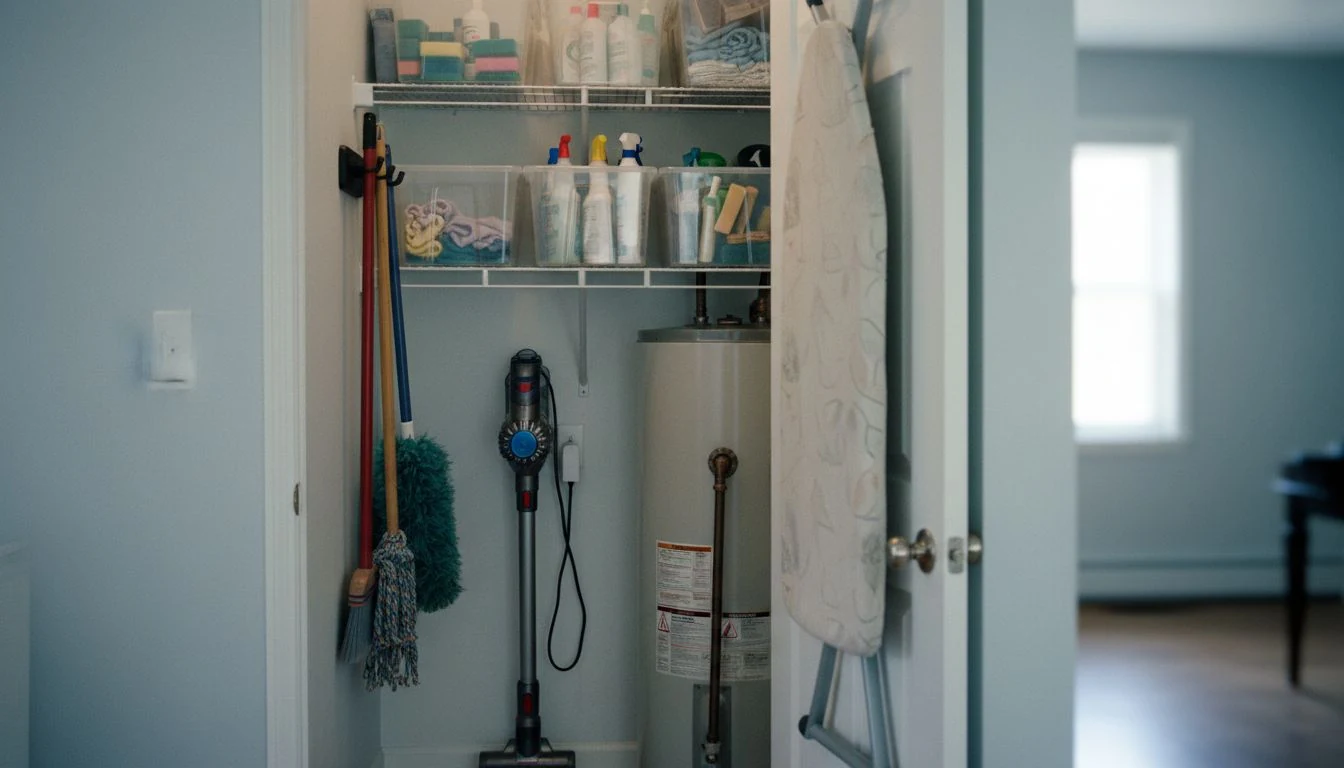
Our utility closet is the narrow door off the hallway that holds the water heater, the vacuum and roughly everything I didn’t want to look at. Last January I opened it to grab the mop, and the ironing board slid out sideways and hit me in the shin. A bottle of drain cleaner I’d forgotten I owned rolled out after it.
That was the day I finally did my utility closet organization properly. It took one Saturday morning and about $40, and it has stayed that way for ten months, which is a record in my house. Below is the setup I landed on, what it cost, and the two things I’d never store in there again.
Utility closet organization starts with taking everything out
I know. Everyone says this. But a utility closet is different from a coat closet, because things in there tend to be heavy, wet, or flammable, and you can’t see what’s leaking until it’s out on the floor.
I put an old towel down in the hallway and pulled out everything. My haul:
- Three mops (I use one)
- Two vacuums, one with a dead battery since 2023
- Eleven half-used spray bottles
- A box of light bulbs in sizes we no longer have
- Paint cans from the previous owners
- The ironing board, the step stool, a bag of rags, and a lot of dust
Then I wiped the floor and looked at the closet itself. Ours has the water heater in the back corner, so the usable space is an L shape. Knowing that changed what I bought.
Sort into four groups before you buy a single hook
I sorted the pile into four groups on the towel: tall tools (mops, brooms, the vacuum), cleaning supplies, household backstock (bulbs, batteries, trash bags), and things that didn’t belong at all. That fourth group was bigger than I expected.
The paint went to our county’s hazardous waste drop-off. The EPA’s household hazardous waste guidance is clear that leftover paints, cleaners and similar products shouldn’t go in the regular trash and should stay in their original, labeled containers. I’d been about to pour two near-empty cleaners into one bottle to save space. Don’t. Mixing products is exactly what you’re not supposed to do.
I tossed the dead vacuum, two of the mops and six of the spray bottles that were basically empty. If you’re not sure which cleaners you’ll reach for, my post on cleaning products actually worth it walks through the short list I kept.
Hang the tall stuff on the wall, not the floor
This was the single biggest change. A broom and mop holder, the kind with rubber grips that clamp the handle, cost me about $15. I screwed it into the side wall at shoulder height. Mop, broom, duster and the extendable squeegee all hang there now, heads down, off the floor.
The vacuum got its own spot on the floor directly under the holder, with its charger plugged into the outlet that was already in there. Because it lives in the same place every time, my kids can put it back. That’s my bar for any system. If an eight-year-old can’t return it, it doesn’t work.
The ironing board went on two hooks on the back of the door. It used to lean, which is why it attacked me.
Utility closet shelving ideas for the supplies
Our closet had one sad wire shelf up high. I added a second one at about chest height, using the same brand of wire shelving so the brackets matched. Total for the shelf and brackets: around $18.
On the shelves, I use open bins, one per category, so I can grab a whole bin and carry it to the bathroom:
- Bathroom cleaning (toilet cleaner, scrub brush, glass spray)
- Kitchen and floors (floor cleaner, dish refills, sponges)
- Backstock (bulbs, batteries, trash bags)
- Rags and microfiber cloths
The bathroom bin is the one I use the most, so it sits on the lower shelf. The bulbs and batteries live up top, since I touch them maybe four times a year. If you’re working with an even smaller space, the same trick of one bin per job is what I used in my under-sink storage setup.
Keep the water heater zone clear
I used to tuck the rag bag and a stack of cardboard right up against the water heater, because it was the only empty corner. Now I leave about an arm’s length clear around it, and nothing flammable goes in that closet at all. Check your water heater’s manual for the clearance it lists. Mine has a label on the side, which I’d never read.
If you have small kids, put anything that would be dangerous to swallow on the top shelf, or add a cheap cabinet lock to the door. The CPSC poison prevention center recommends keeping household chemicals out of reach and in their original containers, which lines up with the EPA advice above.
A utility closet organization zone map
This is how my closet is laid out now. Yours will have a different shape, but the logic of “how often do I touch it” holds up. Good utility closet organization is mostly that one question, asked about every item.
| Zone | What lives there | How often I use it | What it cost me |
|---|---|---|---|
| Side wall, shoulder height | Mop, broom, duster, squeegee | Every few days | About $15 for the grip holder |
| Floor under the holder | Cordless vacuum and charger | Daily | $0 |
| Lower shelf | Bathroom and kitchen cleaning bins | Weekly | About $18 shelf plus bins I already had |
| Top shelf | Bulbs, batteries, trash bags, chemicals | A few times a year | $0 |
| Back of door | Ironing board, step stool | Weekly | About $7 for two hooks |
| Around the water heater | Nothing | Never | Free, and safer |
Three utility closet organization mistakes I made
- Buying an over-the-door organizer first. It looked great online. In real life, the door couldn’t close with the ironing board hooks plus a full pocket organizer, so it went back.
- Keeping backups of backups. I had four bottles of the same glass cleaner. Now the rule is one open, one spare, and the spare lives in the backstock bin.
- Using the closet as overflow storage. Holiday boxes, a broken lamp and a bag of donations had crept in. If it isn’t for cleaning or keeping the house running, it goes somewhere else.
What didn’t work for me
I tried labeling every bin with a label maker. It looked tidy for a week. Then my husband put the sponges in the rag bin and I didn’t notice for two weeks, because I don’t read labels on a bin I can see into. Open bins plus a clear “what goes where” habit did more than the labels ever did.
I also bought a tall rolling cart to squeeze next to the water heater. It blocked the clearance I’d just promised myself I’d keep, and it tipped when I pulled the top drawer. It’s in the laundry room now, where it fits. My laundry room organization post shows where it ended up.
Grab the free printable: my Utility Closet Zone Map, a one-page sheet to sketch your closet, list what lives in each zone and track your one-open-one-spare supplies. Get the free sheet →
FAQ
How do you organize a small utility closet?
Take everything out, keep only what’s for cleaning or running the house, and go vertical. Hang mops and brooms on a grip holder, give the vacuum one fixed spot on the floor, and use open bins on shelves sorted by how often you use them. Leave the area around a water heater or furnace clear.
What should you not store in a utility closet?
Skip anything flammable near a water heater or furnace, like paint thinner, gasoline or piles of cardboard and rags. Hazardous leftovers belong at your local household hazardous waste drop-off, not on a shelf for years. And if kids live in the house, keep chemicals up high or behind a lock.
How do you store a mop and broom in a closet?
A wall-mounted grip holder is the easiest fix. Mount it at shoulder height and hang them heads down so the bristles and mop head dry out and stay off the floor. Mine cost about $15 and took ten minutes to install.
This weekend, put a towel in the hallway and empty that closet. Sort it into four piles, hang the tall stuff, and leave the water heater corner empty. If your ironing board stops falling on you, that alone is worth the Saturday morning.
Get my free Home Reset Planner
The calm, room-by-room planner I use to reset my whole home without the overwhelm. Join the newsletter and I’ll send it straight to your inbox.
No spam, ever. Unsubscribe anytime. — Lena
Keep reading — more on Home Organization

Turning a Bedroom Into a Closet Without a Remodel ($480)
Nursery Organization Ideas: A Calm Baby Room That Grows With Them
Corner Cabinet Organization: Lazy Susans, Pull-Outs and What Actually Works