In September we finally gave the kids half the basement, and I had a whole board of playroom organization ideas saved. For two years every toy in our house lived in the living room, in bins behind the couch, and I’d told myself a playroom would fix everything. It took eleven days for the new playroom to look exactly like the living room used to, only bigger, with a train track running under the treadmill.
What fixed it wasn’t more bins. It was zones, a shelf rule my kids can follow without me, and a plan for the wave of new toys that arrives every December. These are the playroom organization ideas that held up through a birthday party and two sleepovers, in a room shared by a 9-year-old and a 6-year-old.
Why playroom organization ideas fall apart in a bigger room
A playroom gives you more space, and more space hides more mess. In the living room, toys had to be cleared every night so we could sit down. In the basement nobody needed the floor, so nothing got put away, and by Friday I couldn’t see the rug.
The fix was to stop thinking of it as one room with toy storage and start treating it as four small areas, each with its own job. When a toy has a home that’s in the area where it gets played with, kids put it back more often. Not always. More often.
Split the playroom into zones
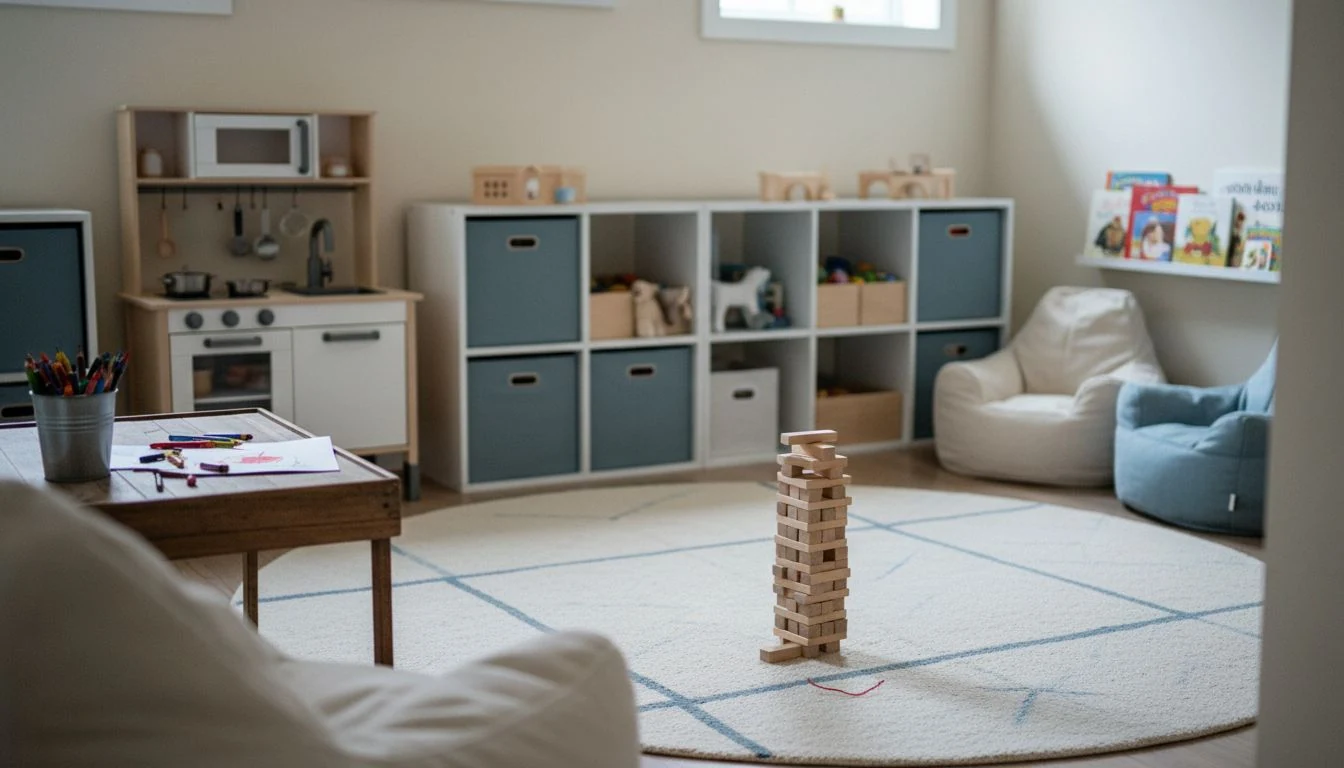
We used a rug and furniture to mark the zones, so the kids can see where one stops and the next starts. Here’s how ours is laid out, and the storage that went with each one.
| Zone | What lives there | Storage we used | The rule |
|---|---|---|---|
| Building | Blocks, train track, magnetic tiles | Low open bins on the floor along the wall, one bin per set | Sets don’t mix. Tiles never go in the block bin |
| Pretend play | Play kitchen, dress-up, dolls | A few hooks at kid height, a basket for food, a low shelf | Dress-up goes on hooks, not in a pile |
| Art and table | Crayons, paper, play dough, puzzles | Caddy on the table, puzzles in zip pouches on a shelf | Art stays at the table |
| Quiet corner | Books, two beanbags, a reading lamp | Front-facing book ledge, one basket of library books | Books, nothing else |
The zones came from watching them for a week. My son builds for hours; my daughter cooks for everyone. If your kids never touch dress-up, don’t give it a zone. If yours live for art, give it the biggest table you can fit.
Playroom storage that kids can actually use
Most of what I learned about toy storage carried over from the living room, and I wrote that system up in toy organizing ideas: sort into real categories, rotate, and keep the number of bins small enough to clear in 90 seconds. The playroom changed three things.
- Everything sits below 36 inches. If my 6-year-old can’t reach it, she can’t put it back. The high shelves hold the rotation bins and games with small pieces.
- Open bins beat lids. Lids look tidy, and nobody lifts them. Open bins get used.
- Picture labels. I printed a photo of what goes in each bin and taped it on the front. My daughter reads fine, but she sorts faster with pictures.
Anchor the shelves. Every one of our low bookcases and cube shelves is screwed into the wall, even the short ones, because a kid will climb anything. The American Academy of Pediatrics’ childproofing guide flags small objects as a choking hazard and points to its advice on furniture and TV tip-overs. Since my 6-year-old has friends with toddler siblings over, the tiny-pieces sets live on the top shelf.
Playroom organization ideas for the holiday toy wave
Between Thanksgiving and New Year’s, our kids get more new toys than in the other ten months combined. Last year I just added them to the bins. By February the bins overflowed, and I spent a Saturday sorting everything again. This year we have a plan.
- A pre-holiday clear-out in November. Each kid fills one bag of toys to donate before the holidays. They pick, I don’t.
- A landing bin. New toys go into one big bin for the first two weeks. The ones they still play with after two weeks get a real home. The rest go into rotation.
- One in, one out for big things. A new large toy (a dollhouse, a play tent) means one large toy leaves.
Broken electronic toys don’t go in the trash in our house anymore. The EPA’s page on electronics donation and recycling is where I started looking for drop-off options for the dead light-up toys and old kid tablets.
Three playroom organization ideas I got wrong first
- Buying the storage before the zones. I bought a 16-cube shelf in August. We use nine cubes. The other seven became a dumping ground.
- Making the playroom the only place toys can be. Kids want to be near you. We kept one small basket in the living room, and that’s fine.
- Cleaning it up for them. The first two weeks, I did the evening reset myself. Now it’s five minutes before dinner, kids only, with a song playing.
What didn’t work for me
I tried a big wooden toy chest at the end of the room, the kind I had as a kid. It became the bottomless bin all over again. Everything went in, nothing came out except by tipping the whole thing onto the floor, and the lid is heavy enough that I worried about little fingers. It’s a blanket chest in our bedroom now.
I also tried color-coding the bins by kid. It started arguments about whose block was whose and fell apart in a week. Sorting by toy type, not by owner, has held. For the rest of the basement, the storage zones and shelving I use are in my basement organization ideas post, and the kids’ bedrooms follow the same height rule as in kids room organization ideas.
Grab the free printable: my Playroom Zone Planner, with a room sketch grid, a picture-label sheet for bins and the two-week landing bin tracker for holiday toys. Get the free planner →
FAQ
How do you organize a playroom with a lot of toys?
Divide the room into zones by type of play, give each zone its own low, open storage, and keep only part of the toys out at a time. Rotate the rest from a high shelf or closet every few weeks.
What is the best storage for a playroom?
Low cube shelves or bookcases anchored to the wall, with open bins that kids can pull out and put back on their own. Picture labels help younger kids, and small-piece sets go up high.
How do I stop a playroom from getting messy?
A short daily reset that the kids do, with a timer or a song, and a rule that each toy goes back to its zone. Fewer toys out at once makes the reset take minutes instead of an hour.
Before December hits, walk your playroom with a notepad and write down what your kids actually played with this week. Build the zones around that list, anchor the shelves, and set out one empty landing bin for the gifts. You’ll still find a train track under something. It just won’t be every day.
Get my free Home Reset Planner
The calm, room-by-room planner I use to reset my whole home without the overwhelm. Join the newsletter and I’ll send it straight to your inbox.
No spam, ever. Unsubscribe anytime. — Lena
Keep reading — more on Home Organization

Turning a Bedroom Into a Closet Without a Remodel ($480)
Utility Closet Organization: The $40 Setup That Finally Stuck
Nursery Organization Ideas: A Calm Baby Room That Grows With Them