The man standing in my hallway had a flashlight and a phone, and the phone had a photo on it. Grey fur packed into a metal box, thick as felt. “That’s your return,” he said.
It was not my return. I had asked him twice to point the camera down the actual duct while I watched, and both times he moved on to something else. That afternoon is the reason I spent the next four months working out what an honest air duct cleaning cost looks like, who should pay it, and who is being sold something. I did pay for it in the end. It was $640, from a different company, and not for the reason the first guy was selling.
The federal guidance on this turned out to be blunter than anything the salesman told me, and it is what stopped the second visit cold with one question I would never have thought to ask on my own.
What the air duct cleaning cost on my receipt covered
My house is 1,450 square feet with one forced air system, fourteen supply registers, and a single return in the hallway ceiling. That inventory matters more than the square footage, because openings are the thing that gets priced.
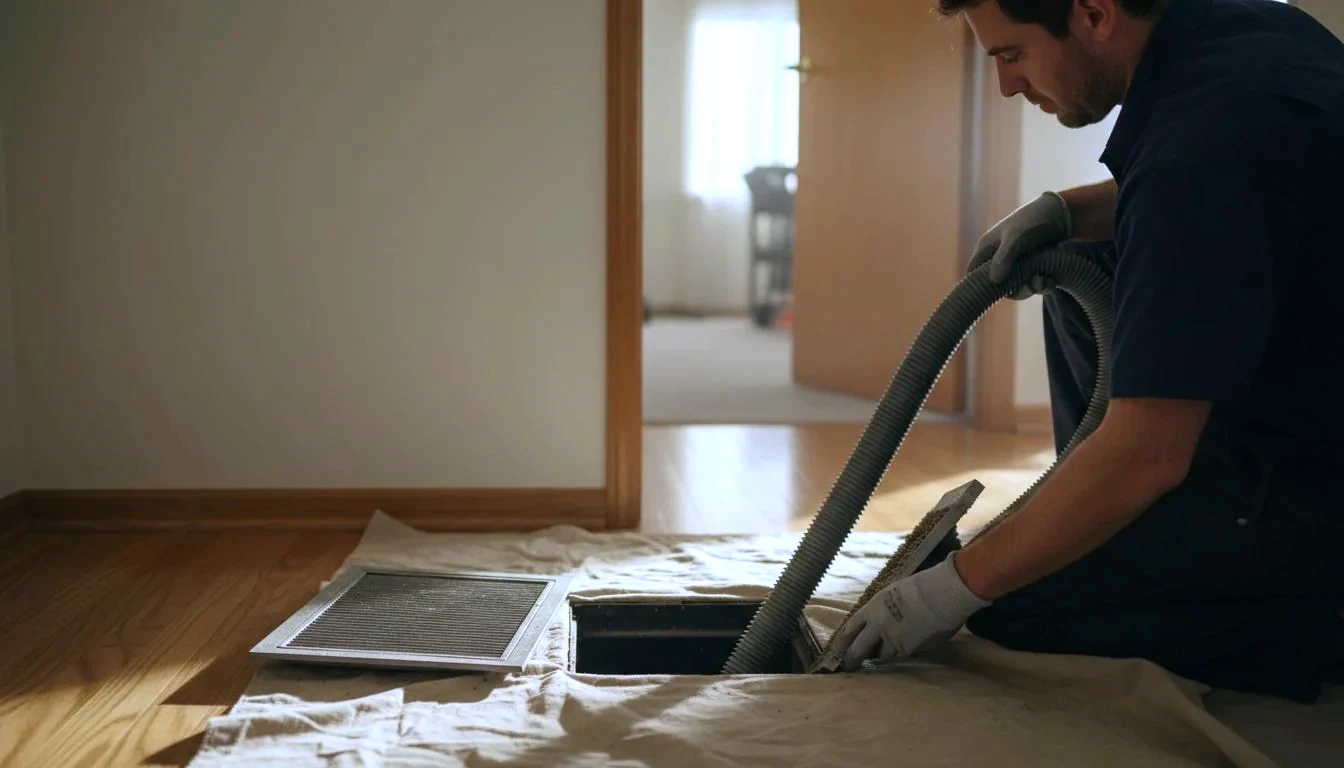
The company I used charged $640 flat. For that, two people were here a little over three hours. They cut and later resealed an access port in the trunk line, ran a negative pressure vacuum from a unit parked in the driveway, brushed each run, then did the blower wheel, the evaporator coil, and the condensate drain pan. They photographed every opening before and after with a borescope and left the photos on a USB stick, which I did not ask for and which turned out to be the most useful part.
What sold me was the estimate itself. It listed fifteen openings by location, priced the system components separately, and had a line at the bottom saying nothing would be added on site without a signature. I have started treating that last sentence as the single best predictor of whether a home services quote is real, and it is the same thing that eventually got me a fair carpet cleaning cost after a similar afternoon.
How air duct cleaning cost gets quoted, and where the teaser price hides
Three companies, three completely different shapes of number.
The first was the $89 advertisement, which is the one that put a man in my hallway. On the phone that $89 covered up to six vents. Everything past six was $35, the return line was $95 on its own, and the blower and coil were another $120. Fourteen supplies plus a return is fifteen openings, so the real arithmetic was 89 plus 280 plus 95 plus 120, which is $584 before anyone knocked on my door. That is a reasonable number for the work involved. It is also six and a half times the number painted on the van.
The second company quoted $1,180 flat and would not itemize it. When I asked what was in it, the answer included a UV lamp installed in the plenum, which is a piece of hardware they screw in and leave behind.
The third was the $640. What made those numbers comparable at all was something I did before any of them quoted me: I counted my own openings and handed each company the same fifteen. Walk the house, count every grille in a floor, wall, or ceiling, and count the big one your filter sits behind separately. It takes six minutes and it turns three unrelated numbers into three comparable ones.
Is air duct cleaning cost worth it? The three conditions that make it a yes
This is where I stopped being annoyed and started reading, because the federal guidance on this is unusually blunt.
The EPA’s consumer document on the subject says plainly that “duct cleaning has never been shown to actually prevent health problems,” and that the agency “does not recommend that the air ducts be cleaned routinely, but only as needed.” It lists exactly three conditions that justify it: substantial visible mold growth inside the ducts or on system components, ducts infested with vermin such as rodents or insects, and ducts so clogged with dust and debris that particles are actually being released into the room from your registers. You can read the whole thing at the EPA’s guidance on having your home’s air ducts cleaned.
Two lines from it changed how I handled the next two visits. One: ask the provider to show you the contamination they say exists. Two: the guidance warns against hiring anyone who recommends duct cleaning as routine maintenance, or who claims to be certified by EPA, because EPA does not certify duct cleaning companies at all.
One honest caveat about that document, since I am asking you to lean on it. It carries a publication line of October 1997, and it shows its age in places, including a cost range and a list of licensing states that I am deliberately not repeating here, because a price from 1997 is not a price. The decision criteria are the part that has not aged, and they are still the guidance EPA publishes today. Every dollar figure in this post is a 2026 quote from my own kitchen table.
My own trigger, when it finally came, was the third condition and it was my fault. We had a small bathroom remodeled in March, the drywall got sanded with the system running, and by June the registers in two bedrooms were laying down a grey line on the sill underneath them every few days. That is debris leaving the ducts and entering the room. It is the one on the list you can see from a chair.
Grab the free printable: my one-page Duct Quote Sheet, with the register tally grid to fill in before you call, the five add-ons that get quoted as mandatory and are not, and the two questions that end a sales visit early. Get the free sheet →
The add-ons, and the one I paid for
Four things were offered to me across three visits. I said yes to one. Every air duct cleaning cost I was quoted had at least two of them baked in somewhere.
The antimicrobial fogging, at $150, was the easiest no. The EPA guidance is direct about this: research has not demonstrated the effectiveness of chemical biocides in duct cleaning, and it notes that no chemical biocides are registered for use in internally insulated air duct systems. I did not need to argue about it. I just asked what was being sprayed and whether my ducts were internally lined, and the conversation ended on its own.
The $400 duct sealant coating was the one I had to think about, because the name collides with something genuinely useful. A sprayed film on the inside of a duct does something different from sealing the leaks at the joints, and only the joints job shows up on your bill.
The UV lamp at $500 sat in a different category again. It is hardware, priced during a cleaning visit, and it does nothing about the dust sitting in a duct today.
The blower wheel and evaporator coil at $120 was the yes. It is the only add-on the EPA guidance gives any ground to, noting that some research suggests cleaning components like coils, fans, and heat exchangers may improve system efficiency, while little evidence exists that cleaning only the ducts does. My blower wheel had a felted grey rim on every fin. That was the problem.
What to do instead when your ducts are just dusty
Most houses that call about this are not in one of the three conditions. Mine was not, for four months. What I would spend the money on instead is sealing.
ENERGY STAR models the typical 1970 to 1989 house as having 23 percent total system duct leakage, which means close to a quarter of the conditioned air you pay for never reaches a room. Its methodology puts the estimated annual utility bill savings from a competent air sealing and insulation job at 11 percent of the total house bill nationally, and 15 percent on the heating and cooling portion, with the northern climate zones running higher. You can see the assumptions behind those numbers in the ENERGY STAR methodology for estimated energy savings.
Washing the inside of a leaky duct recovers none of that. Sealing the joints does, every month, for as long as you own the house. So if an air duct cleaning cost is being justified to you by a vague sense that something about the air is off, sealing is where I would put the money first. Before either one, change the filter and work through the jobs that belong on a maintenance schedule instead of an invoice, which I keep in my fall cleaning checklist alongside the dryer vent, a job that has nothing to do with your HVAC ducts and is a good deal more urgent. The room by room version lives in my deep cleaning checklist.
| The line on the quote | What it usually means | What it is worth | What I did |
|---|---|---|---|
| “Whole home special, $89” | A cap of five or six vents, with the return and the system components priced separately | An anchor, not a price. Mine grew to $584 on the phone | Asked for the per vent rate and gave them my own vent count |
| Antimicrobial fogging, $150 | An aerosolized biocide blown through the system after cleaning | EPA says effectiveness in duct cleaning is not demonstrated, and none are registered for internally lined ducts | Declined, after asking whether my ducts were lined |
| Duct sealant coating, $400 | A film sprayed on the inside surface of the duct | Not the same job as sealing leaks at the joints, which is the one that lowers a bill | Declined, then priced actual air sealing on its own |
| Blower wheel and coil, $120 | Cleaning the air handler components rather than the runs | The one add-on the federal guidance gives ground to on efficiency | Paid it. The wheel was the dirtiest thing in the system |
| UV lamp in the plenum, $500 | Installing a piece of equipment during a cleaning visit | Equipment, not cleaning. It does nothing about dust already in the duct | Declined and got the visit itemized instead |
Common air duct cleaning mistakes to avoid
- Booking off a per vent price without counting your vents first. The count is the whole invoice. Six minutes with a notepad turned three incomparable quotes into a real comparison, and it is the only reason I could see that the $89 job and the $640 job were closer than they looked.
- Cleaning before you fix whatever is making the mess. The EPA guidance is explicit that if the underlying cause is not corrected first, the problem comes back. Mold that grew because insulation got wet will grow again in the same spot. I waited until the remodel dust had stopped arriving before I booked anything.
- Accepting a photo as proof of anything. A picture of a filthy duct on a stranger’s phone is a picture of a duct. Ask them to run the camera live, down your opening, while you stand there. Every company willing to do that was also the company with an itemized estimate.
What didn’t work for me
Before any of the quotes, I tried to do it myself. I bought a rotary brush kit that threads onto a drill, borrowed a shop vac, and gave up a Saturday to it.
It cleaned the first three or four feet of each run and did nothing past that, because a shop vac cannot hold the whole system under negative pressure while you agitate it. So instead of pulling dust out, I was mostly pushing it deeper, and some of it came back into the bedroom through the register I was working on. I ran an air purifier in there for two days afterward feeling fairly stupid.
The kit was $54, and it sits on the short shelf of cleaning gear I would not buy again. I do not regret it exactly. It is how I learned what the $640 buys, which is the truck in the driveway holding the whole system under suction while somebody agitates the far end.
The other thing that did not work was calling in July. Every company I reached was booked three weeks out on air conditioning emergencies and none of them wanted a cleaning job. I called back in the second week of September and had three quotes in four days. If you are planning this, the shoulder weeks between the cooling season and the heating season are when these companies have hands free, which is also when I schedule the rest of my deep cleaning schedule.
Frequently asked questions
How much does air duct cleaning cost for an average house?
My 2026 quotes for a 1,450 square foot house with fifteen openings and one system ran from $584 to $1,180, and I paid $640 including the blower wheel and coil. The number is driven by the count of registers and returns, whether the air handler components are included, and how accessible your trunk line is, not by your square footage. Get the same opening count in front of every company and the quotes turn comparable. Treat any advertised whole home price under $150 as a starting point rather than a total.
How often should air ducts be cleaned?
There is no schedule. I know how that sounds, and it is still the guidance. EPA does not recommend routine cleaning and specifically warns about providers who sell it as regular maintenance. It is an as needed job, triggered by a condition you can point a finger at: visible mold on system components, a vermin infestation, or debris visibly coming out of your registers. If none of those is true in your house, you do not have a cleaning problem yet. Changing the furnace filter on time does more for you than a five year cleaning cycle would.
Does air duct cleaning help with allergies or dust in the house?
I cannot tell you it will, and the federal guidance will not either. EPA states that duct cleaning has never been shown to actually prevent health problems, and that studies do not conclusively demonstrate that particle levels in homes rise because of dirty ducts, largely because much of the dirt adheres to the duct surface instead of traveling into the room. Cooking, cleaning, and simply moving around a house put more particles into your air than the ducts do. My own dust did drop after the work. My trigger was visible debris leaving the registers after a remodel, which is a mechanical problem with a mechanical fix, and a narrower reason to spend the money than hoping for cleaner air.
If you are looking at a quote this week, do these three things in this order. Count your registers and your returns and write the number down. Ask each company for a per opening rate, an itemized estimate, and whether the blower and coil are in or out. Then ask whoever shows up to point a camera down your duct while you watch. That last one cost me nothing, and it is what turned a $584 sales visit into a $640 job I would book again.
Get my free Home Reset Planner
The calm, room-by-room planner I use to reset my whole home without the overwhelm. Join the newsletter and I’ll send it straight to your inbox.
No spam, ever. Unsubscribe anytime. — Lena
Keep reading — more on Home Services & Costs

Home Staging Cost: What Stagers Charge (and What You Can Do Yourself)
Local Movers Cost: Hourly Rates, Crew Size, and What Adds to the Bill
Rug Cleaning Cost: Area Rugs, Wool, and When It’s Worth Sending Out