
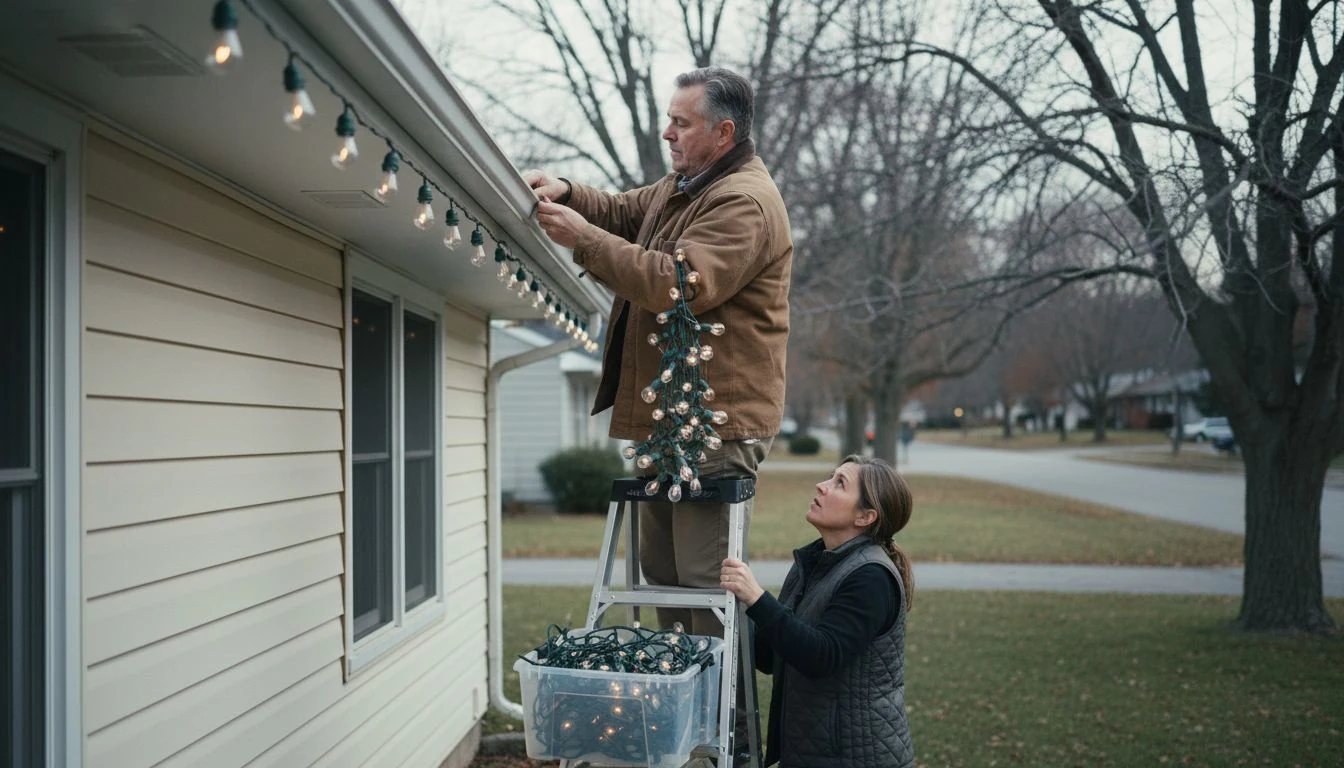
I spent a Saturday in November two years ago trying to get lights onto the front of our house, and I came down off the ladder at four in the afternoon with forty feet done out of a hundred and forty, wet socks, and hands too cold to work a plastic clip.
The next morning I started calling around about Christmas light installation, mostly to find out how insulting the number would be. Four companies quoted the same roofline. The spread ran from $315 to $522, and almost none of that gap came from what a crew charges for time on a ladder. It came from which lines each company left out of the first number they said out loud.
Here is our front: 140 linear feet across, a single-story eave at about eleven feet, and one two-story gable over the entry that peaks somewhere near twenty-two. That gable is the whole story of the pricing, and I did not understand that until the third call.
What Christmas light installation actually costs, quoted four ways
I called in early September, which turned out to matter, and I asked all four for the same thing so the numbers would sit next to each other. Treat these as quotes I was given in one market in 2026. They are not a national average, and the crew that does your neighbor’s house has its own math.
- Company A: $2.25 per linear foot with their lights, so $315 for the run. Takedown in January included. The lights go back on their truck.
- Company B: $1.60 per linear foot if I supplied the lights, so $224. Then $85 for second-story access on the gable. Takedown quoted separately at $140.
- Company C: flat package. $450 for a single-story front up to 150 feet, lights and takedown and off-season storage all in.
- Company D: $95 an hour for a two-person crew with a three-hour minimum. She estimated four hours, so $380, plus about ninety minutes in January at the same rate.
Read down that list quickly and Company B wins. I wrote the four numbers on the back of an envelope and B lost.
The cheapest rate per foot produced the second most expensive job
Company B’s $1.60 was the lowest per-foot rate anybody quoted me, and by the time the job was hung and taken down again it came to $449. The gable surcharge added $85, because ladder work over the entry is a different job from the eave. The January takedown added $140 on its own invoice.
Company C’s flat $450 covered the same work, plus the lights, plus a shelf in their warehouse from January to November. The two totals landed a dollar apart. One of them took four phone calls to assemble and the other took a card number.
The rate is what they lead with because the rate is what compares well. The gable, the takedown and the lights are three separate lines, and every company draws those boundaries somewhere different. I ask for the all-in figure now, install plus takedown, before I write anything down.
Christmas light installation with the lights you already own
Two of the four quotes included lights, and both of those are leases. The strands are theirs, they come off in January, and year two costs the same as year one. That is a fair deal if you never want to think about a bin again. It is a bad surprise if you assumed you were buying something. If buying something is what you want, a track system that stays up all year is a different product, and I priced it for the same roofline in permanent Christmas lights cost.
The bring-your-own route has its own gate. Company B told me plainly that they inspect what you hand them and will refuse a strand they do not like, which sounded like an upsell until I read the actual guidance. The U.S. Fire Administration says to inspect holiday lights each year before you put them up, throw away strands with frayed or pinched wires, and follow the manufacturer’s instructions for how many strands may be connected end to end. An installer who refuses your 2014 incandescents is applying somebody else’s rule rather than inventing one.
Which is where the bring-your-own savings tend to go. If the bin has to be replaced anyway, price the replacement before you pick the cheap quote. ENERGY STAR certified light strings use about 92 percent less energy than incandescent strands, last up to ten times longer, and run cool to the touch, so the swap earns itself back over several seasons. It still lands on this December’s card.
Either way, the strands have to live somewhere for ten months that is not a heap on the garage floor, and how you coil them in January decides whether they pass inspection next fall. Mine sit in a labeled bin now, sorted the weekend I finally dealt with our garage storage.
Grab the free printable: my one-page Light Install Quote Sheet, with the measuring line for your roofline, the six questions that pull the hidden lines out of a quote, and the January takedown checklist that keeps your strands usable next year. Get the free sheet →
Why the January takedown costs about half
The back half of a Christmas light installation gets priced like a different job, because it is one. Company B’s install was $224 and the takedown was $140. Company D estimated four hours up and ninety minutes down. The ratio held everywhere I asked, and once somebody explained it, it stopped sounding like a discount.
Hanging is a fitting job. Somebody measures the run, cuts or spaces the strands to it, works out where the power comes from, and clips every foot of it to a gutter lip or a shingle edge. Taking it down is unclipping and coiling. Every decision has already been made, so it moves about twice as fast.
Two questions are worth asking on the first call. Is the takedown inside the number you just gave me, and what is the window in January. Company C answered “first two weeks, weather permitting,” which is the kind of specificity that tells you they have done this. Company D said “we get to everyone by February,” and a string still hanging over the entry in February undoes most of the point of paying. If you already run some version of a new year home reset, that is the week to book it into.
Where the ladder stops being the right tool
The eave across the front sits at about eleven feet on level lawn. That is an extension ladder and a free Saturday, and I have done it.
The gable over our entry is another matter. It peaks near twenty-two feet, there is a flowerbed under it, and the ground slopes toward the driveway. All four companies priced that section separately or flagged it on the phone, which told me something before I had done any thinking of my own.
The test I use now has nothing to do with a number of feet. Can the ladder stand on level ground, at the right angle, with the work reachable without leaning past the rails? On our eave, yes. On the gable, no, and no amount of care fixes a ladder foot planted in a flowerbed. Buying Christmas light installation for that one section and doing the eave yourself is a legitimate answer, and two of the four quoted it that way when I asked.
Everything above is the outside of the house. The inside is a separate trade: a holiday decorator does the tree, mantel and stairs, and I compared three of those quotes for my mom in what a Christmas decorating service costs.
When Christmas light installation is not worth paying for
Three of the four had minimum charges between $250 and $350. If your run is forty feet of single-story eave you can reach off a stepladder, you are paying that minimum for about twenty-five minutes of somebody’s afternoon.
The same goes for porch railings, a wreath, and a tree in the front window, which is most of what people picture when they picture a decorated house. None of that is roofline work and none of it needs a crew.
Hiring earns its money on height, on length, and on the specific December where you have neither the Saturday nor the appetite. That last reason counts, and I stopped apologizing for it. The year we paid, I spent the Saturday I got back on the inside of the house, which is the part that shows once people are standing in it. Facing both jobs at once, the honest order is decluttering before the holidays first, preparing the house for guests second, and the roofline behind both.
What the calendar does to a Christmas light installation quote
I called in the first week of September for a job that would happen in November, which felt absurd while I was dialing. It was the same week I was working through the rest of our fall home reset, so the phone calls rode along with everything else. Three of the four thanked me for calling early, and one said it in the tone of a woman who spends late November saying no to people. I asked all four the same question about their own calendars, and the answers lined up closely enough to be worth writing down.
| When you call | What was still open | What it did to the quote | The catch |
|---|---|---|---|
| Early September | Any install week, weekends included | Two held an early-booking rate. One took $40 off the flat package | You commit to a date two months out, usually with a deposit |
| Early October | Most weeks. Weekends thinning at the two busiest | No change to any of the four numbers | Your date comes from what is left rather than from the whole month |
| First week of November | The crew assigns you a date and you accept it | Still no surcharge, and no room to negotiate either | If weather moves your slot, you go to the back of the queue |
| Thanksgiving week | One of the four, waitlist only | A rush rate on top of the standard quote | You are in line behind everyone who tried it themselves first |
| Mid-December | Repairs and takedown bookings | Nobody was quoting new installs at all | The only thing you can still book in December is January |
Three things I got wrong the year I did it myself
- I bought the clips after I bought the lights. Gutter clips, shingle tabs and railing clips are three different products, and I owned the wrong one for two thirds of the house. That is what ended the Saturday, not the cold.
- I measured the front of the house off the drawing. Our plans say 118 feet. The roofline is 140 because it turns, and it turns four times. Walk it with a tape along the gutter, corners and all.
- I put them away warm and tangled. Everything I pulled out of that bin the following November had to be tested strand by strand, and two of them were dead. January is when next November gets decided.
Frequently asked questions
How much does Christmas light installation cost?
The four companies I called in 2026 quoted my 140-foot roofline at $315, $449, $450 and roughly $522 with the January takedown counted in. The rates came in three shapes: $1.60 to $2.25 per linear foot, a flat package around $450, and $95 an hour for a two-person crew. Ask for the all-in figure including takedown, because the per-foot rate leaves out the lines that move the total most.
Do installers use their own lights or mine?
Both models exist. Companies that supply the lights are leasing them to you, so the strands leave in January and year two costs the same as year one. Companies that hang yours will inspect them first and can refuse a strand with damaged wiring. If your bin is old enough that it needs replacing anyway, price the new lights before you decide the bring-your-own quote is the cheaper one.
Is the takedown included in the price?
Sometimes, and it is the single line most worth confirming. Two of my four quotes included it and two billed it separately at roughly half the install cost. Ask for the January window in weeks rather than in the phrase “after the holidays.” A company that answers “the first two weeks of January, weather permitting” has done this before.
If you are anywhere near deciding, call in September, even though it feels ridiculous while you are standing in a warm house. You are not buying lights in September. You are buying a date, a rate that has not moved yet, and the version of this where somebody answers the phone. The most expensive Christmas light installation is the one booked on the Tuesday before Thanksgiving, and the second most expensive was the Saturday I spent on a ladder for forty feet.
Get my free Home Reset Planner
The calm, room-by-room planner I use to reset my whole home without the overwhelm. Join the newsletter and I’ll send it straight to your inbox.
No spam, ever. Unsubscribe anytime. — Lena
Keep reading — more on Home Services & Costs

Home Staging Cost: What Stagers Charge (and What You Can Do Yourself)
Local Movers Cost: Hourly Rates, Crew Size, and What Adds to the Bill

Rug Cleaning Cost: Area Rugs, Wool, and When It’s Worth Sending Out