The week before school started last year, I opened my niece’s dresser to find three drawers of clothes that no longer fit her and one drawer stuck half-shut on a pair of leggings from two summers ago. That’s the moment I got serious about kids clothes organization as its own project, separate from the toys and the backpack chaos. Sorting by what actually fits, right now, is the whole game. Folding cuter comes way later, if ever.
This is the exact order I use every August, and it takes an afternoon, not a weekend. No color-coded bins you’ll abandon by October. Just the sort, the drawer map, and the one Sunday habit that keeps it from unraveling by the second week of school.
Jump to:
- Why kids clothes organization falls apart so fast
- Start with the four-pile sort (fits, grows, goes, gone)
- Map the drawers so a five-year-old can put it back
- What earns hanging space in a kid’s closet
- The Sunday outfit trick that saves the morning
- Get the kids doing it (mostly)
- What didn’t work for me
- Frequently asked questions
Why kids clothes organization falls apart so fast
Kids grow out of clothes about every three months when they’re little, and a size or two a year once they hit school age. So the system isn’t fighting mess. It’s fighting a moving target. A drawer you organized perfectly in April is holding a pile of too-small shirts by August, and nobody noticed because the clothes never left the drawer.
The other reason it collapses: most of us organize a kid’s dresser the way we’d organize our own, then hand it to a six-year-old who cannot maintain it. Good kids clothes organization is built for the shortest, least patient person in the house. If they can’t see it and reach it, it’s going on the floor. Every time.
Start with the four-pile sort (fits, grows, goes, gone)
Pull every single thing out. All of it, onto the bed, the same way I’d empty a closet before rebuilding it. You can’t decide what to keep while it’s still crammed in a drawer. Then make four piles, and be honest, because the whole system only works if this part is ruthless.
| Pile | What goes in it | Where it ends up |
|---|---|---|
| Fits now | Try-on confirmed, comfortable, worn in the last month | Back in the dresser and closet |
| Grows into | Next size up, hand-me-downs, gifts still too big | Labeled bin in the closet, sorted by size |
| Goes | Outgrown but in good shape | Donate or pass down within two weeks |
| Gone | Stained, holes, stretched-out, single socks | Textile recycling, not the trash |
My rule for the “fits now” pile: if it hasn’t been worn in a month and it’s not seasonal, it goes in the “goes” pile. Kids wear the same eight favorite things on rotation anyway. Last August I cut my niece’s shirt count from 22 down to 11, and getting dressed got faster, not harder. For the outgrown-but-good pile, the EPA notes that keeping textiles in use through donation and reuse is far better than landfilling them, and most towns have a bin within a few miles (EPA guidance on reducing waste).
Map the drawers so a five-year-old can put it back
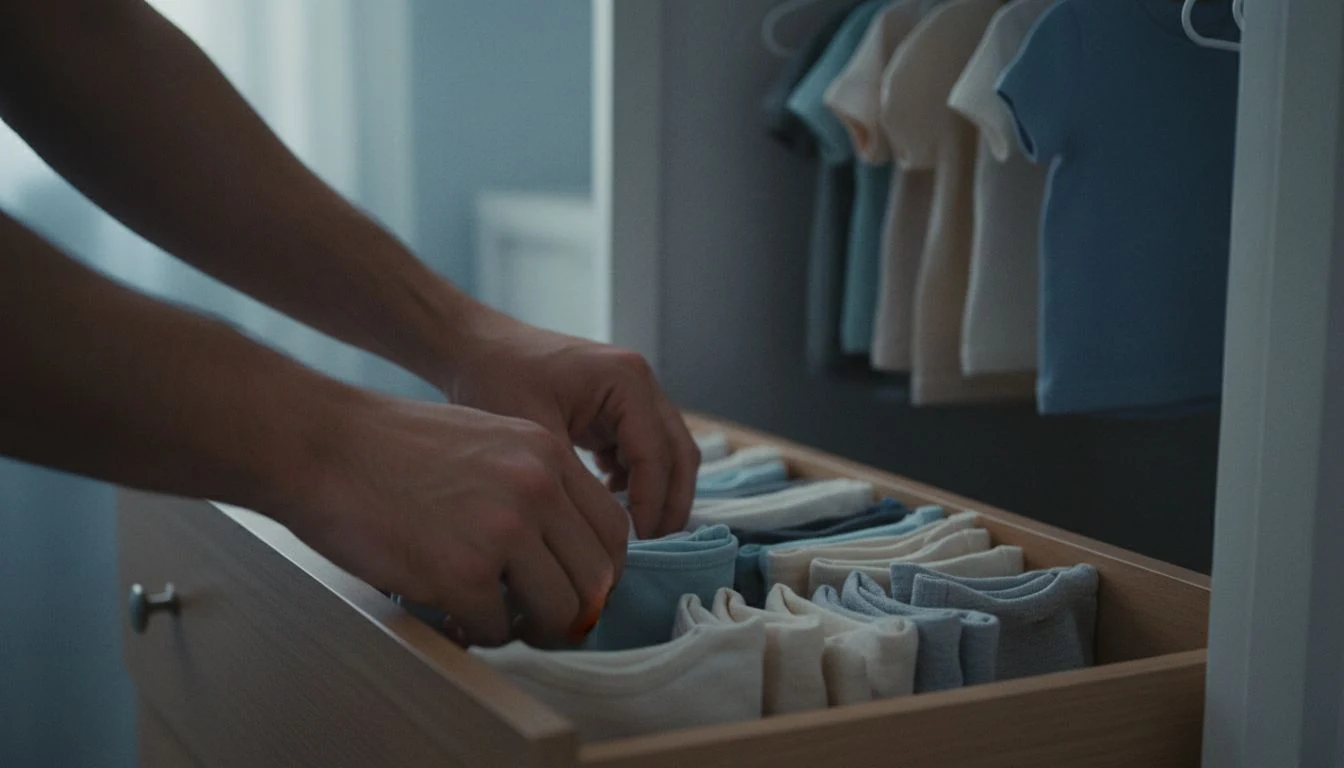
Here’s where kids clothes organization actually gets kid-proof. Assign each drawer one category and keep it stupidly obvious. Top drawer, underwear and socks. Next drawer, shirts. Then bottoms. Then pajamas. That’s it. When there’s one type per drawer, a kid who can’t read yet still knows where the socks live.
Inside each drawer, file everything upright instead of stacking. Fold a shirt into a small rectangle, then stand it on its edge like a folder in a filing cabinet, so every shirt shows its front and you pull one without wrecking the rest. Flat stacks are why the bottom shirt never gets worn and the whole pile topples by Wednesday. I use two cheap drawer dividers per drawer to hold the rows in place, and that’s the entire hardware budget. If you want the room-wide version of this, my kids’ room organization plan covers the toys and desk with the same reach-it-or-lose-it logic.
What earns hanging space in a kid’s closet
Kids don’t need much on hangers. Most of their wardrobe folds fine and lives in drawers they can reach. So I hang only the things that wrinkle or feel special: button-downs, dresses, the one nice jacket, and anything for a specific event. Everything else stays folded and low.
The single best closet change is a cheap thing: lower the rod, or add a second rod at kid height so they can hang and grab their own clothes. A rod at four feet does more for daily independence than any bin system. Up top, out of reach, is where the “grows into” bins go, labeled by size (4T, 5T, 6) so next season’s clothes are already sorted and waiting. When a growth spurt hits, you shop your own closet before you shop a store. For the folding-and-filing method itself, my small closet organization guide works the same on a kid’s scale.
The Sunday outfit trick that saves the morning
This is the habit that keeps the whole thing from sliding back. Every Sunday night, my niece and I set out five outfits for the school week, full sets, into a hanging cubby organizer with a slot per day. Shirt, bottoms, socks, all together. Monday morning she grabs a slot and she’s dressed in two minutes with zero negotiation about the sparkly leggings.
It sounds fussy. It saved us roughly ten minutes of arguing every school morning, which over a week is more than an hour of my life back. A five-slot cubby costs about twelve dollars and it’s the only “system” in this post I’d call non-negotiable once school starts. It also surfaces the “this doesn’t fit anymore” discoveries on a calm Sunday instead of a frantic Monday.
Get the kids doing it (mostly)
A system a kid can’t run is a system you’ll be running forever. So build it for their hands and then hand it over. Putting away their own laundry, choosing between two shirts, loading their Sunday slots. The American Academy of Pediatrics points out that age-appropriate chores build real responsibility and confidence, and sorting laundry is one they list as doable young (HealthyChildren.org on chores).
Will it be as tidy as if you did it? No. My niece’s sock drawer looks like a small weather event most weeks. But she can find her socks, she put them there, and she stopped melting down about getting dressed. That trade is worth a messy drawer. If mornings are the real battle at your house, my post on keeping a tidy home with kids goes deeper on the habits side.
Common kids clothes organization mistakes to avoid
- Organizing by outfit instead of by category. Pre-matched sets look adorable and fall apart in one laundry cycle. Sort by type (shirts with shirts) and pre-set outfits only for the coming week, not the whole wardrobe.
- Keeping every size “just in case.” The too-small pile is not a keepsake box. Move outgrown-but-good clothes out within two weeks or the closet quietly fills back up with things nobody can wear.
- Building it at adult height. If the rod, the bins, or the hooks are above your kid’s reach, you’ve made yourself the permanent operator. Lower everything to their level and the clothes actually go away.
What didn’t work for me
Plenty of the popular kids clothes organization advice went straight back out the door. The matching fabric bin sets were the prettiest failure. Opaque and unlabeled, they meant pulling out all six to find the shorts, so within a month everything lived on top of the bins instead of in them. Clear or open-front won. Cute and closed lost.
The full drawer-labeling routine was my other flop. I spent one ambitious Sunday making little picture labels for every drawer, and they curled off by the following weekend. Turned out one category per drawer was so obvious the labels were solving a problem I’d already solved. I peeled them off and nothing got worse.
And I tried keeping a big “memory box” of outgrown favorites, which quickly became a bottomless bin of everything I felt guilty donating. Now I keep exactly one gallon bag per kid for the truly sentimental pieces and let the rest go. The guilt was heavier than the clothes.
Grab the free printable: my one-page Kids’ Clothes Sort & Size Chart, the same fill-in sheet I use to run the four-pile sort and log what’s waiting in each “grows into” bin. Get the free sort chart →
Frequently asked questions
How do I organize kids clothes by size for hand-me-downs?
Use one labeled bin per upcoming size (4T, 5T, 6) stored up high, out of daily reach. As clothes get gifted or handed down, sort them straight into the right bin instead of a mixed pile. When your child moves up a size, you pull that bin down and it’s already curated. It turns a growth spurt from a shopping emergency into a five-minute swap.
What’s the best way to fold kids clothes so they stay put?
File them upright rather than stacking flat. Fold each item into a small rectangle so it stands on its edge, then line the rectangles up in a row like books, held by one or two drawer dividers. Your kid can see every shirt at once and grab one without collapsing the rest, which is the exact thing that keeps flat stacks from staying tidy.
How often should I go through my kids’ clothes?
Twice a year as a full sort, timed to the season change, plus a two-minute check whenever something comes out of the wash looking short. Little kids grow fast enough that a quarterly glance saves you from drawers full of clothes that stopped fitting weeks ago. Set a phone reminder for August and January and let the laundry catch the in-between.
Get my free Home Reset Planner
The calm, room-by-room planner I use to reset my whole home without the overwhelm. Join the newsletter and I’ll send it straight to your inbox.
No spam, ever. Unsubscribe anytime. — Lena
Keep reading — more on Home Organization

Small Apartment Organization Ideas (Renter-Friendly, No Drilling)
Mudroom Organization Ideas That Survive Wet-Boot Season

Home Office Organization Ideas for a Small Space