For three years my front door opened onto a pile. Shoes kicked off in a heap, a backpack slumped against the wall, two jackets on the floor because the single hook was already full, and a drift of mail on the radiator cover that I would "deal with later." The first thing I saw coming home, every single day, was a small monument to my own chaos. Most entryway organization ideas I tried looked great in the before-and-after photo and were a wreck again by Thursday.
This is the version that finally stuck in my narrow rental entry, the one that is maybe four feet of wall and no closet. No mudroom, no built-ins, no Pinterest budget. Just what I actually did in an afternoon, what it cost me (about $30), the thing I wasted money on first, and how to build a drop zone that still works on a Monday when everyone is late.
Why most entryway organization ideas fall apart by Thursday
Most entryway organization ideas are designed for the wrong moment. They assume you come home calm, with two free hands, ready to place each item in its labeled home. Real life is you, three bags, a phone between your shoulder and ear, and a kid already asking for a snack. If the system needs more than three seconds, it loses.
The rule I follow now is dead simple. Every single thing that comes off your body at the door needs a landing spot you can hit without looking. Shoes, bag, keys, coat, mail. Five things. If any one of them has no obvious home, that is the one that becomes the pile. I learned this the slow way, after a tidy entry collapsed in a week because I never gave the mail anywhere to go.
Start with the shoe pile (it is the whole problem)
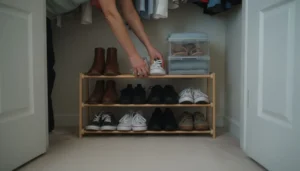
Nine times out of ten the entry mess is a shoe mess. So I started there. I pulled every pair out, and there were sixteen, which was embarrassing for a household of three. Half were shoes nobody had worn since the previous summer.
I sorted them fast, the same way I sort anything I am done arguing with myself about. If you want the full method I lean on for this, my guide on what to declutter first walks through the order that keeps you from stalling.
- Daily pairs stay by the door. Two per person, max. These are the only ones that earn prime real estate.
- Seasonal or rarely worn go to the closet. My snow boots do not need to live by the front door in June.
- Donate or toss the rest. Six pairs left my house that afternoon. The entry had room to breathe again.
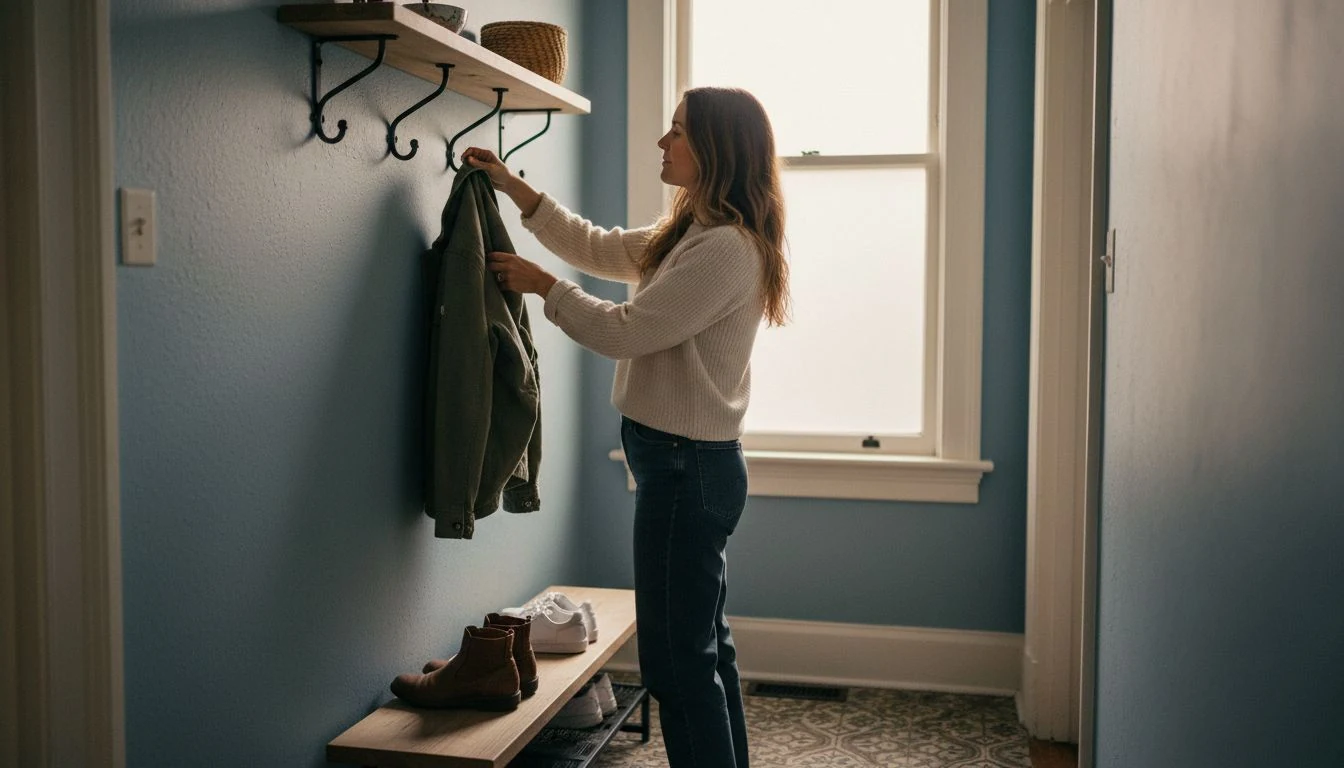
For the pairs that stayed, I used a $0 fix: a low open bench I already owned, with a single boot tray underneath to catch the wet ones. Open storage matters here. The second shoes have to go inside a closed cabinet, my family stops putting them away, and we are back to the heap.
Entryway organization ideas that survive a real family
Once the shoes had a home, the rest came together around what I think of as the five-second rule: every action at the door has to be faster than dropping the thing on the floor. That is the whole design brief.
I put up a row of hooks at three different heights. The high ones for adult coats, a middle one for bags, and two low hooks my kid can actually reach, because a coat hook mounted at grown-up height might as well not exist for a six-year-old. The hooks cost me $12 for a strip of five. Best money in the whole project.
Above the bench I added one shelf with a single basket on it. The basket is the catch-all for the random stuff that has no other home: sunglasses, the dog leash, a stray glove. One basket, not five. When it overflows, that is my signal to spend two minutes emptying it, not a reason to buy more baskets. If bins and plastic are not your style, the basket swaps in my post on organizing without plastic bins are the ones I actually use.
A clear entry is not only about looks, either. Keeping the path to your door free of clutter is a genuine safety thing. The National Institute on Aging notes that clearing walkways of objects you can trip over is one of the simplest ways to prevent falls at home, and a shoe sprawl across a doorway is exactly the hazard they mean.
A landing zone for keys, bags, and the mail you keep losing
The mail was my downfall last time, so this time it got its own dedicated spot. On the shelf I put a small flat tray, $6 from the hardware store, and made a single rule: keys go in the tray, mail goes in the tray, nothing else. When the tray gets full of mail, it gets sorted that night. The tray being small is the point. It forces the habit before paper takes over the whole surface again.
I also keep one boring but useful thing by the door now: a slim folder for the stuff you grab on the way out in a hurry. A spare mask, the library books due back, the form the school needs signed. Ready.gov actually recommends keeping an emergency kit somewhere accessible near an exit, and the door is the logical place, so my folder lives next to a small grab bag. Two birds.
If your hallway doubles as a coat-and-shoe overflow for a bedroom closet too, it helps to fix both at once. My small closet organization ideas cover the seasonal shoes and coats that should not be competing for entry space in the first place.
What didn’t work for me (and what I’d skip)
I want to be straight about the money I wasted, because nobody puts this part in the pretty posts. First, I bought a tall narrow shoe cabinet, the kind with the tilt-out drawers. It looked sleek for about a week. Then my family stopped using it because tilting a drawer, placing a shoe, and closing it is four steps, and four steps loses to the floor every time. It cost $45 and I gave it away.
I also tried the matching-basket look, three of them lined up on the shelf. Pretty in the photo, useless in practice, because nobody could remember which basket held what and they just became three small piles instead of one big one. One labeled catch-all beat three coordinated ones easily.
And I overbought hooks at first, mounting eight in a four-foot space. It looked like a coat-rack store and the wall got crowded and visually loud, which is the opposite of the calm I was after. Five hooks was plenty. With organizing, especially in a tight entry, less hardware almost always wins. It is the same lesson I keep relearning when I try to keep a tidy home with kids: the simpler the system, the more likely they are to actually use it.
The cheap entryway fixes ranked by payoff
If you only have an hour and twenty dollars, do not try to do everything. These are the fixes I made, ranked by how much calmer each one made the door for the money, so you can start with the biggest win.
| The entryway problem | The fix that worked | What it cost me | Payoff |
|---|---|---|---|
| Shoe heap by the door | Cull to 2 pairs each, open bench + boot tray | $0 (owned the bench) | Biggest. Cleared 80% of the mess |
| Coats and bags on the floor | Strip of 5 hooks at three heights | $12 | High. Kids finally hang their own coats |
| Keys vanishing every morning | One small tray, keys-only rule | $6 | High. Zero frantic key hunts since |
| Mail drifting across surfaces | Same tray, sort-when-full rule | $0 | Medium. Needs the nightly habit to hold |
| Random clutter (gloves, leash) | One basket on a single shelf | $6 | Medium. Empty it before buying more |
Common entryway organization mistakes I made first
- Buying storage before culling the shoes. I sized a cabinet to sixteen pairs when I really only needed room for six. Declutter first, shop second, always.
- Choosing closed storage over open. Anything with a lid or a drawer is where my family’s good intentions go to die. If it is not grab-and-drop fast, it does not get used.
- Mounting hooks at one height. All-adult-height hooks meant my kid’s coat stayed on the floor for a month. Low hooks fixed it in a day.
Grab the free Entryway Reset Checklist. One page: the shoe-cull steps, the five landing spots every entry needs, and a quick hook-height guide you can tape inside a cabinet door. Print it, work one zone at a time, done.
Keeping the entry calm past the first week
The truth is my entry does not stay perfect, and I stopped needing it to. What keeps it functional is a thirty-second reset I do while I take my own shoes off: nudge the daily pairs onto the tray, hang whatever slid off a hook, and drop the day’s mail in the tray to deal with that night. Thirty seconds, every day, beats a two-hour overhaul every month. Building the habit into something I already do, like the routines in my post on how to organize around your routine, is the only reason it lasts.
Start with the shoes. If that is the only thing you do this weekend, your door will already feel like a different place to come home to.
Frequently Asked Questions
What are the best entryway organization ideas for a small space with no closet?
Go vertical and open. A strip of wall hooks at two or three heights, one slim bench with a boot tray underneath, and a single shelf with a tray for keys and mail will handle most of the mess. Open storage beats closed cabinets in a small entry because people actually use it.
How do I stop shoes from piling up at the front door?
Cap how many pairs live there: two per person, daily wear only. Move seasonal and rarely worn shoes to a closet. The pile is almost always a quantity problem, not a storage problem, so cull before you buy anything.
How much does it cost to organize an entryway?
Less than you would think. My whole reset came to about $30, and the single most effective fix, culling the shoes and using a bench I already owned, cost nothing. Start with what you have before spending a cent.
Get my free Home Reset Planner
The calm, room-by-room planner I use to reset my whole home without the overwhelm. Join the newsletter and I’ll send it straight to your inbox.
No spam, ever. Unsubscribe anytime. — Lena
Keep reading — more on Storage Solutions
Shed Organization Ideas for the Fall Clean-Out
Wrapping Paper Storage Ideas That Stop the Crushed-Roll Problem
Floating Shelves for Small Spaces: Where They Work (and Where They Fall Off the Wall)