My first apartment was 480 square feet and I owned nine storage bins. Nine. They lived in a tower in the corner of the living room, and one night I stood there and did the math: the bins were eating more floor space than the stuff inside them ever would. That is the trap with most storage ideas for small spaces. They sell you containers when what you needed was a decision.
This is the version I wish someone had handed me at 25. It’s a way to find the square footage you already own, use the walls without putting a bookcase on your kid, and keep the place looking calm instead of like a storage unit exploded. I still live small. Most of what’s below has survived three moves.
Jump to:
Why most storage ideas for small spaces quietly fail
It took roughly $200 in wasted bins to convince me that a small room doesn’t have a storage problem. It has a volume problem. Storage is where we hide the evidence.
I spent two years buying my way around that. Every time a corner got messy I bought a thing to put the mess in, and the thing took up space, so the room got smaller, so more of it looked messy. Round and round. The bins were a coping mechanism with a price tag.
The shift came when I stopped asking “where can I put this” and started asking “does this live here.” Those sound like the same question. They are not even close. The first one ends at Target. The second one ends with a bag by the door and a room that breathes.
Before you buy a single organizer, it helps to know what you actually own. The University of Minnesota Extension recommends keeping a household inventory for insurance reasons, and that is why I started one. But writing my own stuff down, room by room, turned out to be the cheapest decluttering tool I have ever used. You cannot un-know that you own four sets of sheets for one bed.
Start with a zone audit, not a shopping cart
Give this fifteen minutes. Walk your place with your phone and photograph every spot where things pile up. Not the tidy spots. The shameful ones. The chair. The counter by the mail. The floor of the closet.
I did this in my current place last January and found six pile zones. Six, in 620 square feet. Five of the six sat within three feet of a door, which is the part that stung. My stuff was landing exactly where I walked in and gave up.
That told me where the storage had to go: wherever my hands were already dropping things, rather than wherever a bin would look best. I moved a shallow basket to the spot my keys had been living on the floor for a year, and the floor pile stopped in about four days. Not because I got disciplined. Because the basket finally showed up where my hands already were.
The storage ideas for small spaces that stuck for me all came out of that photo walk, not out of a store. If your entryway is the worst offender, that’s normal, and I wrote a whole plan for it in my entryway organization ideas. Do that zone first. It sets the tone for everything behind it.
Go vertical, but anchor it
Small spaces are almost never out of room. They are out of floor. Look up: most of us have three or four feet of dead wall above eye level in every room, and nobody is charging us rent on it.
In my kitchen that meant one rail with S-hooks above the stove, which got six pots off a shelf and gave me back an entire cabinet for $14. In the bathroom it meant a narrow shelf over the door, and that is where the extra toilet paper lives now instead of in a bag on the floor.
One caveat I don’t treat as optional: anything tall and top-heavy has to be anchored to the wall. The CPSC’s Anchor It! campaign exists because unsecured furniture and TVs tip over onto kids, and their reporting puts it at roughly 38,000 emergency room visits a year, two-thirds of them children under five. An anti-tip kit runs about $10. My tall shelf sat unanchored for a month because I told myself I’d get to it. Then my sister’s toddler visited and used it as a ladder. I anchored it that night with shaking hands.
The best storage ideas for small spaces are the ones you can reach in one motion
The rule that changed my house: if putting something away takes more than one motion, I won’t do it. I stopped pretending otherwise about three years ago, and my house got tidier the week I admitted it.
One motion means: open the basket, drop it in, done. Not lift the lid, move the bin on top, unzip the pouch, place item, re-stack. That is five motions and a personality I do not have at 9 p.m.
So the lids came off. Almost all of them. Lidded bins are for the attic and for things I touch twice a year, like the Christmas stuff. Everything in daily rotation lives in something open: a basket, a tray, a drawer with a divider. My sweaters sit in two open canvas bins on a closet shelf, I have never once folded them beautifully, and the closet still reads calm from the doorway because the containers match and the mess stops at eye level.
The same logic drives my small closet organization ideas and the way I set up a small kitchen on a budget. Fewer steps, always. Pretty comes second, and pretty usually shows up on its own once the friction is gone.
The square footage everyone forgets
The cheapest storage ideas for small spaces are the ones already sitting in your apartment, unused. Every place I have lived in had at least 8 to 10 square feet I was ignoring, and it hides in the same four spots.
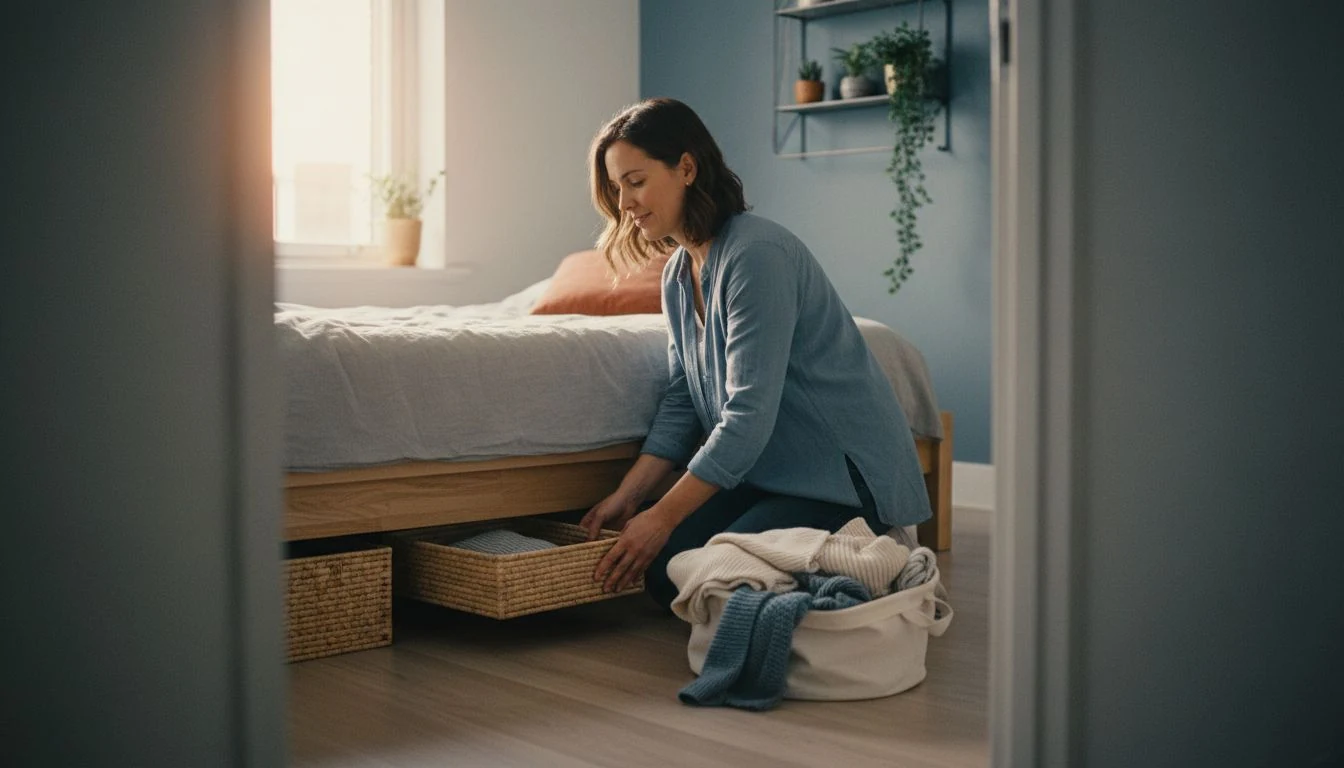
- Under the bed. Roughly 20 square feet of flat floor, and most people store nothing there or store chaos there. Mine holds off-season clothes in two flat rolling bins. If your frame sits low, risers buy you another six inches for about $12.
- The back of every door. Bedroom, bathroom, pantry, closet. An over-door rack turned my hall closet door into where the cleaning supplies live.
- The gap beside the fridge. Mine was 4 inches wide and held nothing but dust for a year. A narrow rolling cart now holds oils, foil, and the snacks I don’t want on the counter.
- The vertical inside of a cabinet. A cabinet is a box, and most of us use the bottom two inches of it. One $12 shelf riser doubles a shelf, which sounds obvious and took me until 31 to do.
A note on what goes in these places. I went through a phase of buying clear plastic bins for everything, and I have walked most of it back. It looked like a supply closet, the plastic cracked, and I wrote about the honest switch in organizing without plastic bins. Baskets cost more up front and I still have every one of them.
My storage ideas for small spaces, zone by zone
These are the storage ideas for small spaces I actually paid for, audited in my 620-square-foot place. I’m listing the prices because every roundup I read at 25 left them out.
| The dead zone | What actually fits there | What it cost me |
|---|---|---|
| Wall above the stove | 6 pots and pans on a rail with S-hooks; freed a whole cabinet | $14 rail |
| Under the bed | Off-season clothes, 2 flat rolling bins, ~20 sq ft of floor | $30 pair |
| Back of the hall closet door | All cleaning supplies, vertical, off the closet floor | $18 over-door rack |
| 4-inch gap beside the fridge | Oils, foil, wraps, snack overflow on a narrow rolling cart | $25 cart |
| Over the bathroom door | Extra toilet paper and towels (was a bag on the floor) | $20 shelf |
| Top 3 ft of every closet | Twice-a-year things in lidded bins, labeled, out of daily reach | $22 in bins |
Common small space storage mistakes to avoid
- Buying the bins before the purge. You end up sizing your storage to the clutter instead of to what you keep, and then you have to keep the clutter to justify the bins. Purge first, measure second, buy last.
- Using lids on things you touch daily. A lid is a tiny toll you pay every single time, and after a week you stop paying it and start stacking on top of the lid. Save lids for the attic and the seasonal stuff.
- Storing things where they look tidy instead of where you use them. My vacuum lived in the bedroom closet for a year because it was out of sight, and I vacuumed maybe twice a month. It moved to the hall closet, three steps from the rug, and now it comes out weekly.
What didn’t work for me
Plenty of the storage ideas for small spaces I tried went straight in the donation pile. The nine-bin tower, obviously. But the more embarrassing failure was the label maker. I labeled everything one Sunday, felt incredible, then discovered that labels only help if the container is already where you need it. A perfectly labeled bin in the wrong room is still a bin in the wrong room. I was decorating the problem.
Vacuum bags were the other flop. They compress beautifully and I loved them for about six weeks, then the seals started letting air back in, and by spring my sweaters had puffed back up inside sad wrinkled plastic. Two of the four bags failed outright. Flat underbed bins hold less and have never once let me down.
And I tried the whole “one in, one out” thing. It works for people whose homes already sit at equilibrium. Mine didn’t. I needed to get to zero first, and pretending a rule could substitute for that just let me keep shopping with a clear conscience. If you’re starting from overwhelmed, my bedroom organization plan walks through the purge before the systems.
Grab the free printable: my one-page Small-Space Zone Audit, the same six-zone walkthrough I use, with a spot to sketch your dead zones and note the measurements before you buy anything. Get the free audit →
Frequently asked questions
What are the best storage ideas for small spaces on a tight budget?
Start with the free one: audit your dead zones and purge before you spend a dollar. After that, the highest return per dollar in my house was an $18 over-door rack and a $12 shelf riser, both of which doubled usable space in spots I already had. Skip the matching bin set until you know exactly what you’re storing and where it lives.
How do I add storage without making a small room feel smaller?
Go up, not out. Anything sitting on the floor eats the visual space that makes a room feel calm, so I put storage on walls, on the backs of doors, and under the bed, and I keep the floor as clear as I can. Matching containers help too, because five identical baskets read as one calm object while five mismatched ones read as clutter.
Are under-bed storage bins actually worth it?
Yes, and they’re the best square-foot-per-dollar move in a small place: about 20 square feet of flat floor most people ignore. Buy flat rolling ones rather than vacuum bags, which failed on me within a season. Measure your clearance first, because a low frame may need $12 risers to make it work.
Get my free Home Reset Planner
The calm, room-by-room planner I use to reset my whole home without the overwhelm. Join the newsletter and I’ll send it straight to your inbox.
No spam, ever. Unsubscribe anytime. — Lena
Keep reading — more on Storage Solutions
Shed Organization Ideas for the Fall Clean-Out
Wrapping Paper Storage Ideas That Stop the Crushed-Roll Problem
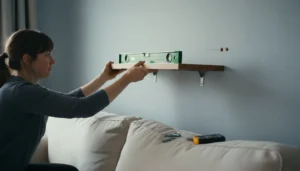
Floating Shelves for Small Spaces: Where They Work (and Where They Fall Off the Wall)