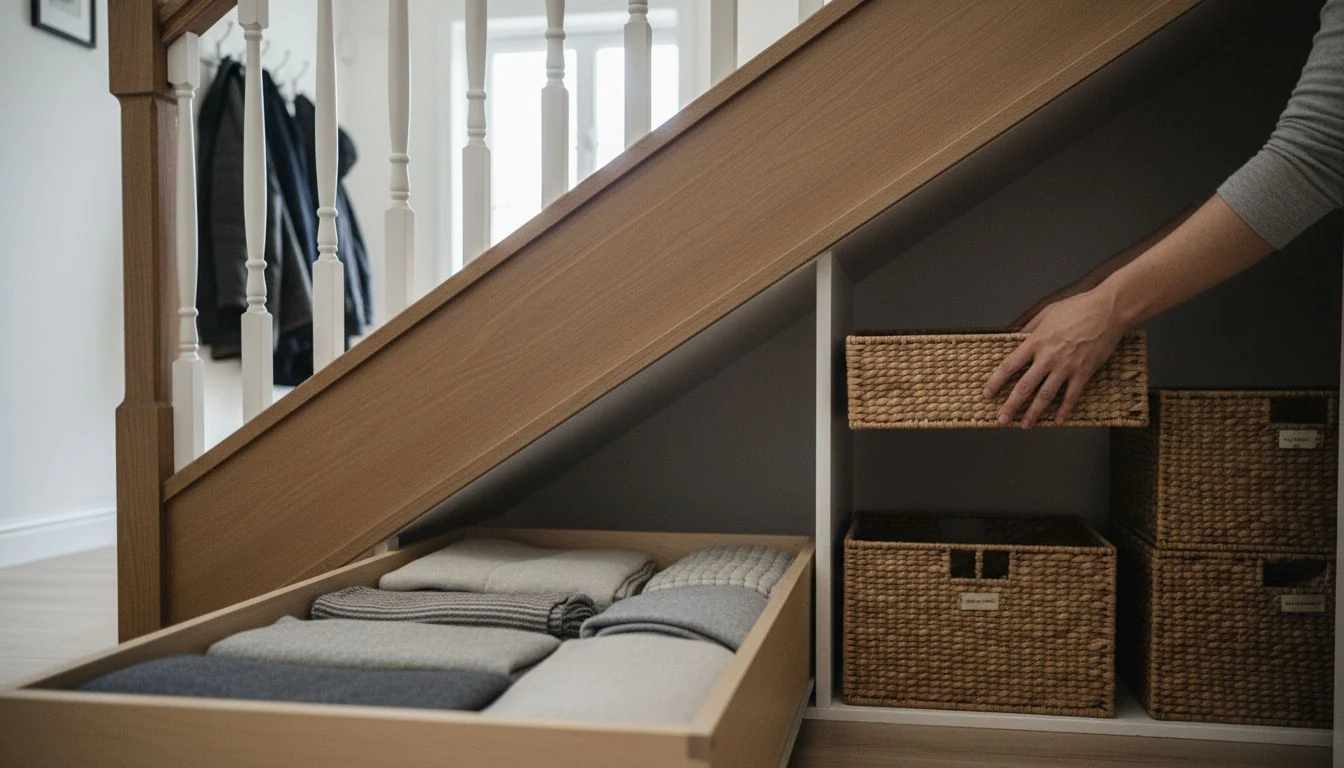
For two years the cupboard under my stairs was where things went to stop being my problem. I’d open the door about four inches, push, and close it fast. Most under stairs storage ideas show you a finished built-in with brass pulls and skip the part that decides everything: the ceiling in there is a slope. That cavity is really four spaces stacked from tall to useless, and only the tall end fits what you keep trying to shove in there.
One Saturday and sixty-three dollars later I had about three feet of house back, the part I’d been paying rent on since I moved in. Below is how I measured it, what lives in each height band now, the three ways to fit one out with what each honestly costs, and the two things that should never go under a staircase.
Jump to:
- Why most under stairs storage ideas ignore the slope
- Measure the triangle before you buy a single bin
- Under stairs storage ideas that work, band by band
- What should never go under the stairs
- Under stairs storage ideas for renters and no-build budgets
- If what you want is an under stairs pantry
- Three ways to fit out the space, compared
- What didn’t work for me
- Frequently asked questions
Why most under stairs storage ideas ignore the slope
Search this and you get photos. Gorgeous ones. A wine rack tucked into a wedge, a reading nook with a sconce, nine drawers that glide out on soft-close runners.
What almost none of them tell you is the number that governs the whole project. On a staircase built to residential code, each step rises somewhere around seven inches over a tread of about ten. Walk one step further into the cavity and you gain roughly seven inches of headroom. That ratio is the entire design problem, and it’s why a shelving unit that fits fine at the door hits the underside of the treads eighteen inches later.
The useful question is how tall the space is at the exact spot you want to put something. I ignored that for two years and bought accordingly, which is how I ended up with two storage bins living half in and half out of a cupboard for a month.
I’ve written about the generic version of this problem in my storage ideas for small spaces, and the zone logic there still holds. But a stair cavity has a sloped ceiling and nothing else in your house does. It needs its own method.
Measure the triangle before you buy a single bin
Fifteen minutes with a tape measure. Do it before anything else, because everything downstream depends on these four numbers.
- Height at the tall end, measured at the doorframe or the open edge. Mine is 74 inches, which is about a foot short of standing up straight in there.
- Height at the low end, at the very back where the slope meets the floor. Mine is 11 inches. Eleven. That’s a shoebox on its side.
- Depth, front to back along the floor. Mine runs 7 feet, which surprised me by about two feet.
- Width, and the width of the door opening, which is usually the real limit. My cavity is 38 inches wide and the door is 27. Nothing wider than 27 goes in, ever.
Then write those four numbers on a scrap of paper and put it in your wallet, or your phone. I keep mine as a note called “stairs” and it has saved me from three impulse buys since March.
Now mark the floor. Measure in from the low end and put a strip of painter’s tape where the ceiling hits 18 inches, another at 36, another at 60. Four bands, taped on the floor, visible from the door. Sounds fussy. It’s the single thing that turned this from a two-year failure into a Saturday.
Under stairs storage ideas that work, band by band
Once the tape is down, the assignments make themselves.
Band one, over 60 inches. The only part of the cupboard where you can stand up more or less straight, so it takes whatever is tall and whatever you grab most. Mine holds the vacuum, a folding step stool, an ironing board flat against the wall, and a hook rail carrying the winter coats that never fit in the entry. Most people fill this band with boxes, which is the single most expensive mistake in the whole cavity.
Band two, 36 to 60 inches. Shelf territory. Two shelves fit and you can read both without crouching, so this is where the seasonal-but-predictable stuff goes: toolbox, spare bedding, a bin of light bulbs and batteries and the extension cords I can never find during an outage.
Band three, 18 to 36 inches. Now you’re crouching. Anything living here has to come out to you, which rules out depth. Shallow only. Shoes on a low rack facing out, the picnic blanket, my partner’s soccer bag, a flat crate of shoe polish and dog towels. Put a deep bin in this band and you’ve built the same trap as the back of a sink cabinet, which I ranted about at length in my under sink storage post.
Band four, under 18 inches. The dead wedge. Unless you install something on runners that carries the contents out to you, this band is a place you put an object once and next see when you move. Mine holds one flat box of leftover floor tiles from the previous tenant. I’ve made peace with it.
Four numbers and four strips of tape. That’s the whole method, it cost nothing, and it’s the part I’d keep if you threw the rest of this post away.
What should never go under the stairs
Two hard rules that outrank everything else here, and neither one is about tidiness. Skip them and the prettiest under stairs storage ideas on the internet stop mattering.
The first is your electrical panel. In a huge number of townhouses and mid-century builds, the breaker box lives in the stair cupboard, and the moment you stack bins in front of it you’ve created a genuine problem. OSHA’s electrical standard spells out the clearance in plain numbers for workplaces: about 3 feet of clear depth in front of the panel, at least 30 inches of width, and headroom to work. Your home isn’t a workplace and that rule doesn’t legally bind you. The electrician standing there at eleven at night, in the dark, with your shoe rack in the way, is absolutely at work. Leave the panel a clear aisle and never put a shelf across it.
The second is the stairs themselves. That staircase is your primary way out of the upstairs of your house, and an enclosed space underneath it is an enclosed space directly beneath your exit route. NFPA’s escape planning guidance is built around exits that stay clear and usable. So: nothing that burns fast and nothing stored loose. Gas cans, propane cylinders, spare paint thinner, the box of old newspapers, a lithium battery pack on a charger overnight. None of it belongs in there. Those go to a garage or a shed, or they leave the house.
Then there’s the softer list, the stuff that survives fine but degrades. A stair cavity isn’t damp the way a basement is, and I don’t want to blur those two problems together, because the fix is different. Under stairs, the enemy is grit and dust. Foot traffic overhead drops a fine sand through the treads for years, and it settles on everything with an open top. Anything textile or paper goes in something lidded. If you’re weighing whether an item belongs down in the basement instead, that’s a humidity call and it runs off a different chart.
Under stairs storage ideas for renters and no-build budgets
I rent. Nothing I did leaves a mark, and the whole thing came to sixty-three dollars.
A clip-on LED light with a rechargeable battery, fourteen dollars, clamped to the underside of a stair stringer. Do this first. The cupboard was a black hole and I suspect that’s half the reason it stayed one for two years. Four shallow woven baskets at seven dollars each for band three, because shallow ones slide out on the floor without a rail. Two lidded eight-dollar bins for band two, against the grit. And a five-dollar pack of tie-on label tags, because a basket you can’t identify from the doorway gets opened, rummaged, and abandoned open.
Skip anything that screws into the slope. Skip tension rods, which sound clever under a staircase and are working against an angled surface. And if you’re tempted by a rolling cart, measure your door opening first, then measure the clear floor in front of the cupboard, because a cart you can’t fully extract is a cart you’ll stop using by week three.
Grab the free printable: my one-page Under Stairs Height Band Map, with the four measurements to take, where to put the tape, and what belongs in each band, so you can carry it to the store instead of guessing in an aisle. Get the free height band map →
If what you want is an under stairs pantry
This is the most-searched version of the project and it can work, with two conditions.
Condition one: the cavity has to open onto or near the kitchen. A pantry you walk through the living room to reach becomes overflow storage within a month, and then it becomes the place the cereal goes stale. Mine opens onto a hallway and I gave up on this idea for exactly that reason.
Condition two: shallow shelves in the tall band only, and I mean shallow. Six to eight inches deep, single row, everything front-facing. Deep pantry shelving under a slope creates a back row you cannot see and cannot reach, and unseen food is expired food. The date-management system I use in my regular pantry assumes you can see the whole inventory in one look, and you can’t get that under a slope.
Where the low bands earn their keep in a kitchen-adjacent cupboard: bulk paper goods, the drinks you buy by the case, the stockpot and the roasting pan you use twice a year, and the appliance you love but don’t want on the counter. Heavy things you reach for rarely. That’s a real win and it doesn’t require a single shelf.
Three ways to fit out the space, compared
I got far enough into this to collect carpenter quotes before I picked the cheapest option anyway. Three real routes, with the under stairs storage ideas that suit each one.
| Approach | What it ran | Who installs it | Best for | The catch |
|---|---|---|---|---|
| Baskets and bins on the floor | $30 to $70 | You, one afternoon | Renters, and anyone who hasn’t yet learned what they’ll really keep in there | Band four stays dead. You’ll use maybe two thirds of the cavity and that’s the deal |
| Freestanding shelf cut to the slope, plus drawers on casters | $90 to $200 in materials | You with a saw, or a handyman for a few hours | Owners who want most of the space without a build, and renters whose landlord says yes | The rolling piece must come fully out, so you need clear floor in front of the door |
| Built-in pull-out drawers on runners | Two local quotes came back at $2,100 and $2,400 for a 7-foot run | A carpenter | Staying put long term, and the dead wedge is the whole reason you’re doing this | Price swings hugely with your staircase and your metro. Treat my two quotes as a data point, not a price list |
Common under stairs storage mistakes to avoid
- Buying containers before measuring the door opening. The cavity is almost always wider than the way into it. My cupboard is 38 inches across and the door is 27, so eleven of those inches are decorative. I found this out holding a 32-inch drawer unit in a hallway.
- Putting the tall stuff at the back. It feels tidy to send the vacuum deep and keep the front clear. It’s backwards. The back is the low end, and now you’re dragging a vacuum out from under a slope every single time. Tall things live at the door.
- Treating it as a second attic. The moment this cupboard becomes long-term storage, it stops being useful storage, because the things you need weekly end up behind the things you need annually. If it’s archival, it goes somewhere else. Under the stairs is for the stuff you touch.
What didn’t work for me
The two 27-quart clear bins were the money I’d like back, though at sixteen dollars I’ll live. I bought them for band three thinking clear plastic meant I’d see what was inside. In a cupboard with no light, clear plastic is just grey plastic. And they were too deep for the crouch, so they sat half out of the cupboard for most of April while I told myself I’d deal with it.
The clip-on light fixed more than the bins ever did. Fourteen dollars, and the difference between a space I avoided and a space I use.
I also tried hanging a shoe organizer from a hook on the underside of the treads, which lasted about nine days. The slope means it hangs at an angle, everything slides to the low corner, and the whole thing swings when someone comes down the stairs. If you want shoes in there, put them on the floor in band three, on a low rack, facing out. The entryway shoe pile is a related fight and I lost that one for longer.
And my first instinct, which was to declutter the cupboard before measuring it, was the wrong order. I spent a Sunday pulling everything out and sorting it into piles, then put most of it back in the same bad places, because I still had no idea what the space could hold. Measure first, sort second. It feels backwards, and it works.
Frequently asked questions
What are the best under stairs storage ideas for a small cupboard?
Light it, then work the bands. A clip-on rechargeable light, tall items at the door where the headroom is, two shelves in the middle band, and shallow baskets that slide out on the floor in the crouch band. That’s under seventy dollars and it uses about two thirds of the cavity. Leave the last wedge empty rather than filling it with something you’ll never see again.
Can I put a washing machine or a fridge under the stairs?
Sometimes, and it’s a real project rather than an organizing one. You need the height at that exact spot, plumbing or a circuit, and ventilation, since appliances shoved into a sealed wedge overheat. Get someone to look at it before you buy anything. This is the version of the job where the quote is worth paying for.
How do I stop the space from getting dusty?
Lids and a mat. Foot traffic on the stairs pushes fine grit down through the treads for years, so anything textile, paper, or fabric-adjacent goes in something closed. A cheap runner or mat on the cupboard floor catches the rest and can be shaken out twice a year, which takes about four minutes.
Is it safe to store things under the stairs?
For ordinary household items, yes, with two exceptions. Keep a clear aisle to the electrical panel if yours lives in there, and keep flammables out entirely, because that cupboard sits directly under your way out of the upstairs. Gas, solvents, propane, and charging battery packs belong in a garage or a shed, not under a staircase.
Four numbers, four strips of painter’s tape, and a fourteen-dollar light. If the rest of your house has the same problem in a less triangular shape, the small-space storage guide is the wider version of this method.
Get my free Home Reset Planner
The calm, room-by-room planner I use to reset my whole home without the overwhelm. Join the newsletter and I’ll send it straight to your inbox.
No spam, ever. Unsubscribe anytime. — Lena
Keep reading — more on Storage Solutions
Wrapping Paper Storage Ideas That Stop the Crushed-Roll Problem
Floating Shelves for Small Spaces: Where They Work (and Where They Fall Off the Wall)
Shoe Storage Ideas for Every Room (Not Just the Front Door)