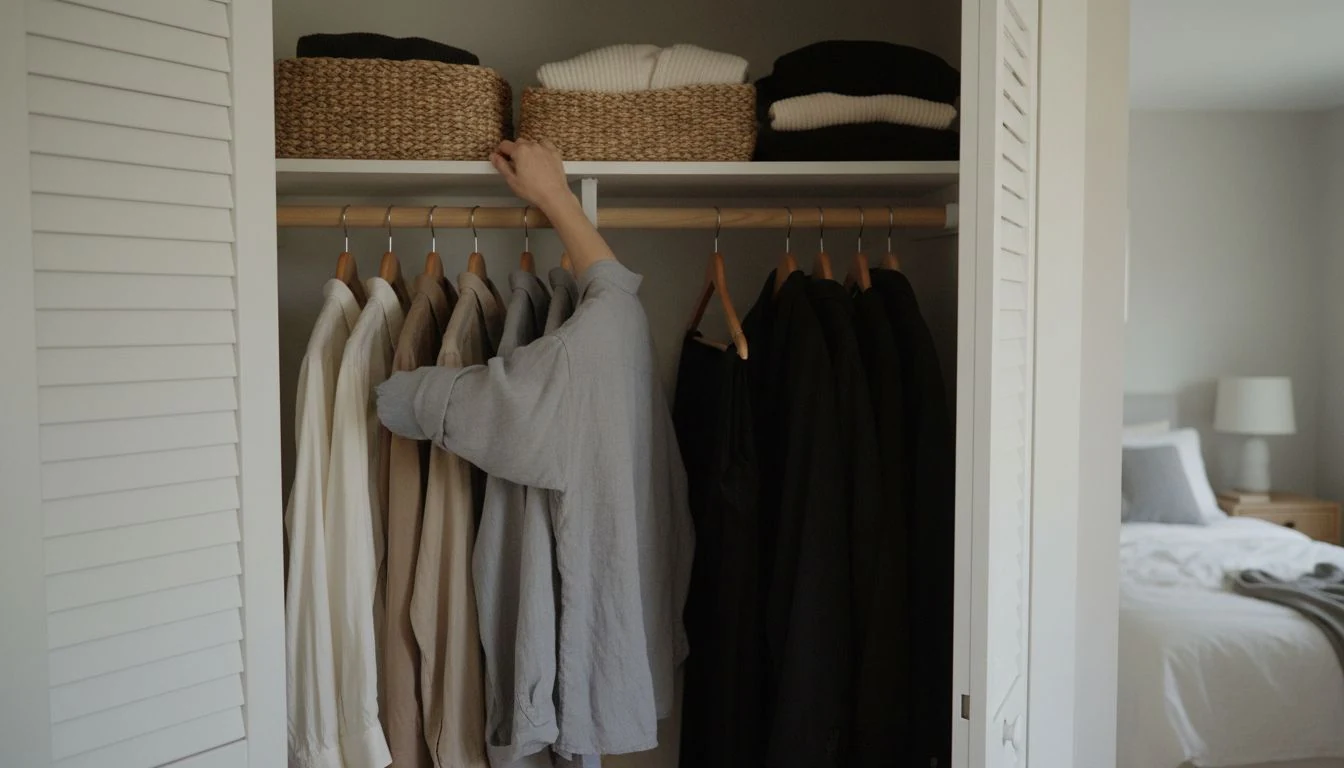
My closet went rainbow on a Tuesday night in November, and by Thursday I couldn’t find a single black shirt. That part never makes it into the before-and-after photo. I’d decided to organize closet by color after seeing the same gradient shot about forty times in a row, and eight months later I still do it. Just not the way I started, and not for the reason I thought.
One thing before we start, so you don’t read the wrong post. If your closet’s problem is the space and not the order, my small closet organization ideas and walk-in closet organization on a budget handle rods, shelves and square footage. Stay here for what sorting by color fixes, which of the two color systems survives real laundry, and the point where it stops helping.
Why I decided to organize closet by color
Getting dressed was taking me eleven or twelve minutes, and most of that was standing still. Seventy-four hanging items in a five-foot closet, sorted by category, and I’d stare at them like a menu in a language I half spoke.
The pitch I’d absorbed was speed. Find things faster. That isn’t what happened.
What happened was I saw what I owned for the first time in years. Six navy tops. Three of them nearly identical, bought across two winters, and I’d have sworn under oath I had two. Once they were hanging shoulder to shoulder there was no arguing with it.
That’s the real return on this, and I’d rather be honest about it than sell you the speed thing. Sorting by color is a visibility tool. It’s the fastest audit of your own wardrobe I know of, which makes it a decent doorway into the gentle decluttering method if the closet is where you’re stuck.
The two ways to organize closet by color
There are two systems and people talk about them as if they’re the same one. They aren’t, and picking the wrong one is most of why this fails.
The first is full spectrum, roughly ROYGBIV: red, orange, yellow, green, blue, purple, with the neutrals bolted onto one end. That’s the version in the photos, and it’s built for closets with a lot of color in them.
The second is neutral blocks. Light to dark in bands, so white, cream, beige, grey, then black, with your true colors parked together at one end as a single group. It photographs badly. It works better for most American closets, which run heavily neutral.
I started with full spectrum. My closet is maybe 70% neutrals, so what I’d built was a small tidy rainbow at one end and a long undifferentiated smear of beige-through-black at the other. The whole thing was doing its job on a quarter of the rod.
Six weeks in I switched to blocks, and that’s the version I still run. If you have a lot of color, use the spectrum. If you open your closet and see mostly neutrals, the spectrum will lie to you about how organized you are.
Where prints, multicolor and black break it
Nobody warns you about the striped shirt. Or the floral dress with six colors in it, or the plaid that’s technically red but reads brown from three feet away.
My rule after some trial and error: sort by background, not by pattern. Whatever color you see most of when the garment is on a hanger at arm’s length is the color it lives under. A navy shirt with small white dots is navy. Don’t hold it up to the window and deliberate.
Black needs its own handling. Treat it as a category with volume, because in my closet it’s the biggest one, and give it a dedicated block with a finger of gap on either side. When black trails off the end of the greys instead, you get one solid wall and you’re back to hunting.
That was the Thursday problem. The black shirt existed. It was in there, third from the end, invisible inside eleven other black things.
How to organize closet by color in one evening
Forty minutes for seventy-four items, and I’ve done it twice since at about the same pace. You don’t need to buy anything.
One thing to skip: emptying the whole closet. My other closet posts start there and they’re right for a real reorganization, but a color sort is a shuffle in place. Pull the rod out onto the bed and you’ve turned forty minutes into an afternoon and a pile you’ll resent by nine o’clock.
- Sort within categories first, never across them. Shirts stay with shirts, dresses with dresses. One rainbow spanning every garment type looks amazing and is unusable.
- Pick your system before you touch a hanger. Spectrum for a colorful closet, neutral blocks for a mostly-neutral one.
- Work one category at a time, sliding pieces along the rod. No piles on the floor. Piles are how this becomes a two-day project.
- Give black and white their own blocks with a visible gap, rather than letting them dissolve into the greys.
- Anything you can’t place in three seconds goes on the bed. That stack is your audit, and it’s usually the duplicates.
- Deal with the audit stack before you sit down. Not next weekend.
Off-season pieces come out at this point too, since they’re just noise in the gradient. Mine go in fabric bins on the top shelf, clean and completely dry, never in sealed plastic. Closets are exactly the sort of dark enclosed space where trapped moisture turns into a mold problem, and the EPA’s guide to mold and moisture in the home is blunt about damp materials in enclosed spaces. I learned that on a wool coat I loved.
What happens when the laundry comes back
This is the part that decides whether you still have a color system in a month, and almost nobody covers it. You can organize closet by color perfectly on a Sunday and lose the whole thing to four loads of washing.
Sunday night I hang nine or ten clean things. If I hang them wherever there’s room, the order is visibly degraded in about three weeks. Not destroyed. Just fuzzy enough that I stop trusting it, and once you stop trusting it you stop using it.
Two fixes, and I use both. Clean laundry always goes on the far left of its category, in a temporary huddle. Then once a week, while the kettle boils, I file that huddle properly. It takes four minutes because it’s ten items, not seventy.
The second fix is stricter: nothing gets hung in a slot that requires shoving. If a color block is tight enough that a hanger needs force, that block is full, and the honest answer is you own too many navy tops. I’ve been there. See above.
Three color systems compared, honestly
This is the comparison I wanted back in November, including the third option I only found later, which is the one I’d point most people toward.
| System | What it looks like | Who it actually suits | Where it breaks | Weekly upkeep |
|---|---|---|---|---|
| Full spectrum | ROYGBIV across the rod, neutrals at one end | Closets that are at least half color. Small wardrobes under 40 hanging items | Neutral-heavy closets, where 70% of the rod becomes one undifferentiated block and the system only works on the colorful quarter | 5 to 8 min |
| Neutral blocks | White, cream, beige, grey, black in bands, with all true colors grouped together at one end | Most American closets. Anyone whose wardrobe runs beige, grey, navy and black | Very colorful wardrobes, where everything interesting gets crushed into one bucket at the end | 4 min |
| Color inside category, category first | Shirts sorted by color, then dresses sorted by color, then pants, each its own small gradient | Nearly everyone, and it’s what I run now. It’s also the only version that holds up in a shared closet | Nothing structural. It just doesn’t photograph as one clean rainbow, which is the only reason it’s less popular | 4 min |
Three mistakes I made in the first month
- One rainbow across every garment type. Dresses, shirts and trousers in a single gradient. It looked like the photos and I couldn’t find anything, because I don’t think in colors when I get dressed, I think in shirts. Sort inside the category.
- Letting black trail off the end of the greys. Eleven black items dissolving into one shape at the far end of the rod. Black earns its own block with a gap, or it eats your evenings.
- Treating the sort as finished. I did the forty minutes, took a photo, and then spent five weeks hanging clean shirts wherever there was room. The four-minute weekly refile is the system. The first sort is only the setup.
Grab the free printable: my one-page Closet Color Map, with both block orders laid out, the sort-by-background rule for prints and multicolor, and a blank rod diagram to plan yours before you move a hanger. Get the free color map →
Who should skip organizing by color
If you have fewer than about thirty hanging items, the decision to organize closet by color adds nothing. You can already see everything. Sorting a small closet by color is a craft project pretending to be a system, and building a capsule wardrobe would do more for you.
Skip it if most of your rod is work clothes in the same two shades. A closet that’s fourteen black polos and six navy trousers doesn’t have a color problem to solve.
And think carefully before imposing it on a shared closet. About 1 in 12 men have some form of color vision deficiency, per the National Eye Institute, with red and green the most commonly affected. A system built entirely on distinguishing shades can be unusable for the other person in the room, and they may never have mentioned it. Position on the rod, or category blocks, works for everyone.
If the closet doesn’t exist at all, that’s a different problem and I wrote about it in clothes storage ideas when your room has no closet.
What didn’t work for me
Color-coded hangers. I bought a set, assigned colors to categories, and spent more time thinking about hanger logistics than clothes. They went in the donation bin in March.
Sorting drawers by color was worse. Folded knits don’t hold their position the way hangers do, and after two weeks of pulling from the middle of a stack it was just a drawer again. Drawers want file-folding by type. Colors don’t survive vertical stacking.
The last one is the honest one. For about two months I kept the rainbow because it looked good in the doorway, not because it was working. When I finally admitted the neutrals half wasn’t doing anything, I rebuilt it in twenty minutes and the closet has been calm since. If you catch yourself defending your system to yourself, that’s your answer.
Frequently asked questions
Does organizing your closet by color actually work?
It works well as a visibility tool and less well as a speed tool. Hanging every navy top together is the quickest way to see what you already own, which surfaces duplicates fast. If you’re expecting to get dressed noticeably faster, sorting by category first and adding color inside each category gets you more of that than a single closet-wide rainbow does.
What order do you hang clothes by color?
Two orders are standard when you organize closet by color. Full spectrum runs white, then ROYGBIV, then grey and black at the end. Neutral blocks run light to dark, white through cream, beige, grey and black, with all true colors grouped as one block at one end. Pick based on your own wardrobe: spectrum if you own a lot of color, neutral blocks if you don’t. For prints and multicolor, sort by the background color you see from a few feet away.
Should I organize by color or by type?
Type first, then color inside each type. Sorting one gradient across dresses, shirts and trousers photographs beautifully and fails in daily use, because most people search for a garment type before they think about color. Category blocks also survive a shared closet, where a purely color-based system can be hard to use for anyone with color vision deficiency.
If you want to test this without committing a whole evening, do one category. Just the shirts, in whatever color order fits what you own, and leave the rest of the closet alone for two weeks. You’ll know by the second Sunday whether you’re refiling it or ignoring it, and that answer is worth more than any before-and-after photo.
Get my free Home Reset Planner
The calm, room-by-room planner I use to reset my whole home without the overwhelm. Join the newsletter and I’ll send it straight to your inbox.
No spam, ever. Unsubscribe anytime. — Lena
Keep reading — more on Home Organization
Small Apartment Organization Ideas (Renter-Friendly, No Drilling)

Mudroom Organization Ideas That Survive Wet-Boot Season

Home Office Organization Ideas for a Small Space