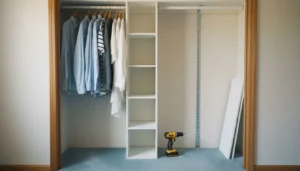

For four years I had a walk-in closet roughly the size of a small bathroom, and I still got dressed standing in the hallway. The closet had become a drop zone: three laundry baskets I never emptied, a rod bowing under coats I hadn’t worn since 2022, and a floor I couldn’t actually see. I kept telling myself the fix was a custom build, until I priced one at $3,400 and nearly cried in the showroom. So I did the whole thing myself for $147 one rainy Saturday. This is the real walk in closet organization plan I used, the renter-safe version, no financing required.
Here’s what you’ll walk away with: the order I emptied and sorted everything so you don’t lose a whole weekend, the five zones that made the space finally work, the exact cheap products that pulled their weight, and the one thing I bought twice because I measured wrong. I’m not a professional organizer. I’ve just re-done this closet more than once and finally got it to stay put.
Why walk in closet organization usually fails (and it’s not you)
Most closet advice assumes two things you probably don’t have: an open budget and a closet that started empty. Mine started with years of stuff shoved in sideways. So the first honest step of any real walk in closet organization plan isn’t buying bins. It’s admitting the closet is doing three jobs at once. Mine was part wardrobe, part laundry limbo, part “I’ll deal with it later” graveyard.
The setups on Pinterest look effortless because someone did the ugly part off-camera. They emptied it, culled hard, and only then styled the survivors. Skip that and any product you buy just organizes the clutter instead of removing it. I learned that the expensive way. My first attempt, I bought $90 of matching velvet hangers and hung everything back up. Same closet, nicer hangers, still couldn’t find my black jeans.
Empty it out first: the 30-minute reset
Set a timer and pull everything off the rods and shelves. Everything. Onto the bed, so you can’t quit halfway and leave a pile. The bed forces you to finish before you sleep. It looks worse before it looks better, and that’s the whole point. You can’t organize a space you can’t see.
While it’s empty, wipe the shelves and check the rod height. Half my “small closet” problem turned out to be a single rod hung at grandma height with four feet of dead air underneath. Just noticing that wasted vertical space is what unlocked the redesign, and it cost me nothing to spot.
Sort into four piles, not twelve
Twelve categories is how you end up on the floor at midnight, buried in decision fatigue. Four is doable: keep, donate, relocate (belongs in another room), and trash or recycle. If an item stalls you for more than a few seconds, it goes in donate. I filled two bags for donation in under an hour once I stopped negotiating with myself. Want a fuller framework for the culling part? I wrote a whole guide on what to declutter first when you’re overwhelmed.
The clothes you remove don’t have to hit the trash. Textiles are one of the most landfilled everyday items in the country, and most of it is still wearable. The EPA’s own textile waste figures are a good nudge to donate or recycle instead of bagging it for the curb.
Grab the free Closet Reset Checklist
I turned this whole process into a one-page printable: the 30-minute empty-it timer, the four-pile sort, the five-zone map, and the measure-before-you-buy numbers so you don’t return anything twice like I did. Sign up below and it lands in your inbox.
The five zones that make walk in closet organization work
Once it’s empty and culled, don’t put things back where they lived before. Put them back by how often you reach for them. This one shift did more than any product I bought. Here’s the zone map I use now.
- Eye level, front and center: the clothes you wear weekly. If they’re a pain to reach, you won’t put them back, and the system dies by Wednesday.
- The high shelf: off-season and rarely used, stored in labeled bins so you’re not standing on a chair playing guess-the-box.
- The dead space under short hangs: a cheap set of stacked drawers or cubbies. This is the four feet almost everyone wastes.
- The floor, contained: shoes on a low rack and exactly one laundry basket. One. The floor becomes a pile the second you allow a second basket in.
- The door and side walls: hooks and an over-the-door organizer for bags, belts, and accessories, the stuff that never has a natural home.
Reaching for my everyday clothes now takes one motion instead of an excavation. That’s the entire test of good walk in closet organization: can you get dressed without moving three other things first?
Cheap walk in closet organization products that earned their spot
I’m skeptical of roundups where every single item is “a game changer,” so here’s the honest version. Only what I still use six months later, and what I’d skip.
The winners were boring. Slimline hangers doubled my rod space, no exaggeration; a packed section got a third roomier. A $22 set of stackable drawers filled that dead vertical zone. An over-the-door organizer I use for everything except shoes. And clear labeled bins for the high shelf. Total damage, about $147.
What I’d skip: the pricey matching-basket sets. They look great in a photo and hold half as much as a plain bin because the thick weave eats the interior. Fewer, less-fussy clothes beat prettier storage every time, which is exactly why building a capsule wardrobe does more for a closet than any bin. And if your space is genuinely tiny rather than a walk-in, my small closet organization ideas cover the no-drill tricks in more detail.
How I keep it organized without a Sunday reset
The upkeep is almost nothing, which is the only reason it stuck. A “one in, one out” rule for clothes. A five-minute tidy when I put away laundry, not a whole afternoon. And a donate bag that lives on the closet floor, so letting go is a two-second decision instead of a project. That last trick is the one I’d keep if I could only keep one.
Clutter creeping back isn’t a character flaw. It’s just entropy, and a light weekly touch beats a heroic seasonal purge. If the whole-house version sounds useful, my room-by-room decluttering guide runs at the same gentle pace. And if you itemize your taxes, the clothes you drop off may even be deductible; the IRS rules on charitable contributions spell out how.
The real budget breakdown (and 3 mistakes to skip)
Here’s exactly where my $147 went, and whether each thing earned it, so you can copy the list or cut the parts I’d cut.
| What I bought | Cost | Worth it? |
|---|---|---|
| Slimline hangers (50-pack) | $24 | Yes, doubled the rod space |
| Stackable drawers (dead-space zone) | $22 | Yes, held all the folded knits |
| Clear labeled bins for high shelf | $31 | Yes, no more chair-standing |
| Over-the-door organizer | $18 | Yes, bags and accessories |
| Low shoe rack | $29 | Yes, floor finally stays clear |
| Matching woven baskets | $23 | No, returned; held too little |
Three mistakes I made so you don’t have to
- Buying storage before culling. I organized the clutter instead of removing it, then had to redo the whole thing. Empty and donate first, every time.
- Measuring once. I guessed a drawer width, bought too wide, and returned it. Measure the actual opening and the depth before you buy anything with a footprint.
- Chasing the aesthetic. The matching baskets cost more and held less. Functional beats photogenic, and your future self won’t care that the bins didn’t match.
Frequently Asked Questions
How do I start walk in closet organization on a budget?
Empty the closet completely, sort everything into four piles (keep, donate, relocate, trash), and only then buy storage for what’s left. Most of the impact comes from culling and from using the dead vertical space you already have, not from an expensive system. I redid mine for about $147, and the single most valuable move, emptying and donating first, cost nothing at all.
What’s the best way to use the space in a walk in closet?
Store things by how often you reach for them, not by category. Everyday clothes go at eye level, front and center; off-season items go in labeled bins on the high shelf; and the wasted vertical space under short-hanging clothes gets stackable drawers or cubbies. Shoes and one laundry basket stay on the floor, while bags and accessories live on the door and side walls.
Do I really need a custom closet system?
No. I priced one at $3,400 and got the same daily function from roughly $147 of hangers, drawers, bins, and hooks. A custom build can be worth it if you own your home and plan to stay for years. But for most people, especially renters, a good sort plus a few cheap, removable pieces does almost everything a built-in does, without the price tag or the wall damage.
Get my free Home Reset Planner
The calm, room-by-room planner I use to reset my whole home without the overwhelm. Join the newsletter and I’ll send it straight to your inbox.
No spam, ever. Unsubscribe anytime. — Lena
Keep reading — more on Closet & Wardrobe

How to Store Summer Clothes: My Fall Closet Swap Routine
The Coat Closet Nobody Fixes Until It’s Already Cold

Building My Own Closet System: The Weekend Version of a $3,000 Quote