

My towels came out of the dryer warm and still damp, so I ran them again. That was the whole event, and it happened most weeks for about a year. The reason I waited is not that I failed to notice. It is that “this dryer is getting old” was a cheaper story to tell myself than finding out what a dryer vent installation cost would actually be.
It was $290. Not for a new dryer, and not for the third cleaning I kept booking instead. That bought me a rebuilt vent run: eleven feet of crushed foil hose pulled out of the wall, replaced with rigid metal, one bend fewer, and a new hood outside that opens. Drying went from three cycles back to one. Below are the four quotes I collected, what each line on them meant, and the signals I read wrong for a year.
The part that annoys me most is that the official guidance had already described my exact symptom, in plain words, and I had never read it.
What my dryer vent installation cost covered
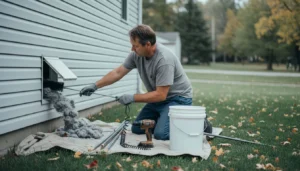
My laundry closet sits on an interior wall. The dryer backs onto a chase that runs eleven feet to the side of the house, and whoever built it ran flexible foil the whole way with four bends in it. Foil is the cheap stuff. It sags, and every sag is a spot where lint stops moving. It also crushes flat the first time somebody shoves the dryer back against the wall.
The $290 job was two people for a little under three hours. They pulled the old hose, ran rigid metal duct with the joints taped and the seams pointing downstream, cut the run from four bends to three, replaced the outside hood with one that has a proper flap and no screen, and put a short periscope box behind the dryer so the machine sits closer to the wall without kinking anything.
What sold me on that quote over the others was one sentence in it. The installer wrote down the developed length of my run and the number of bends, and said what he was going to do to reduce both. Nobody else measured. Two of the four quoted me a price over the phone without asking how long my run was, which is a bit like pricing a paint job without asking how many rooms.
The signs I misread for a year
Here is the line that stopped me, from the National Fire Protection Association’s own clothes dryer safety sheet: clean lint out of the vent pipe “once a year, or more often if you notice that it is taking longer than normal for your clothes to dry.” My symptom was not a mystery. It was the published trigger, printed on a one-page tip sheet, and I had spent a year treating it as a personality flaw in my appliance.
The same sheet is blunt about the stakes: “The leading cause of home clothes dryer fires is failure to clean them.” The U.S. Fire Administration puts a number on it, listing failure to clean at 31 percent of what causes home clothes dryer fires to ignite. I am not going to write the scary paragraph here, because the scary paragraph is what the guy selling a $400 annual plan does. The useful version is duller. A long drying time is information, and it is cheap to act on.
The other signals I had and ignored were a laundry closet that felt like a greenhouse by the end of a load, and an exterior flap I never once saw open. I assumed the flap was decorative. It was painted shut.
How a dryer vent installation cost gets quoted, and where the numbers diverge
Four companies, four different shapes of number, for the same eleven feet.
The first quoted $149 flat and called it an install. On the phone that turned out to be a hose swap: pull the foil, put in new foil, done in forty minutes. It is a real service and it is not what my run needed, because new foil in a chase with four bends is the same problem with a cleaner surface.
The second was $610. That one included going through the roof instead of the wall, which is more work and does cost more, and which I did not need, because I already had a side wall eleven feet away.
The third would not give a number until someone came out, then quoted $340 on site with a $75 trip fee folded in if I declined.
The fourth was the $290. What made the four comparable was something I did before any of them arrived. I measured the run myself with a tape, counted the bends, and gave every company the same two numbers. Length and bends are what drive this price. Every elbow adds resistance, so both residential codes and dryer manufacturers cap how long a run can be and count bends against that cap, which means a short crooked run can be worse than a long straight one. Ask your installer to tell you your developed length and how many bends he is leaving in. If he cannot, he has not looked.
Grab the free printable: my one-page Dryer Vent Check, with the five-minute symptom walkthrough, the run-and-bends worksheet to fill in before you call, and the four questions that separate a hose swap from a real install. Get the free sheet →
Cleaning and installation are two different bills
I conflated these for a year, and it cost me about $360 in cleanings that solved nothing for six weeks at a time.
A cleaning is a maintenance job. Someone runs a rotating brush and a vacuum through the existing duct and takes the lint out. In my area that ran $130 to $200, and the NFPA’s once-a-year guidance is aimed squarely at this. If your duct is sound, this is the whole answer and you should just book it.
I now book mine every September on the rebuilt run, and I broke down what a dryer vent cleaning costs by vent type, plus the add-ons I say no to.
An installation is a construction job. The duct itself is wrong: foil where it should be metal, too long, too many bends, terminating somewhere it should not, or come apart inside a wall. No amount of brushing fixes geometry. The NFPA is specific on materials, saying “rigid or flexible metal venting material should be used to sustain proper air flow and drying time.” Mine was foil, which is neither.
The tell that mine was structural and not dirt: the cleaning worked, briefly, every time. Six weeks later I was back to two cycles. A duct that re-clogs that fast has a shape problem. Lint was piling up faster than any brush could take it out, because the run kept handing it places to sit. That is the same logic I used on my air duct cleaning cost, which is a completely separate system and a completely separate bill, and one I now schedule alongside the rest of my deep cleaning schedule.
Read the symptom before you book anything
This is the table I wish I had a year earlier. It goes symptom first, because that is the order you meet this in.
| What you are noticing | What it usually means | What it takes to fix |
|---|---|---|
| Two or three cycles to dry one normal load | Airflow is restricted: lint packed along the run, or the hose crushed behind the machine | $130 to $200 if the duct is sound. $250 to $600 if the run itself has to be rebuilt |
| The laundry room is hot and humid by the end of a load | The duct is leaking or has come apart, and it is venting into the wall cavity or the room | $180 to $350 to reconnect and seal, plus drywall repair if it has been wet a while |
| No lint outside, and the exterior flap never opens | The hood is painted shut, screened, or blocked, or the run does not terminate outdoors at all | $90 to $160 for a new hood. Considerably more if it ends in an attic or crawlspace |
| A hot or burning smell during a cycle | Lint sitting against heat, in the run or around the drum | Stop using it and book this week. Usually the $130 to $200 cleaning, and the reason not to wait |
| The dryer sits a foot off the wall because the hose will not fold | The hose is too long and kinking behind the machine, which is the most common one and the cheapest | $25 to $60 for a periscope box, and it is a do-it-yourself job |
Three mistakes that cost the most money
- Paying for repeat cleanings when the run is the problem. If the drying time creeps back within two months of a cleaning, you are renting a solution to a shape problem. Three cleanings and I could have paid for the rebuild.
- Letting foil hose stay inside a wall. It sags into low spots that collect lint, and it crushes the first time the dryer gets pushed back. Metal is the material the safety guidance names, and it is not much more expensive.
- Accepting a phone quote with no run length. Every number I got without a measurement was either too low to be real or padded to cover the unknown. The measurement takes four minutes and it is yours to take.
What did not work
Two things, and one of them I paid for twice.
The indoor lint trap bucket came first. I bought one for about $18 during the year I was avoiding the real bill, because it promised to catch lint without venting outside. Those are meant for very specific situations, and a normal electric dryer in a closet is not one of them. Mine dumped humidity straight into the laundry closet, which is exactly the greenhouse symptom I already had, and I threw it out after three weeks.
The other was the longer hose. When the dryer would not sit flush to the wall, I bought a longer flexible hose so it would fold more easily. That is backwards. More length means more slack to kink, and it made the drying time worse. The periscope box, which is a flat rigid elbow that lets the machine sit within a couple of inches of the wall, was the thing that solved it, and it cost less than the hose did. I put it in myself in about twenty minutes, which is the same twenty minutes I now spend resetting my laundry room after a big wash.
Frequently asked questions
How much does dryer vent installation cost for a typical house?
My four quotes in 2026 for an eleven-foot side wall run went from $149 for a like-for-like hose swap to $610 for rerouting through the roof, and I paid $290 for a rigid metal rebuild with a new exterior hood. Length of the run, number of bends, whether it exits through a wall or the roof, and whether anyone has to open drywall are what move the number. The square footage of your house has nothing to do with it. Measure your run and count your bends before you call, and the quotes become comparable instead of random.
Is dryer vent cleaning or installation the right job for my situation?
Book a cleaning if your duct is metal, reasonably short, and your drying time has crept up gradually over a year or more. That is normal lint accumulation, and the once-a-year cleaning the NFPA describes is the entire fix. Consider an installation if the drying time comes back within a couple of months of a cleaning, if the duct is foil, if you can count more than three or four bends, or if you have never seen the flap outside open. Those are geometry and material problems, and brushing them out only buys weeks.
How often should a dryer vent be cleaned?
Once a year is the published baseline, and more often if clothes start taking longer than normal to dry. That second half is the part most people skip, and it is the one that matters, because it turns a calendar chore into a signal you can respond to. I do mine every autumn with the rest of my fall cleaning checklist, and I no longer wait for the calendar if a load needs a second cycle two weeks running.
If you are looking at this in your own house this week, do three things in this order. Run one normal load and time it, so you have a real number instead of an impression. Go outside while it runs and hold your hand near the vent hood to confirm warm air is leaving the building. Then measure the run and count the bends before you call anyone. Those three steps cost nothing, they take about fifteen minutes, and they are the difference between buying a $290 repair and buying a $149 one three times.
Get my free Home Reset Planner
The calm, room-by-room planner I use to reset my whole home without the overwhelm. Join the newsletter and I’ll send it straight to your inbox.
No spam, ever. Unsubscribe anytime. — Lena
Keep reading — more on Home Services & Costs
Dryer Vent Cleaning Cost (and Why Fall Is When I Book It)

Hot Tub Removal Cost: What We Paid to Get Ours Gone

Rent a Christmas Tree: What Our Potted Spruce Cost (and Asked of Us)