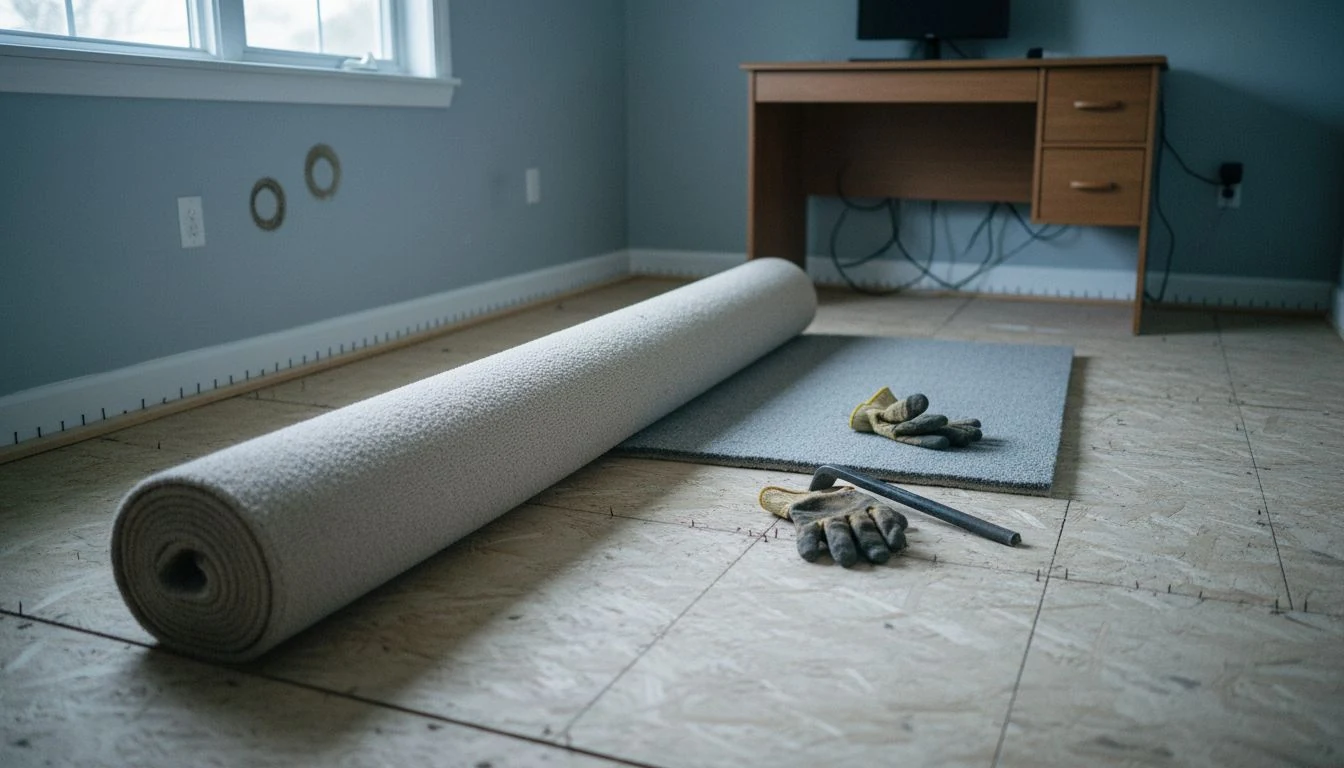
The office carpet came up at the closet corner with one pull of the pliers, and the smell came up with it. Three weeks earlier I had paid a company to clean that carpet, and the two old pet spots by the window stayed where they were. They had soaked through to the pad, the technician said, maybe further. In September I stopped paying to clean it and started pricing the carpet removal cost instead.
It’s one room plus its closet, 147 square feet. My quotes ran from $145 to $275, and I ended up doing it myself for $68 and most of a weekend. Below is what each quote covered, what was under the pad, and where doing it yourself stops saving money.
What I was pulling up
Our office is 11 by 12 feet, with a 3 by 5 closet. Beige carpet over a grey foam pad, laid when the house was built in 1996. If you read my carpet cleaning cost post, this is the room I said I’d made my peace with. I hadn’t.
Read that one if your carpet can still be saved. This one starts when it’s finished and the only question left is what it costs to get it out of the house.
Before calling anyone I wrote down what “removal” would have to cover:
- The carpet, cut into pieces a person can carry.
- The pad, stapled to the floor every few inches.
- The tack strips, thin wood strips along the walls with nails pointing up.
- Getting all of it to a dump, a truck or the curb.
Each company I called covered a different piece of that list, and the quotes made no sense side by side until I lined them up against it.
The carpet removal cost, quote by quote
All four came from my suburb in September 2026, for the same 147 square feet. Your town will price it differently, but you’ll hear the same four kinds of answer.
The flooring store by the highway only pulls carpet as part of a new floor they install. Their removal line is $1 a square foot and vanishes during “free removal” promotions, so it lives inside the installation price. I hadn’t picked a floor, so that one was out.
An independent flooring installer broke his quote into lines: $0.75 a square foot for carpet and pad, $0.30 a square foot to pull the tack strips and staples, and $75 for disposal. That adds up to $229.35. His minimum for any job is $275, though. A room my size pays the minimum, and his per-foot rates only start to count at around 190 square feet. He also wanted $50 to move the desk and bookcase, which I said I’d empty and drag out myself.
A handyman quoted $65 an hour, guessed three hours, and added a $60 dump run. Call it $255, with nothing to stop three hours from turning into five.
The junk removal company from my junk removal cost post would haul it away for their minimum, $145. Only if I had already cut it, rolled it and carried it to the garage, though. They don’t pull anything up. They take what you hand them.
That made four quotes for four different jobs. The $145 and the $275 weren’t competing for the same work, and I came close to booking the cheap one thinking it covered everything.
What was under the carpet
I’d hoped for hardwood. Most people do, I think. The installer had warned me on the phone not to count on it: in houses built when ours was, he said, wall-to-wall carpet nearly always went straight onto the subfloor. He was right. Under our pad was pale OSB, the chipboard-looking panels a lot of newer houses sit on.
The rest of what was down there:
- About 50 feet of tack strip, nailed along the walls and around the closet, points up.
- Staples from the pad. I stopped counting at 300, maybe halfway through.
- Two dark rings in the OSB near the window, right under the spots the cleaning never lifted.
- A half-inch gap between the baseboard and the floor, hidden by the carpet for thirty years.
The rings were the only real worry. I pressed on both with my thumb, then stood on them with my heel. Both felt as hard as the rest of the floor, which told me I was dealing with a smell and nothing worse. If your subfloor gives under your heel, you’re past what this post covers, and someone who repairs floors needs to see it.
I left the window open for two days, then rolled two coats of a shellac-based, odor-blocking primer over both rings and a foot past them. The quart was $27. After the second coat dried I couldn’t smell a thing.
The one thing under carpet I wouldn’t pull up
Our house is from 1996, so this didn’t apply to us. In an older house it’s where I’d slow down, because carpet was sometimes laid over an earlier floor: sheet vinyl, old square vinyl tiles, or a layer of black adhesive.
The EPA says you can’t tell whether a material contains asbestos by looking at it, unless it’s labeled, and that if you’re in doubt you should treat it as if it does and leave it alone. Its page on protecting your family from asbestos exposure also says not to sand or level asbestos flooring or its backing, and recommends against taking samples yourself.
If you pull back a corner and find old vinyl or dark glue, stop there and lay the carpet back down. An accredited asbestos professional tests it before anyone scrapes. That’s a different job with a different price, and not a Saturday one.
| What I found | What it means | What dealing with it cost me | Do it yourself? |
|---|---|---|---|
| 147 sq ft of carpet and pad | Heavy once rolled; the pad is light but bulky | $0, cut into short rolls for the town’s bulk pickup | Yes, with a sharp knife and spare blades |
| About 50 feet of tack strip | Nailed down, points up, easy to step on | $0 and 50 minutes with a pry bar | Yes, in gloves and shoes |
| 300-plus pad staples | Hold the pad down, and snag the next floor if left in | $0 and two hours on my knees | Yes, if your knees can take it |
| Two stain rings in the OSB | Pet urine that soaked all the way through | $27 for a quart of odor-blocking primer | Yes if the wood is firm; a floor pro if it’s soft |
| A half-inch gap under the baseboard | The carpet was hiding it | Nothing yet; it’s trim work for whoever lays the new floor | Leave it for the installer |
| Old vinyl or black glue (not in my house) | Could contain asbestos in an older home | Not something I’d price myself | No. Stop and have it tested |
Common mistakes that raise the carpet removal cost
- Pulling the carpet before you’ve picked the next floor. If whoever installs the new floor includes removal, doing it first saves you nothing, and you live on bare subfloor in the meantime.
- Comparing a minimum with a per-foot price. My installer’s rates added up to $229 for my room. A room that small pays his $275 minimum instead, so get the minimum before you do any math.
- Booking the hauler and assuming the job is done. The $145 truck only takes what’s already cut, rolled and waiting. The pulling and the staples are still yours.
When doing it yourself beats the carpet removal cost
Mine came to $41 in tools (knee pads, a utility knife with spare blades, a flat pry bar, end-cutting pliers for the staples, heavy gloves), $27 for the primer and $0 for disposal. That’s $68 against the $275 quote, $207 saved, for about seven and a half hours across a Saturday and a Sunday morning.
The disposal was the part no one quoted. My town’s monthly bulk pickup takes carpet and pad for free, as long as each roll is tied, no longer than 4 feet and under 50 pounds. The installer’s $75 and the handyman’s $60 were mostly dump fees I never had to pay, and that one call to public works saved me more than any quote did.
Before you put it at the curb, ask whether your area has a carpet recycling drop-off. The EPA counted 3.4 million tons of carpets and rugs thrown out in 2018, with about 9 percent recycled and 73 percent sent to landfills.
Doing it yourself stops saving money in a few places:
- Stairs. Each step is wrapped and stapled on three sides, which is why installers price them by the step. I left ours alone.
- Glued-down carpet. Scraping the adhesive takes hours, and in an older house there’s the asbestos question on top.
- A new floor with removal included. Your weekend saves you $0.
- Towns that charge by weight at the dump. Then the pro’s disposal line looks fair.
Grab the free printable: my one-page Carpet Removal Quote Sheet, with a line for each part of the job (carpet, pad, tack strip, staples, disposal, furniture, stairs), a box for each company’s minimum, and the questions I’d ask before booking anyone. Get the free sheet →
What didn’t work, and what I’d do differently
I cut my first strip across the whole room, 12 feet long. Rolled up, it was too heavy for me to carry and three times the length the bulk pickup takes. I spent twenty minutes on my knees cutting it into pieces on top of the pad, the knife skipping the whole time. After that I cut 3-by-4-foot pieces from the back, where the blade can follow the lines in the backing.
I pried the first few tack strips out straight against the baseboard and cracked the paint along 3 feet of it. The fix, which I found after the damage, is a wide putty knife behind the pry bar so the pressure lands on the knife and not on the wall.
And I stepped on a tack strip in socks. Once. I wore shoes for the rest of the weekend.
Next time I’d call the town first, pick the next floor before pulling anything, and do the staples on day one while I still had patience. The desk went back in on Monday, on primer-white OSB, and it stays there until the new floor is priced. What piles up on top of it is its own fight, and my desk organization ideas are where I start when the office gets away from me. A one-room job like this also fits into a fall home reset with time to spare before the holidays.
Frequently asked questions
How much does carpet removal cost per square foot?
My installer quoted $0.75 a square foot for carpet and pad, $0.30 more for tack strips and staples, and $75 for disposal, in a suburb in 2026. For a small room the rate barely matters, because his $275 minimum covered anything under about 190 square feet. Ask for the minimum first.
Is it cheaper to remove carpet yourself?
For me it was $68 against a $275 quote, mostly because my town picks up tied carpet rolls for free. It stops being cheaper on stairs, with glued-down carpet, when a new floor includes removal, or when your dump charges by weight.
What is usually under wall-to-wall carpet?
A stapled foam pad, tack strips around the edges, and whatever the house was built with. In our 1996 house that was OSB subfloor. Older houses sometimes hide hardwood, or an older vinyl floor that the EPA says to leave alone until it’s been tested for asbestos.
If there’s a carpet in your house you’ve stopped trying to save, pull back one corner inside a closet this weekend, where no one will see it. Check what’s under the pad and measure the room. Then call your town before you call anyone else, because the free way to get rid of it might already be on the calendar.
Get my free Home Reset Planner
The calm, room-by-room planner I use to reset my whole home without the overwhelm. Join the newsletter and I’ll send it straight to your inbox.
No spam, ever. Unsubscribe anytime. — Lena
Keep reading — more on Home Services & Costs
Dryer Vent Cleaning Cost (and Why Fall Is When I Book It)
Hot Tub Removal Cost: What We Paid to Get Ours Gone
Rent a Christmas Tree: What Our Potted Spruce Cost (and Asked of Us)