Last September I found a book fair flyer, two graded spelling tests, a field trip form due that morning, and a construction-paper turkey all fused together at the bottom of my son’s backpack. The turkey had a juice box stain shaped like Florida. That was the morning I stopped pretending I’d deal with it later and built an actual kids school paperwork organization system, one that survives real weeks and not just the first tidy week of school.
I’ve run this setup through three school years and two kids who treat their backpacks like compost bins. Below is the exact system: where the papers land, the three folders that do all the work, what to do with the art avalanche, and how to decide what to keep without feeling like a monster for recycling a worksheet. No laminator. No guilt.
Jump to:
Why the paper piles up so fast
One elementary kid brings home somewhere around a thousand sheets of paper a school year. I counted a single Friday folder once: eleven pieces. A newsletter, a PTA fundraiser, a reading log, a math packet, three worksheets, a permission slip, and three drawings. Times two kids. Times 180 days.
That pile isn’t about discipline. It’s sheer volume. Most of us try to sort each sheet the second it comes in the door, standing up, holding a lunchbox and a whining four-year-old. That’s the fantasy version. Real kids school paperwork organization has to work when you’re tired and only half paying attention, or it doesn’t work at all.
So the whole system rests on one idea: catch everything in one spot first, then sort it later in a two-minute batch. If your papers already have a home base like a family command center, you’re halfway there. If not, the launch pad below is the smallest possible version.
The 3-folder kids school paperwork organization system
The part that took me two years of overcomplicating to get right is this: you do not need a binder with tabs for every subject. You need three folders. That’s the whole thing.
The action folder holds anything with a deadline or a signature: permission slips, order forms, the reading log, picture-day envelopes. I check it every single evening. Mine is bright red and lives in the kitchen, impossible to ignore. If a paper needs my hand or my money, it goes here and nowhere else.
The reference folder holds things you’ll want but don’t act on: the class contact list, the lunch menu, the bell schedule, the teacher’s email. I check it maybe once a week. Half of it lives on the school app now, so this folder stays thin.
The keep-for-now folder holds graded work and drawings your kid is proud of, waiting to be sorted at the end of the month. This one is the pressure valve. Nobody has to decide in the moment whether the spelling test is a keeper. It goes in the box and waits.
My first year I made the action folder a pretty acrylic tray instead of a loud folder, and papers slid under it, behind it, everywhere but in it. Round up the visibility, not the aesthetics. A cheap plastic folder that yells “RED” beats a beige one that blends into the counter. For the day-to-day study zone that pairs with this, my kids’ homework station setup keeps pencils and chargers out of the paper flow entirely.
The artwork avalanche, without the guilt
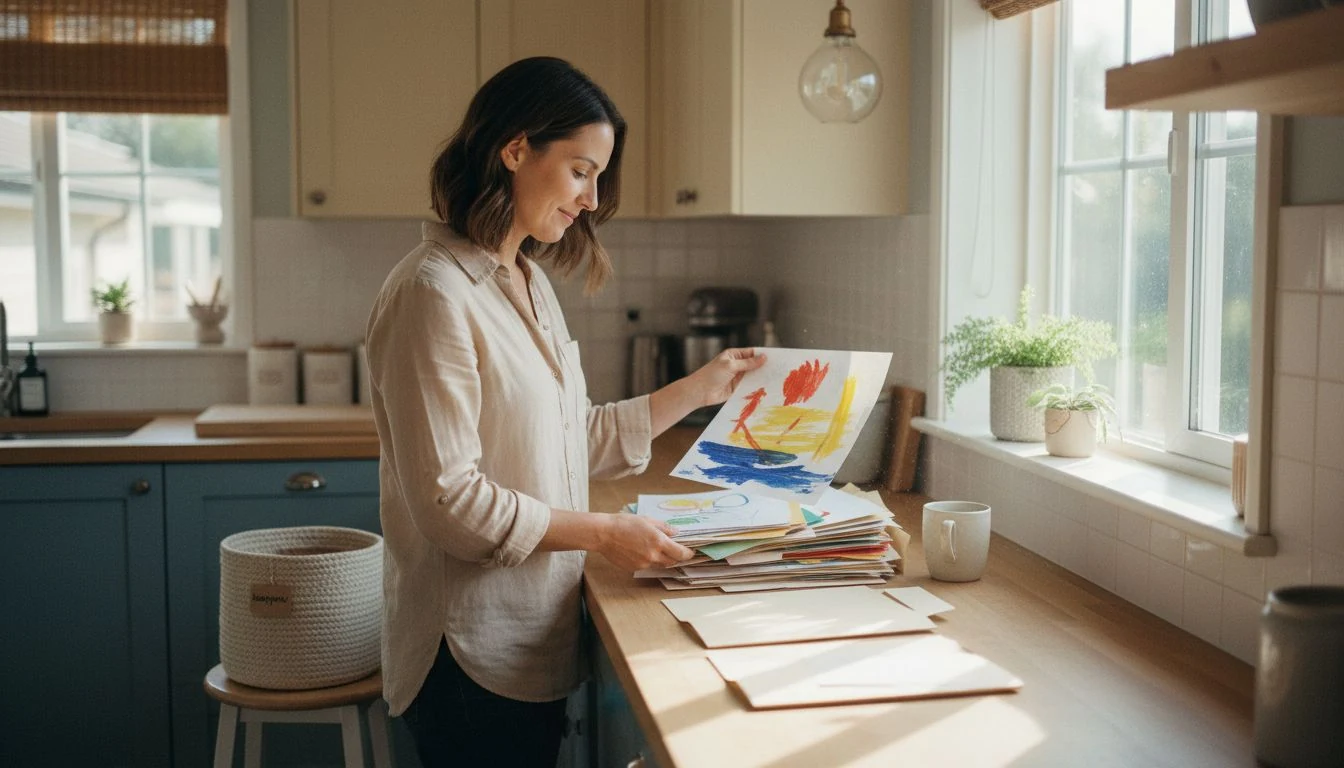
Nobody warns you that a preschooler can produce four paintings before lunch. The guilt is real. Tossing a drawing feels like tossing a little piece of your kid. I white-knuckled a bulging bin of macaroni art for two years before I made peace with a rule that respects the work: keep the ones that show who they are, photograph the rest.
My monthly ritual takes ten minutes. I dump the keep-for-now box on the table, and each kid picks their three or four favorites. Those go into a flat, letter-size bin, one per child, labeled with their name and grade. Everything else, I snap a quick phone photo of, kid holding it up with a big grin, and then it goes in the recycling. The photo keeps the memory. The paper just collects dust. The physical turkey does not need to outlive the turkey.
For the pieces you truly can’t part with, store them so they last. The National Archives has a plain-English guide to preserving family papers and keepsakes: acid-free, flat, out of the attic heat. And the mountain you recycle isn’t waste going nowhere. Paper is one of the most recycled materials in the country, per the EPA’s paper and paperboard recycling data. That reframe helped me let go. If the guilt still grabs you, my post on decluttering guilt and sentimental stuff goes deeper on it.
Setting up your launch pad in 20 minutes
You don’t need a Pinterest wall for good kids school paperwork organization. You need one catch spot near the door the backpacks land, plus your three folders. The whole build:
- Pick the spot where backpacks already get dumped. Fighting the natural drop zone is a losing game, so work with it.
- Put a single bin or wall pocket there. Every backpack paper gets emptied into it, unsorted, the second they walk in.
- Set your three folders somewhere you stand daily. Mine live on the kitchen counter next to the coffee maker, so I sort while the coffee brews.
- Add a small recycling bin within arm’s reach. Half the sorting is just tossing, and if the recycling is across the room, you won’t.
- Label one flat keepsake bin per kid and stash it in a closet. Out of sight, but it exists.
Total cost when I built mine: about $18 in folders and a bin from Target. The two-minute nightly sort is the habit that makes it hold, and I do it standing at the counter after dinner. Papers in the bin get triaged into action, reference, or keep-for-now, and the junk gets recycled on the spot. If your mail and adult documents are also drowning you, the same triage logic is in how to organize paperwork at home.
The keep-or-toss cheat sheet
When you’re standing over the pile at 8 p.m., you don’t want to think. You want a rule. This is the exact kids school paperwork organization breakdown I use: where each type of paper goes and how long it stays.
| Paper type | Where it goes | How long it stays |
|---|---|---|
| Permission slips / forms | Action folder | Until signed & returned, then toss |
| Graded tests & worksheets | Keep-for-now folder | Sort monthly; keep 3–4, recycle rest |
| Class info / menus / schedules | Reference folder | Replace when the new one arrives |
| Artwork & projects | Keep-for-now, then keepsake bin | Photo everything, keep favorites only |
| Report cards / official records | Home file (permanent) | Keep for good |
| Fundraiser flyers / ads | Recycling | Right away, unless you’re buying |
Common mistakes to avoid
- Sorting standing up, one sheet at a time. You’ll burn out by October. Batch it instead: everything into one bin, triage once a day.
- Keeping every “keeper” because deciding feels mean. Photograph the rest. The picture carries the memory; the paper carries dust.
- Making the action folder pretty instead of loud. If it blends into the counter, deadlines slip past it. Choose visible over cute, every time.
What didn’t work for me
The subject binder. I built this beautiful thing with a tab for math, reading, science, the works. It looked incredible for about nine days. Then hole-punching each sheet became the chore I skipped, and the papers stacked on top of the binder instead of inside it. Too many steps between the kid’s hand and the paper’s home, and any system dies.
The file-it-immediately rule died the same way. Real evenings don’t have a calm filing moment. The batch-and-triage rhythm survived because it asks for two minutes once a day, not a decision every time a paper appears. Lower the bar and the habit holds.
Grab the free printable: my one-page Kids’ School Paper Sorting Cheat Sheet, with the keep-or-toss rules plus folder labels you can print and tape up tonight. Get the free cheat sheet →
Frequently asked questions
How do I organize my kids’ school papers without spending hours?
Catch everything in one bin as it comes in, then triage the whole pile once a day into three folders: action, reference, and keep-for-now. Batching beats sorting sheet by sheet, and that daily pass is the core of any kids school paperwork organization system that actually lasts. The whole thing takes about two minutes standing at the counter.
What should I keep and what can I recycle?
Keep official records like report cards and immunization forms permanently, keep three or four favorite pieces of work or art per month, and recycle the rest. Photograph anything sentimental before it goes, because the photo is the real keepsake, not the paper.
How do I store the artwork I decide to keep?
Use one flat, labeled keepsake bin per child, stored somewhere cool and dry rather than a hot attic. Acid-free folders help the special pieces last. Do a quick sort once a month so it never becomes an overwhelming mountain again.
Get my free Home Reset Planner
The calm, room-by-room planner I use to reset my whole home without the overwhelm. Join the newsletter and I’ll send it straight to your inbox.
No spam, ever. Unsubscribe anytime. — Lena
Keep reading — more on Home Organization
Small Apartment Organization Ideas (Renter-Friendly, No Drilling)
Mudroom Organization Ideas That Survive Wet-Boot Season
Home Office Organization Ideas for a Small Space