For about a year, the cabinet under my kitchen sink held a spray bottle I used, a spray bottle I didn’t, four plastic bags full of other plastic bags, a sponge still in its packaging, and a dead flashlight. I called it storage. It was a junk cave with a pipe running through it. Most under sink storage ideas skip the one thing that makes that cabinet different from every other cabinet in the house: the drain pipe eats the middle of the space, and it’s damp down there.
This is the setup that finally held, in both my kitchen and my bathroom. It cost me under fourteen dollars total, took one slow Sunday, and it has survived four months without sliding back. Nothing here needs a drill or a custom pull-out system. It just needs you to work with the pipe instead of pretending it isn’t there.
Jump to:
- Why under sink storage ideas fall apart
- Empty it and meet the pipe first
- Under sink storage ideas that work around the drain pipe
- Kitchen vs bathroom: what belongs under each sink
- Under sink storage ideas for renters and tight budgets
- What to never store under the sink
- The 60-second under-sink reset
- What didn’t work for me
- Common under-sink mistakes to avoid
- Frequently asked questions
Why under sink storage ideas fall apart
Almost every guide tells you to buy bins and stack them. Then you get the bins home, and the P-trap, that curved pipe under the drain, sits right where the second bin was supposed to go. So you shove things around it, and the cabinet goes back to being a cave within a week.
The other problem is damp. This cabinet shares a wall with plumbing that sweats, and a slow drip can go unnoticed for months. I once found a warped cardboard box of dishwasher tabs that had wicked up a leak I didn’t know I had. So the real rule underneath all under sink storage ideas is this: nothing on the floor of that cabinet that can’t survive getting wet, and nothing blocking your view of the pipe. You want to notice a drip on day one, not day sixty.
Empty it and meet the pipe first
Pull everything out. All of it, onto a towel on the floor so you can see what you actually own. I found three of the same all-purpose cleaner and a bottle of something with a faded label I couldn’t identify, which is its own small warning.
Now look at the cabinet empty. Find the P-trap and notice two numbers: how much floor is clear to the left and right of it, and how much height you have from the floor to the pipe. Mine was about nine inches of usable height on one side. Measure before you buy a single thing. The reason under-sink organizers get returned is that people buy for the width of the cabinet and forget the pipe cuts the usable space roughly in half.
Under sink storage ideas that work around the drain pipe
Here is what earned a spot, in the order that did the most work:
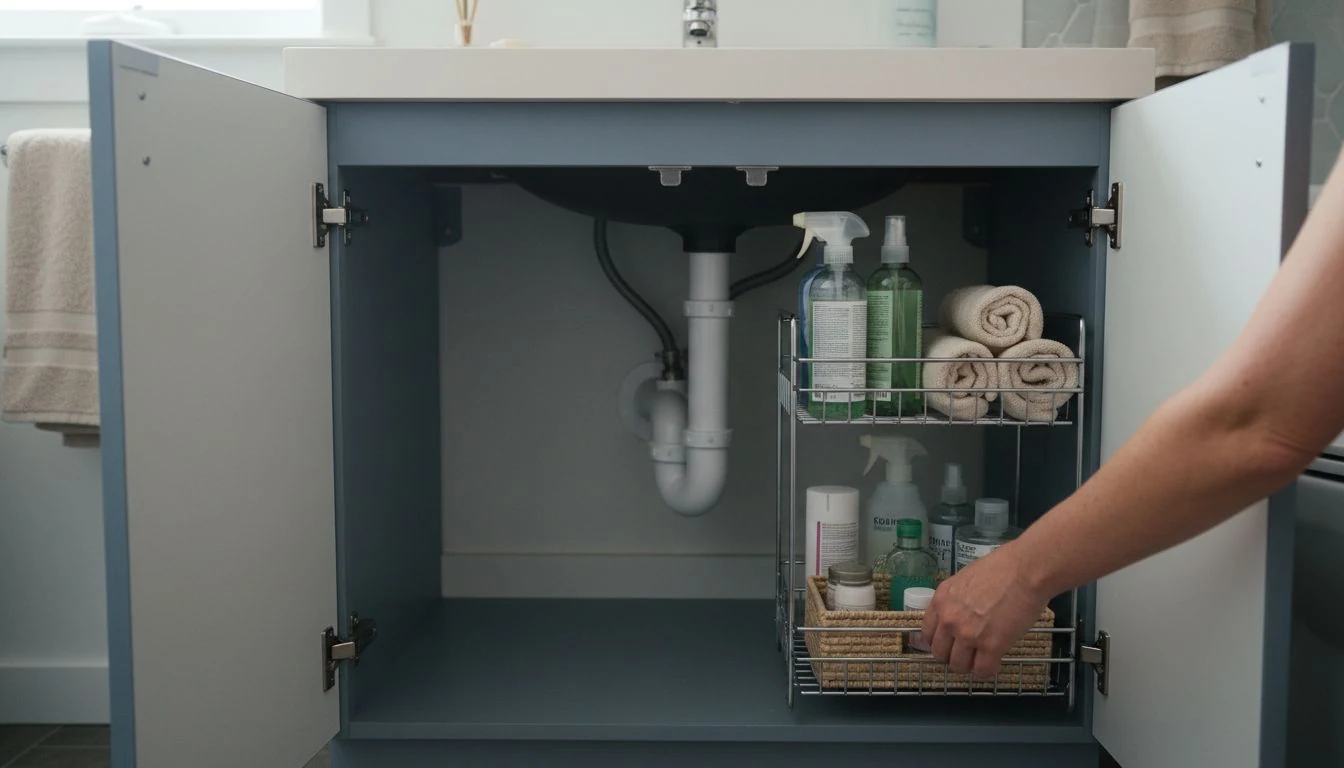
- A U-shaped or two-tier pull-out that clears the pipe. The good ones have a notch or an open back so they slide in beside the P-trap instead of fighting it. Mine holds spray bottles on top and backups below, and it rolls out so I’m not on my knees reaching into the dark.
- A tension rod across the cabinet, up high. Hang trigger-spray bottles by the neck. It costs a few dollars, frees the whole floor, and the bottles drip-dry instead of ringing the shelf with residue. This was the single best two dollars I spent.
- One shallow bin on the floor, on each side of the pipe. Shallow, so you can pull it straight out. Deep bins turn into their own caves.
- An over-the-door caddy for the small, flat things: extra sponges, gloves, a scrub brush. It uses the one surface everybody forgets.
What I deliberately left out: a lazy Susan. In a cabinet with a pipe down the middle, a turntable can only spin on one side, so you pay for a circle and use a half. If your sink cabinet is a rare one with the pipe against the back wall, ignore me and get the turntable.
Kitchen vs bathroom: what belongs under each sink
The mechanics are the same, but the contents are not, and mixing them up is how the cabinet fills back up. Under the kitchen sink I keep one multipurpose cleaner, dish soap refill, a roll of trash bags, and the scrub brush. That’s it. Everything else, the ten specialty cleaners and the bulk sponges, moved to a shelf in the laundry closet where it’s dry and I can actually see the whole collection. If you want the full kitchen version, I wrote a separate walkthrough on how to organize a small kitchen on a budget.
Under the bathroom sink goes backup toiletries, one basket of hair tools, and a small first-aid box. No towels stacked flat (they mildew against the damp back wall), and no makeup I use daily (that belongs within arm’s reach of the mirror, which I get into in the small bathroom organization post). The bathroom cabinet is smaller and the plumbing runs closer to the doors, so I lean harder on the tension rod and the over-door caddy there than I do in the kitchen.
Under sink storage ideas for renters and tight budgets
I did the first version of this in a rental where I couldn’t drill a single hole, and it still worked. Everything here is removable and cheap:
- A boot tray on the cabinet floor. A dollar-store one under the pipe catches a slow drip and protects the wood. It’s the least glamorous thing in this post and the one I’d install first.
- Adhesive-hook plus a small basket on the inside of the door for gloves and a brush. Peel-off hooks that come off clean at move-out.
- Dollar-store bins instead of the pretty branded ones. Down here, nobody sees them, and they get damp. Spend the money where it shows.
- The tension rod again. No tools, no damage, holds real weight.
My whole renter version came in under fourteen dollars: a boot tray, a tension rod, two bins, and a pack of adhesive hooks. If you want more no-drill tricks for a tight place, the smart storage ideas for small spaces post has the ones I use everywhere else in the house.
What to never store under the sink
This is the part I wish someone had told me before I stored dish tabs down there. A few things really shouldn’t live under a sink, and one of them is a genuine safety issue.
Household cleaners are the reason. If you have kids or pets, the under-sink cabinet is at exactly their height, and a curious toddler opens a cabinet faster than you’d believe. The safest move is to store cleaning chemicals up and away, in a high cabinet, and if they must go under the sink, use a cabinet lock. Keep the national Poison Help number, 1-800-222-1222, saved in your phone; you can read more at the federal HRSA Poison Help site. And when a cleaner is finally empty or expired, don’t just bin it, some products count as household hazardous waste, which the EPA explains here.
Beyond safety, keep these out too: paper products (they soak up leaks and grow mold), pantry overflow or pet food (damp plus a warm cabinet invites pests), and anything you’d be heartbroken to lose to a flood. Down here, assume water. If you’re not sure a cleaner earns its spot at all, my honest roundup of cleaning products actually worth it will thin the herd fast.
The 60-second under-sink reset
Once a week, when I wipe the counter, I open the cabinet and do one loop: glance at the boot tray for water, put the two stray bottles back on the pull-out, and toss anything empty. Sixty seconds, and the cave never comes back. The whole point of good under sink storage ideas is that the maintenance is this short. If a system needs more than a minute to keep up, it’s too complicated for the least-visited cabinet in your home.
What didn’t work for me
Three real misses, so you can skip them. First, stacking two deep bins: the bottom one became a fossil layer I never dug into. Second, a wide pull-out drawer I bought without measuring, which hit the P-trap and wouldn’t close, so it went back. Third, buying sponges and cleaners in bulk and keeping the surplus down there, where the damp got to the open sponges and they smelled musty within a month. The fix for all three was the same, less stuff, in shallow containers I can pull straight out, with the overflow living somewhere dry.
The under-sink problem, and what actually fixes it
If you only take one thing from this post, take this table. It’s the map I wish I’d had before I bought anything.
| The obstacle | Why it wrecks the cabinet | The fix that held |
|---|---|---|
| The P-trap pipe | Eats the center, blocks bins and turntables | U-shaped or two-tier pull-out that clears it |
| Damp floor | Warps cardboard, molds paper and sponges | Boot tray down first; nothing porous on the floor |
| Deep, dark back | Things vanish and expire unseen | Shallow bins that pull straight out |
| Door blocks a bin | Half the opening is unusable | Tension rod up high, over-door caddy for flat items |
| Too many half-empty bottles | Duplicates hide behind duplicates | Keep one of each; move overflow to a dry shelf |
Common under-sink mistakes to avoid
- Buying containers before you measure the pipe. The single most-returned reason; the cabinet’s usable height and the P-trap position decide everything, so measure both first.
- Storing anything porous on the floor. Paper, cardboard, and spare sponges wick up a slow leak and mold before you ever notice the drip.
- Leaving cleaners loose at toddler height. If kids or pets are in the house, chemicals go up and away or behind a cabinet lock, never just sitting on the cabinet floor.
Grab the free printable: my one-page Under-Sink Reset Card, the measure-first checklist I use to size the cabinet, sort the keep pile, and run the weekly 60-second check. Get the free under-sink reset card →
Frequently asked questions
How do I organize under the sink with pipes in the way?
Work around the P-trap instead of over it. Measure the clear floor space on each side of the pipe and the height up to it, then choose a U-shaped or two-tier pull-out designed to slide in beside the pipe. Add a tension rod up high for spray bottles so the floor stays open. Skip turntables and wide drawers, which the pipe usually blocks.
What should you not store under the kitchen sink?
Keep out paper products, pantry or pet food, and anything you’d hate to lose to a leak, because the cabinet is damp and shares a wall with plumbing. Most importantly, don’t leave cleaning chemicals loose at child or pet height; store them up and away or behind a cabinet lock, and save the Poison Help line, 1-800-222-1222, in your phone.
How do I stop the under-sink cabinet from smelling musty?
The smell is almost always a slow leak plus something porous soaking it up. Put a boot tray on the floor to catch drips, take out cardboard and spare sponges, and leave the doors open for an hour after you clean. If the musty smell keeps coming back, check the P-trap connections for a drip, because a persistent smell down there usually means water, not just poor airflow.
Get my free Home Reset Planner
The calm, room-by-room planner I use to reset my whole home without the overwhelm. Join the newsletter and I’ll send it straight to your inbox.
No spam, ever. Unsubscribe anytime. — Lena
Keep reading — more on Home Organization
Storage Unit Sizes: What Actually Fits in a 5×10, 10×10 and 10×20

What Professional Closet Organizers Actually Cost (and the Session I’d Book First)
Organize Closet by Color: The System That Holds Up (and Where It Backfires)