
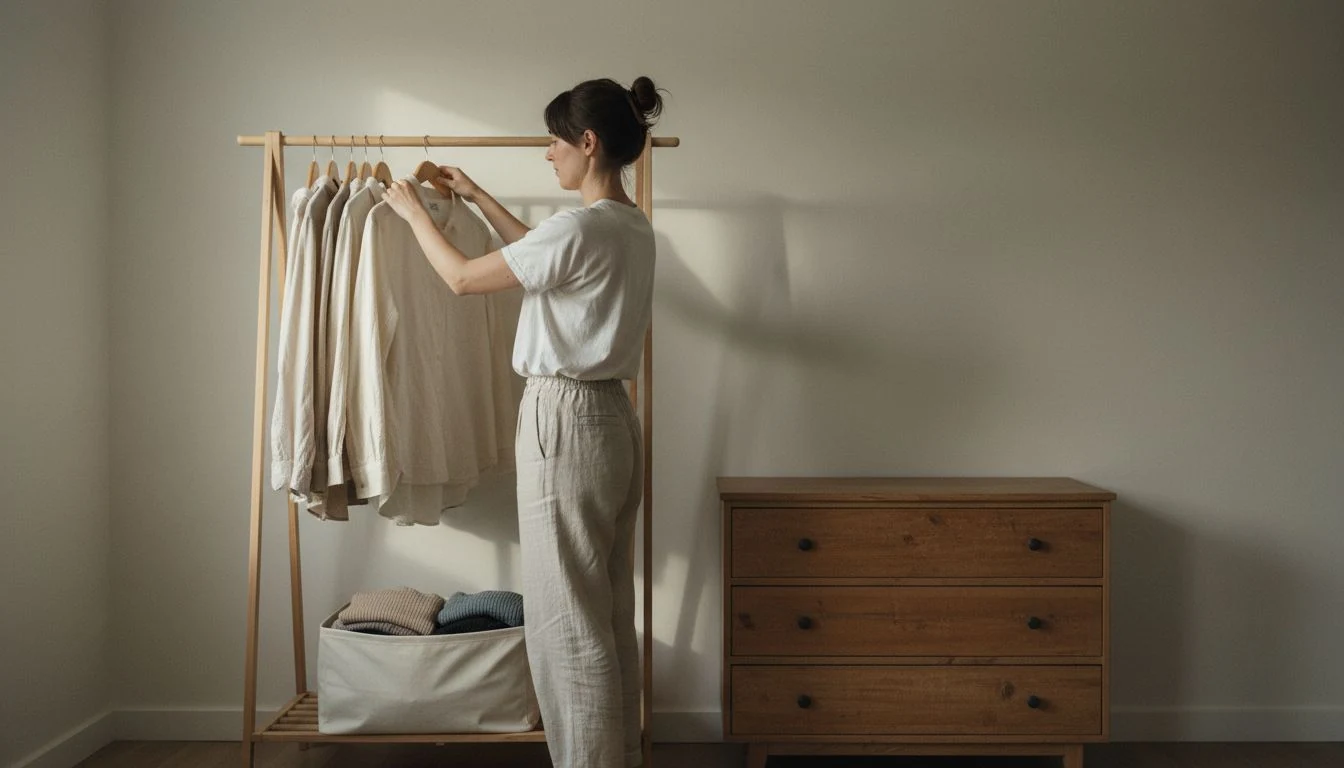
My bedroom has no closet. There’s a radiator under the window, a door that opens the wrong way, and a bare wall where a closet would go. The building went up in 1936, when people owned a wardrobe and carried it in with them, and almost every list of clothes storage ideas I found was written for a room that already has a rod and a shelf in it.
Two other posts here cover the neighboring problems, so you don’t read the wrong one. If you do have a closet and it’s just cramped, that’s my small closet guide. If you want the whole apartment handled zone by zone, that’s the small-space storage post. This one is for the room with nothing on the wall to work with, and it cost me about $190 and one bad purchase to sort out.
Jump to:
- Why most clothes storage ideas assume a rod you don’t have
- Measure the wall before you buy anything
- Clothes storage ideas for a wall with nothing on it
- A low dresser does the job a rail can’t
- Under the bed, and the boxes that wreck things
- What should never live out in the open
- Keeping your clothes storage ideas from looking like a storage unit
- What’s going wrong, and what fixes it
- What didn’t work for me
- Frequently asked questions
Why most clothes storage ideas assume a rod you don’t have
Nearly all of them start in the same place: take everything out, sort it, put it back better. That instruction quietly assumes a “back” exists.
With no closet, the sorting isn’t the hard part. Where things land is. And the two questions nobody answers are which garments survive hanging in open air for months, and how to stop a wall of clothing from being the loudest thing in the room.
My first month here, everything lived in the suitcases I moved with. I told myself it was temporary. It was four months, and I got dressed off the floor the whole time, which is the part I’d skip if I could do it again.
A year in, I’d put it like this. A room with no closet needs three separate pieces rather than one clever product: something to hang on, something to fold into, and somewhere closed for the half of your wardrobe that isn’t in season. Buy one of the three and you’ll be disappointed within a month, and you’ll blame the thing you bought.
Measure the wall before you buy anything
Fifteen minutes with a tape measure, before a single order goes in. I skipped this and it cost me $28.
Write down four numbers. The width of the clear wall you can give up. The height to the ceiling. The depth you can lose before the room stops working, which for me was 24 inches. And your bed’s floor clearance, because that decides the under-bed half of the plan.
Mine came out at 71 inches of wall, 8 feet 4 to the ceiling, 24 inches of depth, and 6.5 inches under the bed. That last number ruled out most of the hard boxes sold for this, which want closer to 7.
Then count what you own. Not roughly. I had 46 hanging items and I’d have guessed thirty. Use that count to decide whether one rail is enough, because it’s the number I wish I’d had before I stood in a store aisle deciding.
Grab the free printable: my one-page No-Closet Wall Plan, with the four measurements to take, where to hold the tape, and a spot to write your hanging count, so you can carry it to the store instead of estimating in the aisle. Get the free wall plan →
Clothes storage ideas for a wall with nothing on it
A freestanding rail is the closest thing to a closet you can put in a room without touching the walls, which matters if you rent. Mine is wood, 48 inches wide, and it was $62.
It holds 34 hanging items comfortably. I’ve had 46 on it, and at 46 the middle of the rail dipped visibly and shirts slid toward the low point all week. That’s a span problem rather than a weight problem, so a center leg or two shorter rails will beat one long rail every time.
What earns a spot: shirts, dresses, blazers, trousers with a crease, anything you’d be annoyed to iron twice. Woven fabric can hang. Knitwear can’t, and I learned that on a grey wool sweater I’d had since college, which came out of the winter with two small peaks at the shoulders that never pressed flat.
One detail made more difference than it should have. I swapped 46 mixed hangers for 30 identical slim ones, $19, and the same clothes on the same rail went from noisy to quiet. Nothing to do with tidiness. Your eye just stops catching on the shape of every hanger.
A low dresser does the job a rail can’t
Whatever shouldn’t hang needs a drawer, and this is the piece people skip because it isn’t the fun purchase. Mine was $85 secondhand, three drawers, 31 inches tall.
Low matters. A tall chest in a room with no closet turns the room into a corridor, and the top of a low one gives you a surface for a lamp, which is what keeps the room reading as a bedroom. If yours is tall and there are children in the house, anchor it to the wall.
Drawer one is knitwear, folded on its side so I can see every edge at once. Drawer two is everyday basics. Drawer three is the awkward middle: swim, thermals, whatever belongs to a season that isn’t now.
Folding on the side rather than stacking flat was the change that stopped me wrecking a drawer every morning. You lose nothing in capacity and you stop excavating. It’s the same trick I use for the kids in the kids’ clothes post, and it holds up better there than any label ever did.
Under the bed, and the boxes that wreck things
With 6.5 inches of clearance I fit two hard lidded boxes at about 6 inches tall, roughly $14 each, and they hold the off-season half of my wardrobe.
Hard and lidded, both words on purpose. Fabric bags let dust through and sag when you drag them. And I’d stay away from vacuum bags for anything whose shape you care about, because a crease pressed into a coat for six months is a crease you keep.
Under-bed is for out of season only. The moment I put in-rotation clothes down there I stopped wearing them, same as everything else I can’t see. That’s a pattern I dug into in the wider bedroom reset.
What should never live out in the open
This is the part the pretty photos leave out, and it’s why open storage has a bad reputation it half deserves.
Wool, cashmere, anything with animal fiber in it shouldn’t spend a summer hanging in open air. Clothes moth larvae feed on wool, fur, hair and feathers, and they’re drawn to fabric that’s absorbed sweat, so the sweater you wore twice and hung back up is the one at risk. The National Pesticide Information Center recommends laundering or dry-cleaning before long-term storage, then keeping items in airtight containers. That’s my whole system now: everything woolen gets washed in May and goes into a hard box under the bed until October.
Damp is the other one. Clothing packed away in a humid room comes out smelling of the box, and the fix is the room rather than the container. The EPA puts indoor relative humidity below 60 percent, ideally between 30 and 50, to stop mold getting started. I bought a $12 hygrometer, sat it on the dresser, and it’s the cheapest thing in this post that changed a habit.
Silk and anything dark fades in direct light too, so if your clear wall is the sunny one, that’s the wall for the dresser and not the rail.
Keeping your clothes storage ideas from looking like a storage unit
An open wardrobe is a wall of color and texture you see from bed every night, and tidying alone won’t fix that.
A few things did the work here. Matching hangers, already mentioned. One bin type instead of the four mismatched ones I’d collected. And a plain linen curtain on a $16 tension rod across the front of the rail, which I pull closed when the room needs to be a bedroom and leave open the rest of the time.
The other half of it is volume. A rail holding 34 things looks intentional, and the same rail holding 46 looks like a sale rack. Owning less is the cheapest storage solution there is, which is why the capsule wardrobe approach and a no-closet room go together so well. Shoes are their own separate fight, and those are in the shoe storage post.
What’s going wrong, and what fixes it
These are the five complaints I hear about no-closet rooms, including from myself. The middle column is the part that gets misdiagnosed, and it’s why people replace furniture that was never the problem.
| What’s going wrong | What’s causing it | What fixed it here |
|---|---|---|
| The rail sags in the middle | Unsupported span, not total weight. Mine dipped at 48 in. with 46 items on it | A center support leg, or two short rails instead of one long one. No dip since |
| Sweaters have peaks at the shoulders | Knits stretch under their own weight on a hanger and don’t spring back | No knitwear on the rail. Folded on its side in drawer one |
| The room reads as clutter even when it’s tidy | Open storage shows every color, hanger shape and bin at once | One hanger type, one bin type, a linen curtain across the front for $16 |
| Stored clothes smell musty in spring | Room humidity, not the box. Sealed damp stays damp | A $12 hygrometer on the dresser, room kept in the 30 to 50 percent band |
| Holes in wool that was clean when it went away | Clothes moth larvae feeding on animal fiber, drawn to worn-in sweat | Wash or dry-clean in May, then a hard airtight box, never a fabric bag |
Common no-closet mistakes I made first
- I bought before I measured. The first rail was 60 inches wide for a 71-inch wall, which sounds fine until you account for the door swing that ate 14 of those inches. It went back, and the restocking cost me $28.
- I hung everything, because hanging felt like progress. Four sweaters came out of that first winter with shoulders I couldn’t press flat again. Knits go in a drawer, and I paid about $200 in ruined wool to learn it.
- I left the whole wardrobe on display year round. Winter coats hanging in July is what makes a room look like storage. Sending half the clothes under the bed each season is what made the other half look deliberate.
What didn’t work for me
The fabric portable wardrobe, first. It was $45, it zipped shut, and it looked like the answer: a closet you assemble in an evening. The zipper split down one side in month five, and after that it was a lopsided grey tent in the corner I couldn’t quite justify throwing out. The frame poles bent where the crossbar met the upright, which I’m told is normal for the cheap ones and I’d believe it.
Over-the-door hooks on the bedroom door were the other miss, and that one’s on me for not thinking it through. The door stopped closing flush, my dressing gown was always in the way, and there’s now a dent in the top edge of a rental door I’ll be explaining when I move out.
Then I spent an embarrassing Saturday hunting for one product that would replace a closet. That’s the mistake sitting under the other two. There isn’t one. The room wants a rail, a low dresser and two boxes under the bed, and once I quit looking for a single answer the whole thing came together in an afternoon for less than the price of a wardrobe.
What I got right was luck. The rail went on the wall away from the window, only because the radiator was in the way of the other one. A year on, nothing has faded.
Frequently asked questions
What are the best clothes storage ideas for a bedroom with no closet?
Three pieces working together rather than one. A freestanding rail for woven clothes you’d otherwise iron, a low dresser for anything knitted or folded, and two hard lidded boxes under the bed for the off-season half. Mine came to about $190 including a secondhand dresser, and it holds a 46-item wardrobe without the room feeling like storage.
How do I store clothes without a dresser or a closet?
Lidded fabric bins on a shelf or on the lower rung of the rail stand in for drawers, and they’re the cheapest workable substitute. Keep them shallow, because a deep bin turns into a pile you dig through. Stacked crates work too, though anything you have to unstack to reach will quietly stop being used within a couple of weeks.
Is it bad to leave clothes hanging on an open rack?
It’s fine for woven fabrics like cotton shirts and trousers. It’s a bad idea for knitwear, which stretches at the shoulders, and for anything woolen you’re storing over the summer, since moths feed on animal fibers. Keep the rail out of direct sun to protect darks and silk, and put the wool in a sealed box between seasons.
Measure your wall this week and count your hangers before you buy anything. Those two numbers decide the whole plan, and the count is going to be higher than you think. Mine was, by sixteen.
Get my free Home Reset Planner
The calm, room-by-room planner I use to reset my whole home without the overwhelm. Join the newsletter and I’ll send it straight to your inbox.
No spam, ever. Unsubscribe anytime. — Lena
Keep reading — more on Closet & Wardrobe
The Coat Closet Nobody Fixes Until It’s Already Cold

Building My Own Closet System: The Weekend Version of a $3,000 Quote
Custom Closet Storage Solutions: What They Really Cost (and When a Kit Wins)