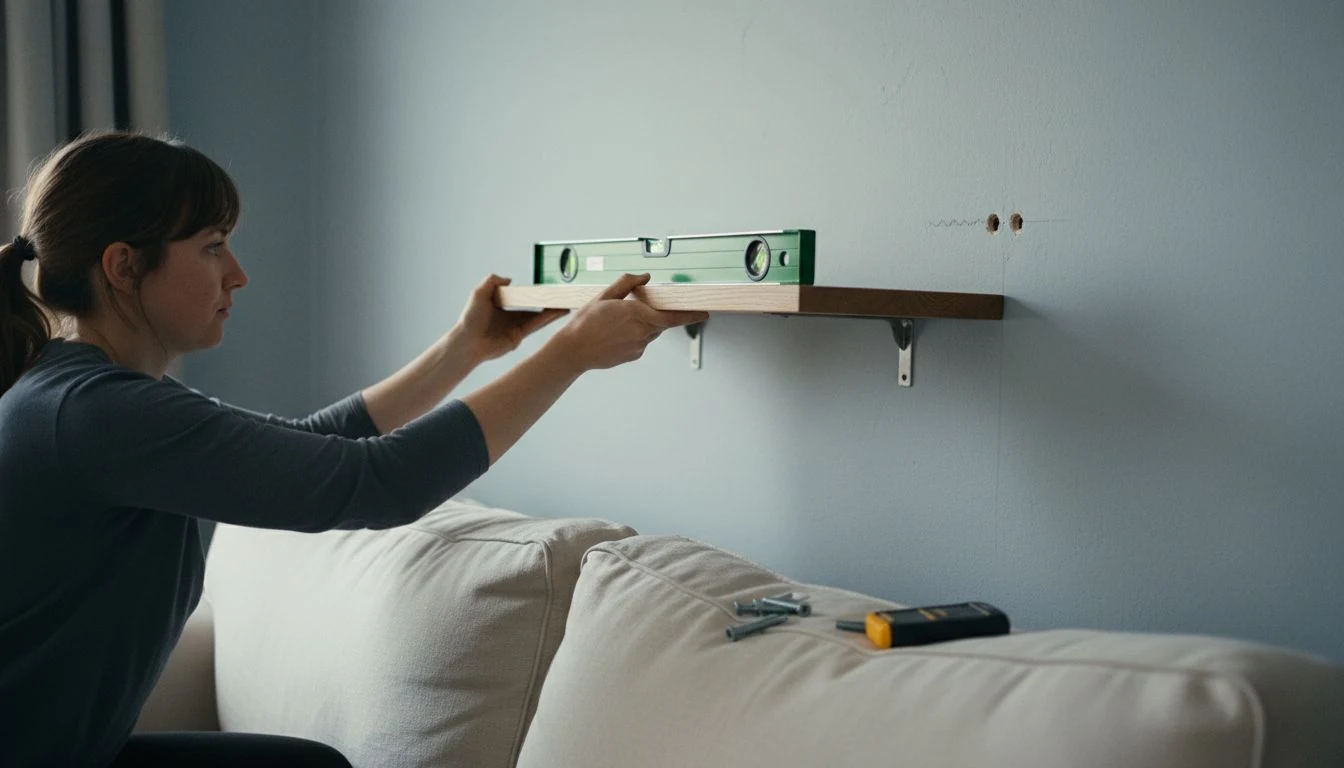
My hallway shelf came off the wall at 6:40 on a Tuesday morning, and I heard it from the shower. Thirty-six inches of oak, four paperbacks, a ceramic dish of keys, and two plastic anchors that had chewed a pair of holes the size of dimes on their way out. I had put that shelf up eleven days earlier. Every article I read about floating shelves for small spaces spent its energy on what to put on top, and I had skipped straight to the part with the ceramic dish. The wall was where I should have started.
One thing to sort out before you keep reading. If the open question is still where storage belongs in your place at all, my guide to storage ideas for small spaces goes zone by zone through the whole apartment and works out what deserves a spot. This post picks up after that. It treats the shelf as a physical object screwed to a wall: how deep it needs to be, what sits behind the drywall holding it, how much it takes before it sags, and the three places I have watched them come down.
Why floating shelves for small spaces are a depth decision first
A floating shelf has no legs and no visible bracket, so everything on it is trying to rotate it off the wall. The longer the reach from the wall to the front edge, the harder it pulls. Depth is the load math, and you settle it at the checkout page before the thing ever arrives.
I learned this by buying wrong. The shelf in the photo I saved looked like it held a stack of books and a small plant with room to spare. The listing said 5.9 inches deep. My paperbacks are 7 inches from spine to edge, so every single one hung over the front lip, which shoved the whole load forward past the part of the shelf the bracket was holding.
Now I measure the thing I want to store before I look at a single shelf. Paperbacks want about 7 inches. Cookbooks and hardbacks want 9 to 10. A row of spice jars is happy at 4. Mugs need 5 and a bit of forgiveness. If the shelf is shallower than the object, the object is a lever, and the wall is what gives.
My rule after two patch jobs: in a small room, go shallow on purpose and long only if the wall behind it cooperates. A 4-inch shelf that holds what you use is worth more than a 10-inch one you’re afraid to load.
Studs, drywall, and what each one actually holds
Every shelf listing treats your wall as a solid surface. Mine is a thin sheet of gypsum with vertical wooden studs behind it, usually spaced 16 inches apart, sometimes 24 in newer construction. The stud is the part that holds. The drywall between studs is about half an inch of compressed chalk, and on its own it holds close to nothing.
That leaves three situations. The bracket lands on two studs, which is the one you want. It lands on one stud, workable with help. Or it lands on nothing, which is where my hallway shelf lived for eleven days.
I bought a stud finder for nine dollars and it changed how I hang everything. Before that I used the knuckle-knock method and I was wrong constantly, because the sound in a hallway with a closet behind it is a lie. If you’re renting and you’d rather not own one, the low-tech version is to find the outlet, since the box is usually screwed to the side of a stud, then measure across in 16-inch steps and confirm with a small finish nail somewhere that will be hidden.
One thing I wish someone had told me before I drilled into a wall in a building from 1962. Older paint layers matter. The EPA is direct about it in its renovation, repair and painting guidance: any project in a pre-1978 home with lead-based paint can easily create dangerous lead dust. Drilling counts. It takes about four seconds to hold a damp paper towel under the bit and wipe the dust off the floor after, and I do it every time now.
How much weight floating shelves for small spaces really take
Package ratings are for one screw in a laboratory, driven perfectly, pulling straight down. Your shelf is a cantilever with a plant on the front edge. The two numbers are not the same number and I stopped treating them as related.
What I do instead is name the shelf’s job before I load it. Some of mine are for display, meaning light and pretty and nothing I would miss if it hit the floor. Most are for daily reach: mugs, spices, the little speaker. And two hold weight, books and heavy dishes, and those two are the only ones I hang off studs.
Then I load closest to the wall. Heaviest items go at the back, against the mounting line, and the front third stays for light things. Same shelf, same brackets, completely different amount of strain. That single habit is why the shelf over my sofa has held a stack of art books for two years while the hallway one gave up in under two weeks.
The emergency-preparedness people arrive at the same instinct from a different direction. Ready.gov’s guidance on preparing your home for earthquakes says to secure heavy items like bookcases and objects that hang on walls, and to store heavy and breakable objects on low shelves. I don’t live on a fault line. I do live below a neighbor who slams a door, and low and heavy has been the right call anyway.
Grab the free printable: my one-page Shelf Load Card, with the depth-to-object chart I measure against, the stud spacing cheat sheet, and the three checks I run before anything goes on a new shelf. Get the free shelf card →
Heights that work, room by room
I hung my first shelf at the height it looked good from across the room, which is how you end up on your toes reaching for a mug every morning. Height is an ergonomics decision and it changes by room.
Above a sofa I go 10 to 12 inches over the back cushion. Any lower and you knock your head sitting down. Any higher and it starts floating off on its own, disconnected from the furniture.
In a kitchen, above the counter, I want 18 inches of clear working space under the shelf. Less than that and you can’t stand a tall pitcher up or get a hand in behind the kettle. I go into the reasoning more in my post on how to organize a small kitchen, but the short version is that a shelf hanging low over your counter costs you the counter.
Beside a bed, the shelf works at roughly mattress height plus a hand’s width, so you can reach a glass of water lying down. Above a desk, keep it high enough that a monitor and your head both clear it, which for me was 22 inches above the desktop and took two tries.
In a narrow entry I keep them above shoulder height for anything I don’t touch daily, and low near the door for keys. That split is the same logic behind my entryway organization ideas: the things you use in the first eight seconds go where your hand already is.
The three places floating shelves for small spaces always fail
After eight shelves in two apartments, the failures cluster in the same spots.
The first is above a toilet. It’s the most-recommended shelf location on the internet and it’s almost always a stud-free zone, because plumbing lives in that wall and framing gets moved around it. My bathroom shelf is fine, but only because I gave up on centering it over the toilet and slid it 9 inches left onto solid framing. Nobody has ever noticed. I notice every day that it’s still on the wall.
The second is a hallway, which is where mine came down. Hallways feel like empty wall and they are usually the thinnest, most interrupted framing in the place, full of closet returns and door headers. They also take a beating from people walking past with bags.
The third is anywhere with a temperature swing or steam. A shelf in a bathroom with a bad fan, or over a radiator, will move. Solid wood cups and warps, cheap veneered board swells at the edges and stops sitting flat on its bracket, and then it rocks a little every time you set a cup down, and that rocking works the screws.
Filling the shelf without building another pile
This is where I lost the most time, and it isn’t structural. A floating shelf is a beautiful, wall-mounted, permanently visible flat surface. Which means it’s a landing zone. Mine collected mail for a month before I admitted what was happening.
What works for me is deciding the shelf’s job in one sentence before anything goes on it, and then leaving one third of it bare. Bare, with nothing arranged in the gap to make it look intentional. That empty third is what stops the drift, because the second a shelf reads as full, whatever lands on it next looks like it belongs there.
For the loose stuff I use one shallow container per shelf, never two. Two containers turn a shelf into a shelving unit and it starts to feel busy in a room that’s already small. I’ve moved almost entirely to woven and metal for this, for reasons I get into in organizing without plastic bins, but the count matters more than the material.
And I stopped treating the shelf as decoration with a storage bonus. In a small room a surface either earns its wall or it becomes the thing you look at and feel vaguely bad about, which is the same trap I write about in my minimalist home tips.
Mounting methods side by side, and what didn’t work for me
Here’s the honest ledger from two apartments. The left columns are what the box promised. The right ones are what happened in my place.
| What’s behind the bracket | What the package claimed | What I actually put on it | How it held |
|---|---|---|---|
| Two studs, 16 inches apart | “Up to 100 lbs” | Stack of art books, a lamp, a heavy stoneware bowl | Two years over the sofa, zero movement. The only setup I’d trust with books |
| One stud plus a toggle bolt on the other end | “Up to 50 lbs” | Mugs, a small speaker, a jar of utensils | Solid for 14 months. Slight give if I lean on the free end, so I keep the weight over the stud side |
| Toggle bolts only, half-inch drywall | “Up to 50 lbs” | Spice jars and a folded tea towel, nothing over the front edge | Fine, but I treat the number as fiction and load it like it says 10 |
| Plastic expansion anchors, no stud | “Up to 30 lbs” | Four paperbacks and a key dish | Eleven days. Two dime-sized holes and a Tuesday morning I’d rather forget |
| Plaster and lath, older building | Nothing specific, and that’s the tell | One small frame, essentially decorative | Held, but the plaster cracked on the pilot hole. I drill slow and small here, or I don’t drill |
Three mistakes I’d undo
- I hung the shelf where the room wanted it, not where the framing was. Centering matters far less than I believed. Sliding a bathroom shelf 9 inches off center onto a stud looked wrong on paper and is invisible in real life. The hallway shelf I insisted on centering is the one that fell.
- I trusted the anchors that came in the box. Those little ribbed plastic sleeves are packed with almost every shelf sold and they are the cheapest part of the purchase. I now throw them out on principle and buy toggles separately, which cost me about four dollars and one trip.
- I loaded the front edge because it looked better. The plant goes at the front in every photo because that’s the flattering angle. Physically it’s the worst place for the heaviest thing. Heavy at the back, light at the front, and the shelf stops arguing with you.
Frequently asked questions
How much weight can floating shelves for small spaces hold?
It depends almost entirely on what’s behind the wall, not on the shelf. Anchored into two wooden studs, a decent bracket will carry books and dishes and I’ve had one hold a loaded stack for two years. Mounted into drywall alone with toggle bolts, treat the rating on the box as optimistic and keep it to light daily-use items with nothing hanging over the front edge. Mounted with the small plastic anchors that ship in the box and no stud, assume it’s decorative. Weight also isn’t the whole story: where you put it on the shelf matters as much as how much it weighs, since the front edge pulls far harder than the back.
How deep should a floating shelf be in a small room?
Measure the thing you plan to store and buy a shelf at least that deep. Spice jars are happy at about 4 inches, mugs at 5, paperbacks at 7, hardbacks and cookbooks closer to 9 or 10. If the object hangs over the front lip, it’s levering the shelf off the wall and it looks messy from the side too. In a tight room I’d rather run a shallow shelf longer along the wall than a deep one that intrudes into the walking space, because anything you clip with your shoulder in a hallway eventually loosens.
Can I hang a floating shelf without hitting a stud?
Yes, with proper toggle bolts, and with a clear head about what it’s for. Toggles open behind the drywall and spread the load, which is a different mechanism to the plastic sleeves that just wedge in the hole. That setup holds spices, a speaker, framed photos, light everyday things. It does not hold a row of books, whatever the box says. If the wall is plaster and lath rather than drywall, drill slowly with a small bit and expect the surface to be fragile. And if you’re renting, remember you’re patching every hole eventually, so fewer, better-placed holes is also the cheaper move.
The order that finally worked for me runs backwards from how I used to shop. Measure the thing you want to store. Find the stud. Then buy the shelf that fits both. I did it the other way round for years, and it cost me two wall repairs and a set of keys that spent a morning under the radiator.
Get my free Home Reset Planner
The calm, room-by-room planner I use to reset my whole home without the overwhelm. Join the newsletter and I’ll send it straight to your inbox.
No spam, ever. Unsubscribe anytime. — Lena
Keep reading — more on Storage Solutions
Shed Organization Ideas for the Fall Clean-Out
Wrapping Paper Storage Ideas That Stop the Crushed-Roll Problem
Shoe Storage Ideas for Every Room (Not Just the Front Door)