
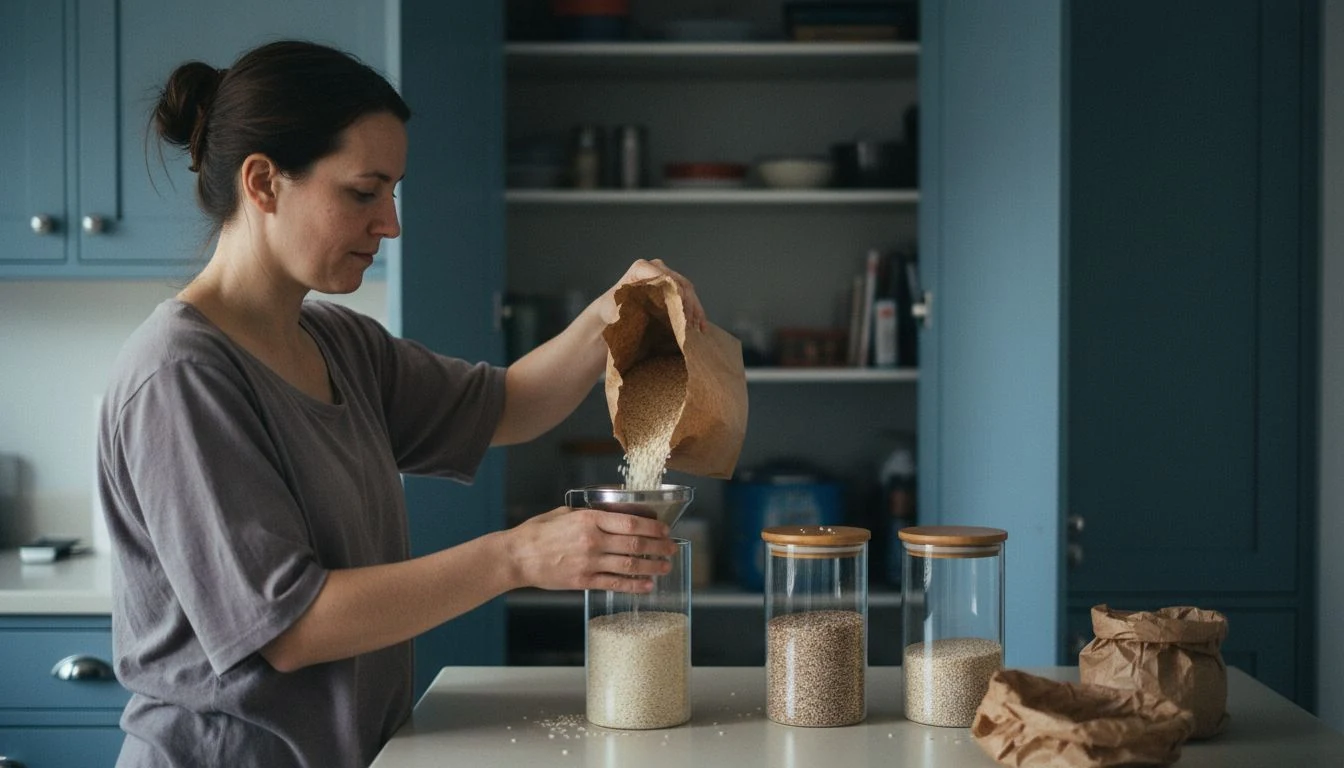
I decanted my whole pantry over one weekend in March. By June I had put about a third of it back in the original bags. The jars did look lovely lined up on the shelf, and they also cost $94, and a good number of them were guarding foods that were never going to spoil in a paper sleeve anyway. Two years on, I can tell you which airtight containers for pantry storage earn their shelf space, and which ones are just very pretty rent.
I keep eleven sealed containers now, down from eighteen, and I have firm opinions about lids that I did not have in March. If you want the pantry sorted before you buy anything, my pantry organization post is the empty-it-and-zone-it version, and organizing without plastic bins covers what I use when I want to avoid plastic altogether. Neither one gets into which foods actually need a seal, which is the only thing I’m covering here.
Why I bought airtight containers for pantry shelves twice
The first set was a mistake I made with real enthusiasm. Ten plastic canisters with snap-down flaps, $32 for the lot, bought after an evening of looking at other people’s shelves online. They were the same height, which meant my baking flour sat in a container built for lentils and I had to keep a second bag of it behind the rice anyway.
Within about five months, three of the flaps had gone loose. They didn’t break. The hinge just got tired enough that the lid sat on top instead of pulling down, which is a different thing from airtight even though it looks identical from two feet away. I found out when I opened the brown sugar and it had gone to a brick.
The second set was six glass jars with clamp lids and orange gaskets, about $9 each. I bought them one at a time over four months instead of all at once, and I only bought a jar after I’d been annoyed by a specific bag. That’s the whole trick, and I wish somebody had told me before the first $32.
What actually needs an airtight seal, and why
A seal does three jobs: it keeps moisture out, it slows down oxygen, and it stops pantry moths and weevils from getting in or spreading. Most of what sits on a pantry shelf only needs one of those, and quite a lot of it needs none.
The foods that changed once I sealed them were the ones that trade moisture with the room. Brown sugar hardens because it dries out. Crackers and chips go soft because they take moisture on. Both problems are the same problem running in opposite directions, and a gasket fixes both.
Then there’s the pest question, which is the one that actually convinced me. Flour, rice, oats, cornmeal and dried fruit are where pantry moths turn up, and they can chew through paper and thin plastic film without much trouble. Glass and rigid plastic they can’t. That one is worth doing even if you never care how the shelf looks.
Nebraska Extension’s home food storage guide is a useful reminder that storage conditions change the flavor, color and texture of room-temperature staples well before anything becomes unsafe to eat. Ohio State Extension’s pantry food storage factsheet is the one I keep bookmarked for how long staples actually keep, because I was wrong about most of them by a wide margin.
What I stopped decanting after the first year
Pasta was the first thing to go back in its bag. It’s dry, it’s stable, nothing gets in, and it comes in a shape that wastes about a third of any round jar. I was paying rent on air.
Canned goods, obviously, though I’ll admit I briefly considered it. Anything I buy less than twice a year went back too, because the jar sat empty for eight months waiting. And spices, which surprised me, because the jars they come in are already better than anything I was going to move them into. Grouping those by how often I reach for them did more than any container would have, which is the same logic that runs my small kitchen setup.
The one I regret longest is cereal. I decanted it because it looked good, and everyone here stopped eating the boring one once nobody could see the box. I turned a cereal we were actually eating into cereal I threw away.
Airtight containers for pantry storage: four lid types, ranked
After two rounds of buying I’ve used all four of the common closures, and they are not close to equal.
- Clamp lid with a rubber gasket. The best of them, and the only kind I’d buy again without thinking. The gasket compresses, the wire does the work, and you can see when it’s shut. Mine are four years old and still hold. Gaskets are replaceable when they perish, which is the quiet reason these last.
- Screw-top with a gasket. Nearly as good, slower to open, and the one I put things in that I reach for weekly rather than daily. No moving parts to tire out.
- Snap or flip flaps. Fine for a year or two, then the plastic hinge relaxes and you have a container, not a seal. This is what failed on me. If you already own these, keep them for pasta and crackers and don’t trust them with flour.
- Press-on lids with no gasket. Not airtight in any useful sense. They keep dust off. That’s the job they’re doing, and it’s a real job, but it isn’t this one.
The other thing nobody mentions: buy square or rectangular. Round jars waste roughly a quarter of a standard shelf once you line them up, and on a 14-inch deep shelf that’s a whole extra row I wasn’t getting. It’s the same measurement problem I ran into with deep kitchen drawers, where the container shape decides how much of the space you ever reach.
Grab the free printable: my one-page Decant or Don’t Sheet, with the eleven staples worth sealing, the four lid types ranked, and a short shopping line for the sizes that actually fit a standard shelf. Get the free decant sheet →
What the whole thing actually cost
My first attempt was $32 for ten plastic canisters, and I’d call about $20 of that wasted, since the four still in service are holding crackers and pasta, which didn’t need them.
The replacement set came to $62 for six clamp-lid glass jars across four months. Add a $9 set of chalk labels I stopped using and a $5 funnel I use constantly, and the honest total is $94 for a pantry that now runs on eleven sealed containers and a lot of original packaging.
If I started over I’d skip the first set entirely and buy six good jars, which is $62 and about six weeks of noticing what annoys me. The going rate for learning that lesson the slow way was $32 and a brick of brown sugar.
Where airtight containers for pantry storage made things worse
The cooking instructions problem is the real one. Once the rice is in a jar, the water ratio is in the trash, and I stood in my own kitchen looking up how to cook something I’d cooked forty times. I now cut the panel off the bag and tape it inside the cabinet door. It looks a bit rough up there, and it has worked every time since.
Then there’s refill friction. Every jar adds a step between the grocery bag and the shelf, and on a bad week that step doesn’t happen, so you get a jar half full of oats and a bag of oats leaning against it. When I had eighteen jars that happened constantly. At eleven it stopped.
Bulk sizes are the third trap. A 10-pound bag of flour does not go into a 2-quart jar, and it doesn’t go into two of them either, so you end up with a sealed jar and an unsealed bag of the same thing, which is exactly the situation the jar was supposed to end. I keep a working jar and store the rest of the bag sealed in the freezer.
What didn’t work for me
Labeling every jar by hand. I bought chalk labels, wrote on eleven jars in my best handwriting, and then re-wrote four of them within a month because the contents rotated. Glass is see-through. I can identify rice.
Buying a matched set before knowing my sizes. Uniform containers photograph beautifully and fit one kitchen: the one in the photograph. Mine has a shallow top shelf and a deep bottom one, and the set assumed neither.
Decanting in one weekend. It felt productive and it was mostly guesswork, because I hadn’t yet learned which bags actually annoyed me. Doing it one jar at a time over four months produced a better pantry and cost less.
Decant or leave it in the bag: my actual shelf
My shelf right now, sorted by whether the seal does any real work.
| What it is | Seal it? | The actual reason | What I do instead |
|---|---|---|---|
| Flour, rice, oats, cornmeal | Yes | Pantry moths get through paper and film; these are where they start | Clamp-lid glass, working jar only |
| Brown sugar | Yes | Dries to a brick in an open bag, and there’s no undoing it quickly | Screw-top with a gasket |
| Crackers, chips, pretzels | Yes | Takes moisture on and goes soft in about four days here | Any gasket lid, size matters more than quality |
| Dried fruit, nuts | Yes | Oils go stale with oxygen, and pests find them fast | Small jars, and nuts live in the freezer past a month |
| Pasta | No | Stable and dry already; wastes a third of a round jar | Original box, standing up |
| Spices | No | The jar it came in is already better than the swap | Leave them, group by how often I reach |
| Cereal | No | Out of sight meant nobody ate it, so it went in the trash instead | Box, front of shelf, clip on the liner |
| Anything I buy twice a year or less | No | The jar sits empty for eight months waiting for it | Bag, back row, and a look at the date |
Three mistakes I’d skip if I started over
- I bought the set before I knew the shelf. Ten identical canisters assume a kitchen with identical shelves, and mine has a shallow top and a deep bottom. Measure the shelf height and depth first, then buy in the two sizes that actually fit, even if they don’t match.
- I trusted a snap flap with flour. A hinge that has relaxed looks shut and isn’t, and you find out months later through a brick of brown sugar or something worse. If a lid doesn’t have a gasket you can see compress, it’s a dust cover.
- I threw away the cooking instructions. Every bag I decanted took its water ratio and its cook time with it, and I spent the next month looking up things I already knew. Cut the panel off and tape it inside the cabinet door before the bag goes anywhere.
Frequently Asked Questions
Are airtight containers for pantry storage actually worth the money?
For about eleven items in a normal kitchen, yes, and for the rest of the shelf, no. The ones that pay for themselves are flour, rice, oats, cornmeal, brown sugar, crackers, dried fruit and nuts, because those either trade moisture with the room or are where pantry moths start. Pasta, spices, cereal, canned goods and anything you buy twice a year don’t change at all in a jar. Six good jars at roughly $9 each did more for my pantry than ten cheap ones did, and cost about the same once I’d replaced the cheap ones.
What kind of lid should I look for?
A clamp lid with a rubber gasket, or a screw top with one. The test is whether you can see a gasket compress when it closes. Snap-down flaps without a gasket work for a year or two and then quietly stop sealing while still looking closed, which is worse than an honest open bag because you stop checking. Gaskets on the good jars are replaceable, which is the real reason mine are still going at four years.
Should I put flour in an airtight container?
Yes, and it’s the single one I’d do first. Flour is where pantry moths turn up most often, and paper bags and thin film don’t stop them. Keep a working jar on the shelf and store the rest of a large bag sealed in the freezer, because a 10-pound bag won’t fit any jar you’d want on a shelf, and half-sealed flour is the situation the jar was meant to prevent.
How many containers do I actually need?
Fewer than the photos suggest. I ran eighteen for a while and the refilling stopped happening, which left me with half-full jars sitting next to the bags they came from. Eleven is where mine settled. Buy them one at a time, and only after a specific bag has annoyed you twice, which sounds slow and gets you a pantry that fits your kitchen rather than someone else’s.
My shelf now holds eleven sealed containers and a fair amount of original packaging, and it looks less uniform than the aesthetic shelves that talked me into this in the first place. It also works. If you’re going to buy one thing this month, make it a single clamp-lid jar for whichever bag has spilled on you most recently, and see whether you reach for it. That’s the test that saved me the second $32.
Get my free Home Reset Planner
The calm, room-by-room planner I use to reset my whole home without the overwhelm. Join the newsletter and I’ll send it straight to your inbox.
No spam, ever. Unsubscribe anytime. — Lena
Keep reading — more on Kitchen & Pantry
How to Organize Deep Kitchen Drawers (So the Bottom Isn’t a Mystery)
Pantry Organization Ideas for Real Kitchens (No Perfect Aesthetic Needed)
Fridge Organization Aesthetic and Small Laundry Rooms: I Tried Both 2026 Trends (Worth It vs. Skip)