
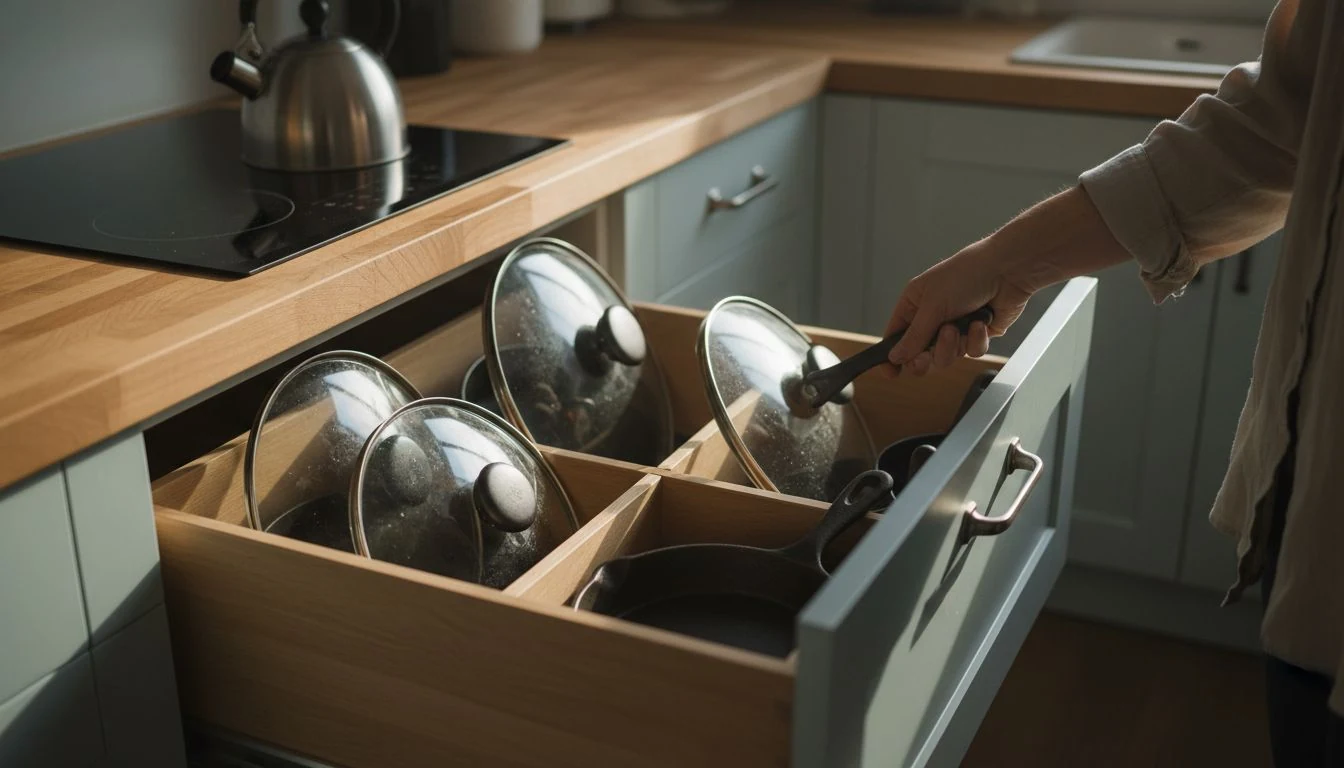
I bought a second stockpot in March for $32 because I was certain I did not own one. It was in the deep drawer under my cooktop the whole time, lying on its side beneath a roasting pan, a colander and a lid that belonged to nothing I could find. That is the real problem with these drawers, and it is why most advice on how to organize deep kitchen drawers slides off them. The drawer is not messy. It is stacked. Everything you own is technically in there, and you can only see the top layer.
Two neighboring posts here cover the rooms around this one, so you land in the right place. If the whole kitchen is the problem and not just the drawers, start with organizing a small kitchen. If what is really buried is food rather than pans, that is the pantry post. This one is only about the drawers that are deeper than they are useful.
Jump to:
- Why deep drawers swallow things whole
- The rule that changed how I organize deep kitchen drawers
- How to organize deep kitchen drawers that hold pots and lids
- What should never live in a deep drawer
- Organize deep kitchen drawers in a rental without drilling
- Drawer by drawer, what is in each of mine now
- What didn’t work for me
- Frequently asked questions
Why deep drawers swallow things whole
A deep drawer gives you vertical space, and then almost every product sold to organize one throws that space away. The plastic trays at the store are about two inches tall, built for forks. Drop one into a ten inch drawer and you have made a shallow drawer with eight inches of dead air on top of it.
So things go in horizontally instead. One pan, then the second pan on the first, then the sieve, then a lid. Now retrieving the bottom pan is a four step excavation, and nobody does an excavation on a Tuesday at 6pm. You take the top pan. The bottom of the drawer becomes a place where objects go to be forgotten, which is how a household ends up with two stockpots.
It took me a year and a spare stockpot to get to the opinion I hold now, which is that depth only counts as storage when you stand things up in it. Lying down, the fourth thing from the top stops existing. The drawer is still holding it. You are just never going to meet it again.
The visible drawer is also not the whole drawer, which matters before you buy anything. Mine run 21 inches front to back, and the back six inches sit under the counter overhang where I cannot see in without crouching. Whatever ends up back there is gone in exactly the same way the bottom layer is gone.
The rule that changed how I organize deep kitchen drawers
One rule holds the whole thing up. Nothing lies flat, and everything stands on its edge like files in a filing cabinet.
Pans go on their sides, lids upright, baking sheets vertical. Container bases nest, but the nest stands rather than sprawls. When everything is on edge you look down into the drawer once and see the whole inventory, and you lift out the one thing you want with one hand while the other hand is holding a phone or a toddler or a hot pan.
I did this one drawer at a time with a fifteen minute timer, which is how I do everything now, because a whole kitchen on a Saturday is a fantasy and one drawer before dinner is not. Empty it onto the counter. Wipe it. Put back only what belongs in that drawer, standing up. Anything that does not belong goes in a pile for later, not back in the drawer.
My first drawer took eleven minutes and produced the second stockpot, a lid for a pot I got rid of in 2024, and a pizza cutter I had bought twice. My last one took twenty five, because it was the appliance drawer and I had to untangle three cords.
Then there is the pile, which is the part that stalls people. Mine was eleven orphan lids, four scratched containers and the duplicate stockpot. The stockpot went to a friend and the lids I had assumed were recyclable mostly were not: the EPA’s own answer is to contact your local county or municipality to find out what your recycling options are, and when I did, mine takes rigid tubs but not thin lids. Six went in the bin. I would rather say that plainly than pretend the pile disappeared somewhere virtuous.
Grab the free printable: my one-page Deep Drawer Measuring Card, with a line for each drawer’s interior width, depth and height, plus the counter-lip clearance most people forget to check before ordering dividers. Get the free measuring card →
How to organize deep kitchen drawers that hold pots and lids
Pans first, because they are the reason the drawer is deep in the first place. Stand each one on its edge, handle pointing up, in a lane of its own. Nesting is allowed only two deep and only for pans that were made to nest, with a sheet of felt or a folded paper towel between them so the coating survives.
The lanes are what make it hold. I use four spring tension rods laid across the drawer front to back, the same kind sold for small windows, at $6 for a pack of four. They wedge against the drawer sides, they cost nothing, and when I need a wider lane for the dutch oven I move one in about four seconds. The dedicated wooden peg systems do the same job for around $28, and if you own a drill and a house rather than a lease, they look better and stay put.
Lids are their own war. Nine of mine used to live flat on top of everything. They now stand in the back four inches of the same drawer, upright in a two dollar dish rack turned sideways, largest at the back. A dish rack beats than most things marketed as lid organizers, and I say that having owned one of the marketed ones.
My heaviest pans live in a drawer for a reason that has nothing to do with tidiness. Sliding a cast iron skillet out of a drawer at knee height is a pull. Taking the same skillet down from a cabinet above your head is a lift with your arms extended. OSHA groups lifting heavy items, bending, reaching overhead and repeating the same motions together as the risk factors behind musculoskeletal injuries, and a kitchen you cook in every night is a place where you repeat the same motions a great deal. My cast iron came down out of the cabinet over the cooktop in June. My shoulders noticed inside a week.
Then the second measurement, the one that cost me a counter. Measure the interior height of the drawer, then measure the clearance between the top of the drawer box and the underside of the countertop. On mine that gap is under an inch, so any divider taller than the drawer walls catches on the counter frame when it slides open. My first bamboo insert did exactly that and gouged a line into the underside of the counter that I will be looking at until I move out. Measure both numbers before you buy anything.
What should never live in a deep drawer
Backup food is the first category out, and I moved mine on comfort rather than on any rule. The deep drawer immediately beside a cooktop is one of the warmest spots in the run. Mine was warm to the back of my hand after a long simmer, and it is where I had kept spare pasta and canned tomatoes for two years without once thinking about it. Dry goods want somewhere cool, dark and boring, which describes a cupboard and does not describe the drawer beside the heat.
Loose knives are the second. In a deep drawer they end up under other things, which means your hand goes into a space you cannot see, above a blade you cannot see either. It is also bad for the knife, since the edge knocks against everything else in there every time the drawer runs. A block on the counter, a magnetic strip, or a knife tray in a shallow drawer. Not the bottom of a pan drawer, and definitely not that if there are children in the house who can reach it.
Then there is the daily-use rule, which is mine rather than anyone official’s. Anything you reach for more than once a day should not be in a deep drawer, because deep drawers reward things you retrieve deliberately and punish things you grab. Wooden spoons, the good tongs and the peeler live in a shallow drawer by the stove. The stand mixer attachments, which I use twice a month, live deep.
Cleaning products are the last one, and the reason is the same as the food reason in reverse. Keep them away from the food drawers entirely, which usually means the utility cupboard rather than the kitchen run. If yours are currently under the sink, the under sink post covers what actually belongs in that cabinet and what does not.
Organize deep kitchen drawers in a rental without drilling
Everything above works in a lease, which was not an accident. I have rented this apartment for four years and I am not putting screws into someone else’s cabinetry for a system I might undo in six months.
Tension rods hold themselves. Non-slip liner, cut with kitchen scissors, keeps pans from sliding into each other when the drawer closes, and a roll cost me $9 and did all four drawers with some left. Sturdy open bins with a straight side work as lanes if you do not want rods, as long as they are as tall as the drawer, not two inch trays.
What I would not do again in a rental is anything adhesive on the inside of a drawer. The peel-and-stick liner I put in the first year left a residue that took mineral spirits and forty minutes to lift, and the drawer floor is a different color now where it sat. Loose liner does the same job and comes out in one piece.
Standing things upright and cutting the number of movements is how I handle every tight cupboard in this apartment, not only the drawers, and I went through that in more detail in the small space storage post.
Drawer by drawer, what is in each of mine now
Four deep drawers, measured with a tape rather than guessed, redone one at a time over two weeks in June. The third column is the useful one. Every one of these drawers had already been organized once before, and every one of them failed for a specific reason.
| The drawer | What lives there now | What it was before, and why that failed |
|---|---|---|
| Under the cooktop 30 x 21 x 10.5 in |
Seven pans on edge in four tension-rod lanes, nothing nested more than two deep | Pans stacked flat four high plus lids on top. The bottom two were used maybe twice a year, and I bought a duplicate stockpot |
| Left of the sink 24 x 21 x 8 in |
Container bases standing upright like files, lids flat in one shoebox-sized bin at the back | Bases and lids loose together. Finding a matching pair took long enough that I used foil instead, which is its own small waste |
| End of the run 18 x 21 x 12 in |
Hand mixer, immersion blender and the mixer attachments standing up, each cord in its own elastic band | Same appliances lying down with cords loose. Every retrieval pulled two other things out with it |
| Under the oven 24 x 20 x 6 in |
Baking sheets, two cooling racks and the pizza stone, all vertical between two rods | The shallowest of the four and the only one I had stacked on purpose. Sheets came out warped from being pulled sideways |
Common deep drawer mistakes I made first
- I bought the organizers before I measured. Two of the three inserts in my first order were shorter than half the drawer height, so they created a shallow drawer with dead air above it, which is the exact problem I was trying to solve. That order cost $41 and most of it went back.
- I put the heavy things at the back. The dutch oven lived in the back six inches under the counter overhang for a year because it seemed sensible to keep the far space for the big item. I stopped using it. Heavy and awkward belongs at the front where you can lift it straight up.
- I organized by category instead of by how often I cook with it. All baking in one drawer sounds tidy, so the loaf tin I use weekly sat behind the cake tins I use at Christmas. Frequency beats category in a drawer you open with wet hands.
What didn’t work for me
The expandable bamboo dividers were the expensive miss at $24 for two. They hold by friction against the drawer walls, which is fine for tea towels and not fine for cast iron. Mine popped loose the third time I shut the drawer with any force, and after that they were two loose sticks of bamboo rattling around under the pans.
Stacking bins in two layers was the dumber miss, and it was free, which is the only good thing about it. I thought a second tier of shallow bins on top of the pans would use the leftover height. It used the height and hid the pans, and I had reinvented the original problem with extra steps. One layer. Everything vertical inside it.
Labels on the drawer fronts did nothing for me either. I could see what was in the drawer the moment it opened, so the label was information I already had, and it made the kitchen look like a storage unit. Labels earn their place inside closed opaque bins, not on a drawer you can see into.
For about a year I read the extra depth as a bonus, so the drawers became the place where anything I felt unsure about went to wait. Storing an undecided thing is still storing it, only slower and further down. Now the rule is that a deep drawer holds fewer objects than a shallow one, each standing where I can see it, and the fifteen minutes it took to get there per drawer is the best trade in this kitchen.
Frequently asked questions
What is the best way to organize deep kitchen drawers?
Stand everything on its edge instead of stacking it flat, and divide the drawer into vertical lanes so nothing tips. Tension rods laid front to back are the cheapest way to make lanes, at around $6 for four, and they adjust in seconds. The test is simple: open the drawer, look down once, and you should be able to name everything in it without moving anything.
What should you store in a deep kitchen drawer?
Pots and pans, lids, baking sheets, food storage containers and bulky appliances you use a few times a month. Keep anything you reach for several times a day in a shallow drawer instead, because deep drawers suit deliberate retrieval and punish grabbing. I would also keep backup food out of the deep drawer next to the cooktop, which runs warmer than the rest of the counter run.
How do I stop the bottom of a deep drawer from becoming dead space?
There is no bottom layer once everything stands upright, which is the point of the rule. If you are using trays or bins, make them as tall as the drawer walls rather than two inches high, and never add a second tier on top. Also check the back six inches under the counter overhang, since that is where things vanish sideways rather than downwards.
How do you divide a deep drawer in a rental?
Spring tension rods, loose non-slip liner cut to size, and tall open bins all work without a single screw or any adhesive. Skip peel-and-stick liner, which leaves residue that can discolor the drawer floor and costs you time and mineral spirits at move-out. Measure the gap between the drawer wall and the underside of the counter first, because a divider taller than that gap will catch when the drawer opens.
Pick the worst of your deep drawers this week and give it fifteen minutes with a timer. Empty it, wipe it, and put back only what belongs there, standing on edge. Mine handed me a stockpot I had already replaced, and I would rather have found that in eleven minutes than in another year.
Get my free Home Reset Planner
The calm, room-by-room planner I use to reset my whole home without the overwhelm. Join the newsletter and I’ll send it straight to your inbox.
No spam, ever. Unsubscribe anytime. — Lena
Keep reading — more on Kitchen & Pantry

Airtight Containers for Pantry: What’s Worth Decanting

Pantry Organization Ideas for Real Kitchens (No Perfect Aesthetic Needed)

Fridge Organization Aesthetic and Small Laundry Rooms: I Tried Both 2026 Trends (Worth It vs. Skip)