My daughter owned a plastic bin labeled “toys” that weighed more than she did. Every toy organizing ideas pin I’d tried started with a cute matching set of baskets and ended, about six days later, with everything back in that one bottomless bin. The baskets weren’t the problem. The bin was, because a single “toys” category is the same as no category at all.
This is the system that finally held in our house, and it held in the living room, not some dedicated playroom I don’t have. It cost me about twelve dollars in bins I already half-owned, took one nap-time to set up, and it’s survived four months, a birthday, and a grandparent visit. Nothing here will make your floor look like a catalog. It will make it clearable in about ninety seconds by a five-year-old, which is the thing I actually wanted.
Jump to:
- Why toy organizing ideas fall apart in a week
- Sort every toy into five real categories first
- The toy rotation that cut our clutter in half
- Toy organizing ideas for the living room, not just the playroom
- The one-bin rule for when more comes out than goes in
- Toy organizing ideas kids can actually maintain
- What didn’t work for me
- Frequently asked questions
Why toy organizing ideas fall apart in a week
A toy bin isn’t storage. It’s a fear response. You sweep the floor before dinner, everything goes in one container, and the mess is technically gone. Then the next morning a kid wants the one dinosaur at the bottom and dumps all of it to find him. You didn’t organize anything. You just moved the pile from the floor to a box and back.
The reason most toy organizing ideas quietly fail is that they’re built around where things go, not around how a kid retrieves and returns them. If getting the blocks means unstacking three lidded bins, the blocks live on the floor now. Forever. The real question I started asking wasn’t “where does this go,” it was “can my kid put it back without me.” That one shift changed every choice below.
Sort every toy into five real categories first
Before you buy a single container, dump everything in the middle of the room. All of it. I know. Do it anyway, because you can’t build a system for a volume you haven’t seen. Then sort into five buckets that a young child understands without reading:
- Building things (blocks, magnetic tiles, train track)
- Little worlds (figures, animals, cars, dolls)
- Art and making (crayons, stickers, playdough)
- Books and puzzles
- Big and loud (ride-ons, instruments, balls)
Our first sort turned up eleven happy-meal toys, two broken things nobody had mentioned in a year, and roughly forty crayons living outside any box. That pile of obvious trash and duplicates is usually a third of the volume, and it never comes back if you bag it while you’re still holding it. The American Academy of Pediatrics makes the case that simple toys that spark imagination beat flashy, overstimulating ones, which was the permission I needed to stop feeling guilty about the donate bag.
The toy rotation that cut our clutter in half
Here’s the move that did more than any bin: I put roughly half the toys away where the kids can’t see them. Not gone, just resting. A rotation.
Each category gets split into “out now” and “in the closet.” Every couple of weeks, or whenever the play gets stale and whiny, I swap a resting set in and send the current one to the closet. The kids treat the returning bin like it’s brand new, because to their memory it kind of is. Our visible toy volume dropped by about half overnight, and the pickup at night got faster in the same proportion. Fewer things out, fewer things to put back. That’s the trick.
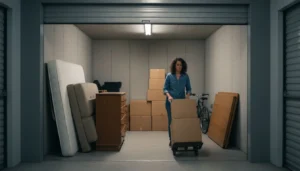
I keep the resting sets in two lidded bins on a high shelf, one per rotation. If you want the deeper version of storing what’s off-duty, I wrote a whole piece on storage ideas for small spaces that applies straight to the toy overflow.
Toy organizing ideas for the living room, not just the playroom
Most toy advice assumes a room you can shut the door on. I don’t have that. The toys live where we live, which is the living room, and I made my peace with it by giving the toys a defined edge instead of a whole floor.
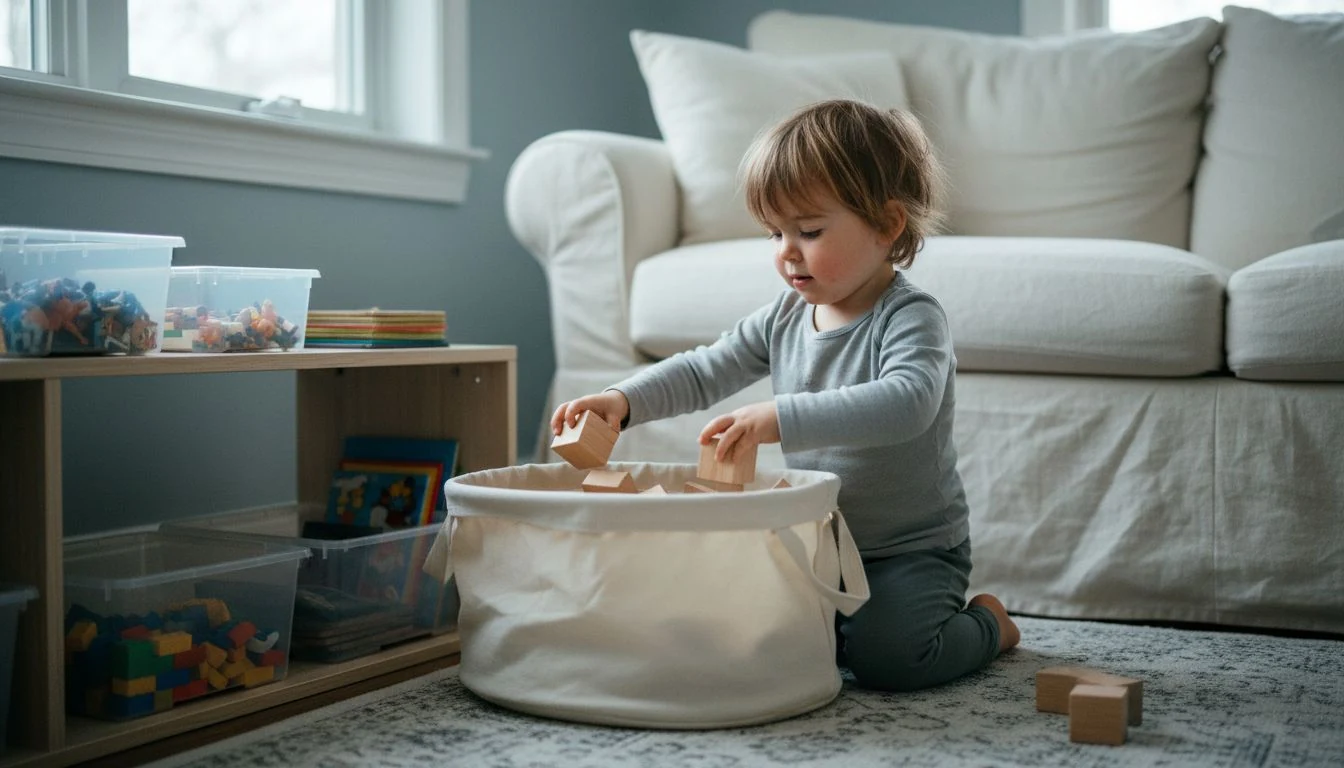
One open bin, low to the ground, in the corner nearest the couch. That’s the living room’s entire toy budget. It’s open on purpose, no lid, because a lid is a step and every step is where a four-year-old quits. What doesn’t fit in that one bin at the end of the day is the signal to rotate something out, not to buy a second bin. When the toys have to earn a spot in a container that can’t grow, the volume regulates itself. A closed system beats a tidy one.
The other thing that saved the living room was going vertical for the flat stuff. Puzzles and thin books slide into a magazine file on the shelf instead of sliding under the couch. If your clutter is more clothes than toys, the same low-open-bin logic carries over to organizing the rest of a kids’ room.
The one-bin rule for when more comes out than goes in
Toys are a river. Birthdays, grandparents, the checkout-line impulse buy. If nothing leaves, any system you build drowns within a season. So the rule at our house is boring and it works: when the “in the closet” shelf is full and something new arrives, something old leaves the same week.
I keep a plain paper grocery bag in the coat closet marked “outgrow.” The second a toy stops getting touched, or a kid ages past it, it goes in the bag. When the bag is full, it goes to donation, no ceremony, no second-guessing at the door. Toy safety recalls are a good forcing function too. I check the CPSC recall list once in a while, and anything flagged goes straight out, which conveniently doubles as a decluttering prompt. If you struggle with the guilt of letting gifts go, I’ve been there and wrote about the guilt of decluttering sentimental stuff in its own post.
Toy organizing ideas kids can actually maintain
A system only counts if the person making the mess can reverse it. Mine can’t read yet, so every container gets a picture, not a word label. I took a phone photo of what belongs in each bin, printed it small, and taped it to the front. Cleanup stopped being “put your toys away” (meaningless) and became “match the picture” (a game she’ll actually do).
Here’s the reference I taped inside the closet door so I stop second-guessing which toy lives where:
| Category | Container that works | Where it lives | Rotate? |
|---|---|---|---|
| Building things | Low open bin or fabric cube | Living room corner | Half out, half resting |
| Little worlds | Clear shoebox bins, one per set | Low shelf, at kid height | Yes, by set |
| Art and making | Lidded caddy, adult-controlled | High shelf, out with you | No, restock instead |
| Books and puzzles | Magazine file, spines up | Bottom shelf, front-facing | Swap a few weekly |
| Big and loud | No container, a floor zone | Against one wall | Store bulky ones off-season |
If you want the broader habit version of this, the routine that keeps the whole house from tipping over with little kids around lives in my post on keeping a tidy home with kids. And if you’re trying to do all of this without a wall of plastic tubs, my take on organizing without plastic bins covers the fabric-and-basket route.
Common toy organizing mistakes to avoid
- Buying matching bins before you sort. I did this first and sized my whole system to the containers instead of to what we keep. The empty compartments just invited more toys. Sort the pile, then buy one thing, if you still need it.
- Using word labels for a kid who can’t read. A label your child can’t decode is a label for you, not them, which means you’re still the one cleaning up. Photo labels turn “put it away” into a matching game they’ll do on their own.
- Keeping every toy out at once. Volume is the enemy of a fast pickup. If it’s all visible, it’s all on the floor by 5pm. Rotate half of it out of sight and the mess halves with it.
Grab the free printable: my one-page Toy Zone Planner, the fill-in sheet I use to assign every category to a bin, log what’s rotating out, and track the “outgrow” bag. Get the free toy zone planner →
What didn’t work for me
The color-coded bin wall from Pinterest was the big flop. Six matching lidded bins, labeled by color, gorgeous for exactly one afternoon. The lids meant my kids never put anything back, and the color system meant nothing to a three-year-old who thinks of toys by what they do, not what shade the box is. I spent thirty dollars to make cleanup harder.
The tiny drawer organizers were the other miss. Cute little compartments for small figures, except a kid dumps a whole drawer to find one thing and now you’ve got twelve compartments of chaos instead of one messy bin. Small kids need big, forgiving targets, not precision. I’ve learned to save the fiddly organizers for my own stuff and give the kids containers they can be a little careless with.
Frequently asked questions
How do I organize toys in a small living room with no playroom?
Give the toys one defined edge instead of the whole floor: a single low, open bin in the corner nearest where the kids play, and keep the overflow rotating out of sight on a closet shelf. When it doesn’t fit the one bin, that’s your cue to rotate, not to add a second bin.
How many toys should a child have out at once?
Fewer than you think. Splitting each category in half and putting the resting half away tends to cut visible clutter by around fifty percent, and most kids play longer and calmer with less in front of them. You’re not throwing anything away, just resting it on a two-week rotation.
What’s the best way to label toy bins for kids who can’t read?
Use photos, not words. Snap a picture of what belongs in each bin, print it small, and tape it to the front. Cleanup becomes a matching game the child can do without you reading anything to them.
Get my free Home Reset Planner
The calm, room-by-room planner I use to reset my whole home without the overwhelm. Join the newsletter and I’ll send it straight to your inbox.
No spam, ever. Unsubscribe anytime. — Lena
Keep reading — more on Home Organization
Small Apartment Organization Ideas (Renter-Friendly, No Drilling)
Mudroom Organization Ideas That Survive Wet-Boot Season
Home Office Organization Ideas for a Small Space