I counted my shoes in March and the number was nineteen. I would have sworn it was eight. Most shoe storage ideas you find are really entryway ideas, which is odd, because hardly any of a household’s shoes sit near the front door: they’re on a closet floor in a heap, under the bed in a plastic bag, in the garage growing a smell, in a bin by the back door that the kids miss every morning.
The pile at my front door was a separate fight and I wrote that one up in my entryway organization guide. What follows is the other four places. How many pairs each thing holds, what belongs where, what warps a pair of boots, and the fifty-eight dollars that sorted it out.
Jump to:
- Why most shoe storage ideas stop at the front door
- Count your pairs before you buy a thing
- Shoe storage ideas for the closet floor
- Under the bed is for off-season only
- Shoe storage ideas for the garage and the muddy pairs
- Kids’ shoes break every system built for adults
- What each solution really holds
- What didn’t work for me
- Frequently asked questions
Why most shoe storage ideas stop at the front door
Search the phrase and you get benches. Beautiful ones, with a cushion on top and three woven baskets tucked underneath, photographed in a hallway that has a window in it.
A bench holds maybe six pairs, and six pairs is roughly what a household wears in a week. Everything else, the dressy ones, the hiking boots, the sandals in January, the pair you keep because they cost a lot and you’ll break them in eventually, lives somewhere else. I’ve never once seen that part photographed.
The bench fills up in nine days, the heap comes back, and you assume you picked the wrong bench. You didn’t. You solved one zone out of five.
My rule after a spring of getting this wrong: sort by how often you wear a pair, then pick the room. Weekly pairs go where you take them off. Monthly pairs go on the bedroom closet floor. Seasonal pairs go in a closed box out of the way. Filthy pairs stay outside the house entirely.
Count your pairs before you buy a thing
Fifteen minutes, one hallway floor. Bring every pair you own out of every room and line them up. This is unpleasant and it’s the whole job.
Mine came to nineteen pairs, which included two of the same black flats bought fourteen months apart because I couldn’t find the first ones. Then sort into four groups:
- Worn this week. I had four. Four pairs, out of nineteen. That number reset how much space I was willing to give the front door.
- Worn this month. Six for me. Work shoes, the boots, the one pair of heels I actually wear.
- Out of season. Seven. Sandals in March, snow boots in July.
- Not worn in a year. Two. Both went in the donate bag that afternoon, and I have not thought about either since.
Write the group counts on your phone before you shop. Group one tells you how big the landing spot by the door needs to be. Groups two and three tell you what to buy for the closet. And if group four runs past about a fifth of your total, that’s a decluttering job before it’s a storage job, so I’d start with the slow method rather than a rack.
Shoe storage ideas for the closet floor
This is where the bulk of them live and it’s the zone people skip, because a closet floor is a place you look at while crouching and it never gets photographed.
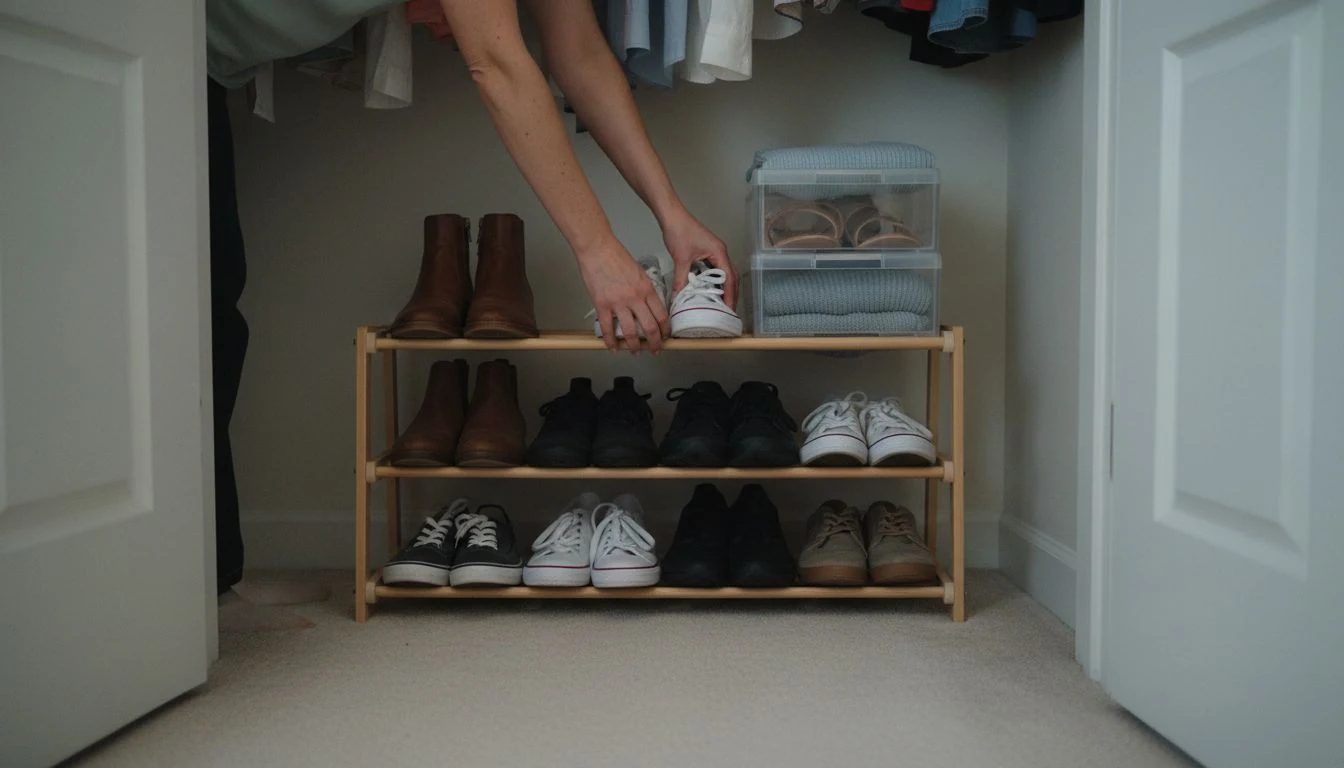
What worked: a two-tier bamboo rack, twenty-two dollars, holding eight pairs facing out. Facing out matters more than the rack does. Shoes turned sideways look tidier and you can’t tell what they are, so you paw through them and the tidiness lasts four days.
Above the rack, on the shelf, three clear boxes with the out-of-season pairs. One pair per box, stacked. They’re about two dollars each and they do a thing a fabric bag won’t, which is let you see the sandals without opening anything.
A few things I’d tell a friend before she bought anything:
- Measure the closet floor and then measure the doorframe. Most racks run 24 to 30 inches wide. My floor is 34 inches across, the doorframe is 28, and 28 was the number that decided it.
- Leave the last six inches of the rack empty. Wet or muddy pairs land there when you’re in a hurry, and without the gap they land on top of the clean ones.
- Keep tall boots off racks. Stood upright on a low tier they fold at the ankle and stay folded. Mine sit on the shelf with a rolled magazine inside each one.
If your closet is the small kind where the floor is already a storage zone by necessity, the layout logic in my small closet post comes first and the shoes fit around it. Bigger closet with a wall to spare? A shelf run at knee height beats any rack, and I covered that build in the walk-in closet guide.
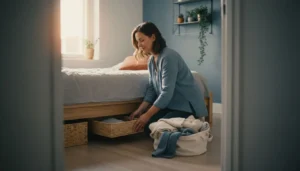
Under the bed is for off-season only
Under the bed is the most tempting shoe spot in any house and the one that goes wrong quietest. Things you can’t see stop existing. I found a pair of good loafers under there in April with a bloom of grey mould across both toes.
Two numbers decide whether this works for you. First, your clearance: get down there with a tape measure. Mine is seven inches, and a hard drop-front shoe box needs about five and a half. Second, humidity, because the EPA’s guidance on mold and moisture puts indoor relative humidity under 60 percent, and leather sitting on a floor in a closed bag under a bed is exactly the pocket of still air where you lose that.
Hard boxes with lids, then. Off-season pairs only, four to six to a box, and put the label on the short end that faces out, because a label on the lid is one you’ll never read again. Pull them out the same week you swap the sweaters over. That’s the only reason my shoes and my clothes run on the same seasonal schedule: one trip, one afternoon.
Grab the free printable: my one-page Shoe Zone Map with the four-group count sheet, the three measurements to take before you shop, and which pairs belong in which room. Stick it inside the closet door. Get the free shoe zone map →
Shoe storage ideas for the garage and the muddy pairs
Garden clogs, the sneakers that mowed the lawn, snow boots in February, the sandals somebody wore to the lake. These should never come through the house and mine did for years.
A thirty-dollar wire rack on the garage wall, mounted so the bottom shelf sits about ten inches off the concrete, took care of it. Those ten inches do the work. Concrete wicks damp upward, and a shoe sitting flat on it stays cool and faintly wet for days after a rain.
What I’d keep out of an unheated garage: leather, anything suede, and running shoes with foam midsoles, because repeated freezing and baking is how foam goes hard and stops cushioning. Rubber, canvas, and plastic are fine out there indefinitely. If your garage is generally where storage projects go to die, the shelving logic in my garage storage post applies to shoes too.
One more thing, and it’s the reason I moved the muddy pairs at all. Shoes left in a walkway are a trip hazard, and clearing floor paths is one of the first fixes in the National Institute on Aging’s room-by-room fall prevention guidance. My mother comes over most Sundays. That settled it faster than any tidiness argument.
Kids’ shoes break every system built for adults
My niece is six. At 7:40 on a school morning, with one sock on and a story to finish, aiming a shoe at a rack is beyond her, and I’ve stopped filing that under discipline.
What she needs is a target that requires no aim: an open bin at floor level, one per child, both shoes in, pointing wherever they land. Give a six-year-old a rack and you get an empty rack and a covered floor.
The other kid-specific problem is size churn. Feet grow through a size every few months, so there’s always a pair that fits, a pair that’s too small, and a pair waiting to be grown into. Keep the waiting pairs out of the daily bin entirely, in a labelled box with the size on the outside, or you’ll spend every morning re-testing shoes on a child who is late. That’s the same hand-me-down system I use for their clothes in the kids’ clothes post.
What each solution really holds
Most shoe storage ideas get sold to you on a pair count, and the listings all round up, because the photo is shot with flat children’s sneakers. These are my own counts across five rooms, plus the part of each thing that gives out first.
| Solution | Pairs it really holds | What it’s for | What fails first |
|---|---|---|---|
| Two-tier rack, 24 to 30 in. | 6 to 8 adult pairs, front-facing | Closet floor, monthly pairs | Nothing, if you keep boots off it. Tall boots fold at the ankle within a week |
| Bench with cubbies | 4 to 6, and only low shoes | Wherever you take them off | It becomes a shelf for bags and mail, then holds no shoes at all |
| Over-the-door pocket organizer | 10 to 12 pairs of flats and sneakers | A closet door, kids’ rooms | The hooks. Mine dented the top edge of the door and the pockets sagged out of shape by month three |
| Clear stacking shoe boxes | 1 pair each, stacked 4 high | Closet shelf, out-of-season and dressy | The stack. Pull from the bottom twice and you’ll stop using the top three |
| Hard under-bed box | 4 to 6 off-season pairs | Under the bed, seasonal only | Air. Anything leather in there needs a lid you actually open twice a year |
| Open floor bin | 3 to 4 pairs per child | Kids, back door, garage | Nothing. It’s ugly and it’s the only thing a six-year-old uses correctly |
Common shoe storage mistakes I made first
- Buying storage for nineteen pairs instead of for four. The pairs you wear weekly need reachable space and the other fifteen need cheap, out-of-the-way space. I bought the same solution for both and paid for the good one twice.
- Turning shoes sideways to fit more in. It looks neater in a photo and it kills the system. If you can’t recognise a pair at a glance you’ll dig, and digging undoes a rack in under a week.
- Storing shoes dirty. Grit ground into a sole holds moisture against it for days, and salt left on leather over a winter leaves marks you can’t take back out. Ten seconds with a dry brush at the door is the whole maintenance routine.
What didn’t work for me
The over-the-door organizer, first. Fourteen dollars, twenty-four pockets, and I was thrilled with it for about a month. Then the metal hooks left two shallow dents in the top edge of my closet door, which is a rental door, so that’s mine to explain when I move. Heels didn’t fit the pockets. Boots weren’t close. And loaded with twelve pairs, the door stopped shutting flush. It lives in my niece’s room now holding hair clips, where it works fine.
Vacuum bags for off-season shoes were the worse idea, and I’d like the twelve dollars back. Suction pulls the sides in, and a crease across a toe box stays creased. Fine for a puffer coat. Bad for anything whose shape you care about.
Then there was the Saturday I spent trying to build one system that would handle every pair in the house from a single spot in the hallway. That was the mistake sitting underneath all the others: I kept shopping for shoe storage ideas when what I needed was five zones and a count. Five zones want five answers, and once I quit trying to unify them the job took an afternoon.
The thing I got right early, by accident: a doormat inside and a boot tray by the back door. Most of what makes shoe storage fail is the dirt, not the shoes, and the tray catches it before it becomes a floor problem.
Frequently asked questions
What are the best shoe storage ideas for a small apartment?
Split them by wear frequency rather than finding one big unit. A narrow two-tier rack on the closet floor for your monthly pairs, clear boxes on the shelf above for dressy and off-season, and a tray by the door for the three or four pairs in rotation. That’s under forty dollars and it uses vertical space you already have instead of floor space you don’t.
How many pairs of shoes should I keep out?
However many you wore in the last seven days, which for most people is three or four. Everything else can be one step away in a closet without you noticing. I keep four out and the front door has stayed clear since March, and that’s the only test that matters.
Is it bad to store shoes in plastic boxes?
Not if they’re dry and clean going in. Trapped moisture is what causes trouble, so let anything damp air out for a day first, and never seal up shoes with grit still on the soles. For leather, open the boxes when you do the seasonal swap so the air changes a couple of times a year.
Where should I put shoes if I have no closet space at all?
Under the bed, in hard lidded boxes, for anything out of season, plus one open bin wherever you take shoes off. Check your bed clearance first, since most hard boxes need about five and a half inches. The wider version of this problem, and the room-by-room way through it, is in my small-space storage guide.
Nineteen pairs, five zones, fifty-eight dollars. Count yours on a hallway floor this week before you buy a single rack. The number is going to surprise you, and it’s the number that decides everything else.
Get my free Home Reset Planner
The calm, room-by-room planner I use to reset my whole home without the overwhelm. Join the newsletter and I’ll send it straight to your inbox.
No spam, ever. Unsubscribe anytime. — Lena
Keep reading — more on Storage Solutions
Wrapping Paper Storage Ideas That Stop the Crushed-Roll Problem
Floating Shelves for Small Spaces: Where They Work (and Where They Fall Off the Wall)
Under Stairs Storage Ideas That Use the Whole Awkward Triangle