The week before Thanksgiving a couple of years ago, I went digging in our chest freezer for a bag of cranberries and came up with a turkey. A second turkey. We had bought one the week before because I was sure we didn’t have one. This one had been at the bottom, under the ice packs and a brick of mystery chili, since the previous year.
That’s what happens with a chest freezer. It’s a deep, dark hole, and things go down there to be forgotten. My chest freezer organization now takes about an hour to set up and five minutes a month to keep going. I’ve listed what I use, what lasted, and how long food holds up down there, using the federal chart.
Chest freezer organization starts with emptying it all the way
Pick a cold day and have two coolers ready. I do this in the first week of November, before the holiday baking starts, which is also when there’s the least in there. Everything comes out. You’ll find things. I once found a birthday cake layer from a party my son doesn’t remember.
While it’s empty:
- Toss anything you can’t identify. Unknown soup isn’t saving you any money.
- Knock off any thick frost, following your manual, if it’s more than about a quarter inch.
- Check the temperature with a cheap freezer thermometer. It should read 0°F or below.
Food that’s kept at 0°F stays safe indefinitely, according to the FoodSafety.gov cold storage chart. The times on that chart are about quality, which matters to me, since nobody wants freezer-burned steak for dinner.
Use bins you can lift, one category each
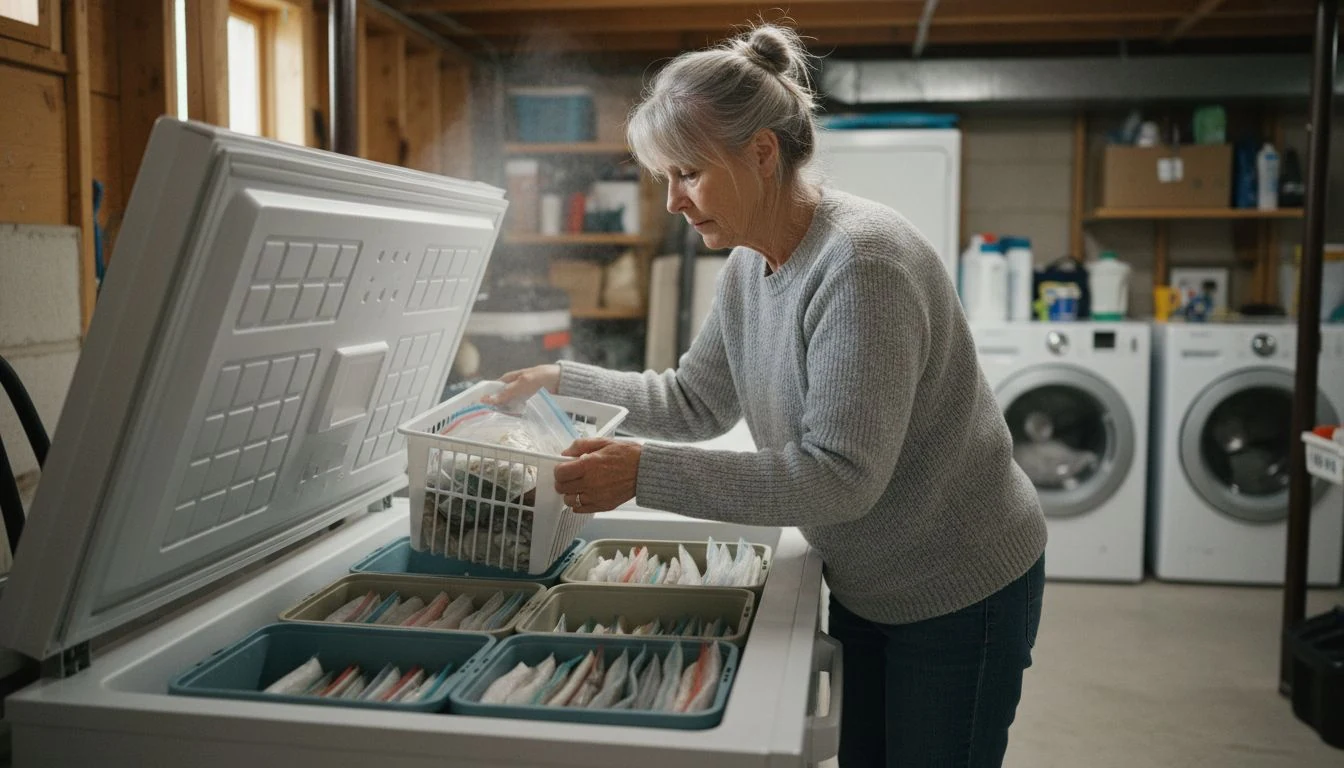
A chest freezer works in layers, so what you need is a way to lift a layer. I use reusable grocery totes in different colors, plus a couple of mesh baskets that came with the freezer. Handles are the whole point. I want to pull one bag up with one hand, look under it, and drop it back.
My categories, since I wanted as few as possible:
- Red: beef and pork
- Yellow: chicken and turkey
- Blue: fish and shrimp
- Green: vegetables and fruit
- White: bread, baking and butter
- Top basket: leftovers and ready meals
Ready-to-eat stuff stays on top, since it moves fastest. The whole-turkey-and-roast layer sits at the bottom, for things I’ve planned ahead for. Laundry baskets didn’t fit, by the way. Measure the inside, and remember most chest freezers have that step at one end for the compressor.
Freeze things flat so you can file them
This is the change that surprised me most. Round lumps of soup and ground beef waste a ton of space. Flat bags stack like books.
I fill a quart bag, press the air out, lay it on a sheet pan and freeze it. Once it’s solid, I stand it on its edge in the right bin with the others, so I can flip through like a file drawer. A pound of ground beef pressed about an inch thick also thaws a lot faster. If you’ve got containers you like for leftovers, check my airtight containers post, though for a freezer I want something rated for it, because regular plastic can crack in the cold.
And label everything. I use masking tape and a marker with the name and date. Every time I’ve thought “I’ll remember what this is,” I have not.
Chest freezer organization by storage time
Once I knew how long things last, I knew which bin to dig through first. I keep this taped to the lid. These numbers come from the federal chart linked above; they’re about best quality at 0°F, not safety.
| Food | Best quality in the freezer | Where it lives in my freezer |
|---|---|---|
| Bacon | 1 month | Top layer, red bin |
| Hot dogs, sausage, lunch meat | 1 to 2 months | Top layer, red bin |
| Soups and stews | 2 to 3 months | Top basket, frozen flat |
| Cooked meat or poultry leftovers | 2 to 6 months | Top basket, dated |
| Ground meat | 3 to 4 months | Middle layer, frozen flat |
| Chicken or turkey pieces | 9 months | Yellow bin |
| Steaks, chops and roasts | 4 to 12 months | Bottom of red bin |
| Whole chicken or turkey | 1 year | Bottom layer |
Notice the short-timers are the ones I put on top. I used to bury bacon under a bag of peas and find it six months later, tasting like a freezer.
Keep a simple freezer inventory where you’ll see it
The bins fixed about half of my problem. The other half was forgetting what we had when I was standing in the grocery store. So I taped a sheet of paper to the lid with a pencil on a string. When something goes in, I add a line. When it comes out, I cross it off.
Yes, an app would do this. I tried one, and nobody else in my house opened it. A sheet of paper on the lid, however, gets used by everyone. I take a photo of it before I shop.
Once a month, I spend five minutes on the first Sunday looking at whatever’s closest to its date and plan one dinner around it. I do this when I go through the fridge too, and my refrigerator clean-out walks through that routine. If you’re trying to find places for everything else in your kitchen, the pantry organization setup follows the same category logic.
Three chest freezer organization mistakes I made
- Too many categories. I started with eleven. Nobody could remember them, including me. Six is plenty.
- Buying in bulk with no plan. Half a cow is only a deal if you eat it within the year. Put new food at the bottom and pull older food up each time you restock.
- Using cardboard boxes as dividers. They got soggy, then froze to the floor of the freezer. Stick with plastic or fabric that can take the cold.
What didn’t work for me
Cutting milk crates down to size to make dividers. It was a whole Saturday project with a saw, and they left sharp edges and snagged the bags. The grocery totes I already owned worked better, and they cost nothing.
I also tried using a wire shelf to create a second level on top of the compressor step. It looked smart for about a week. Then everything shifted and frost locked it in place. I took it out with a butter knife and some swearing.
One practical tip for storm season: keep a list of what’s in there, and know what to do if the power goes out. The FoodSafety.gov power outage guide says a full freezer holds its temperature for about 48 hours and a half-full one for about 24 if you keep the lid closed. Another reason for the list on the lid: I can read what’s in there without opening it.
Grab the free printable: my Chest Freezer Inventory Sheet, with category columns, dates and the storage-time chart to tape to the lid. Get the free sheet →
FAQ
What is the best way to organize a deep chest freezer?
Group food in colored bins or reusable bags with handles, one category each, so you can lift a whole layer out. Put fast-moving items on top and long-keeping items at the bottom, freeze bags flat so you can stand them on edge, and tape an inventory sheet to the lid.
Should a chest freezer be kept full?
A full freezer holds its temperature longer in an outage, about 48 hours compared with roughly 24 for a half-full one, if you keep the lid shut. Don’t cram it to the point that you can’t lift a bin or see what you have, though.
How often should you defrost a chest freezer?
Follow your manual, but a common rule of thumb is to defrost when frost builds to about a quarter inch. Mine comes out to about once a year, and I do it in fall, since that’s when I sort before the holidays anyway.
This week, grab two coolers and six bags or bins you already own. Empty the freezer, toss the mystery items and start the inventory sheet. If you find a second turkey, you know what to do this year.
Get my free Home Reset Planner
The calm, room-by-room planner I use to reset my whole home without the overwhelm. Join the newsletter and I’ll send it straight to your inbox.
No spam, ever. Unsubscribe anytime. — Lena
Keep reading — more on Kitchen & Pantry
Pantry Cabinet Organization for Deep Shelves and No Walk-In
Spice Organization Ideas That Survive Holiday Baking

Airtight Containers for Pantry: What’s Worth Decanting